
SEP Alkayasí · CEPER 500 Viviendas
SEP Alkayasí · CEPER 500 Viviendas
SdA A2·4 · Clase 1
Finales de agosto - septiembre de 2025, el relato empieza


| Bloque | Min | Contenido |
|---|---|---|
| Warm-up + Listening | 15 | Audio + T/F |
| Reading & comprensión | 20 | Lectura + preguntas |
| Language Lab | 20 | must / have to + 15 drills |
| Vocabulary Lab | 10 | 15 palabras nuevas |
| Production | 15 | Speaking + Writing |
| Mediation | 5 | Tarea de mediación |
| Sing Along + Roleplay | 5 | Canción + cierre |
Escucha el audio de la narración (sin leer el texto) y marca True (T) o False (F).
🎧 Coloca el archivo audio/sda4_sesion1_listening.mp3 junto a este HTML para que suene aquí.
1. The tyre problem started while they were already in the border queue. →
2. Julio felt completely fine during the wait. →
3. Itto spoke to a border officer about the situation. →
4. The tyre went flat before they even joined the queue. →
5. They repaired the tyre themselves, without any help. →
De la habitación del hospital a un centro escolar, cinco años atrás
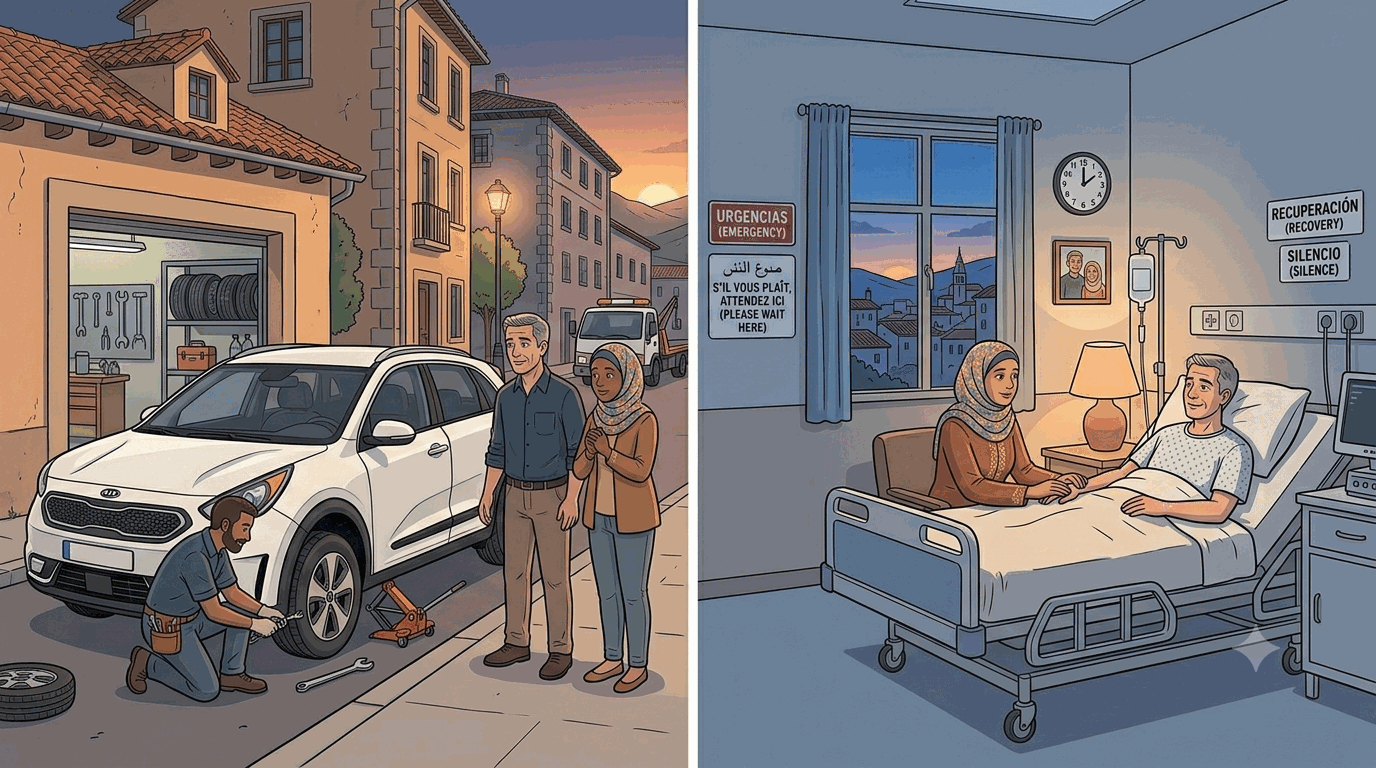
Imagen generada con Google Gemini Flash-Lite
🎧 Coloca el archivo audio/sda4_sesion1_story.mp3 junto a este HTML para que suene aquí.
In the first two weeks of September, Julio was still in hospital — the same illness that
had started in Morocco, now dragging on into a third week. There wasn't much to do, and even
less appetite for food, so the days stretched out long and quiet. Itto stayed with him for
hours at a time, and one afternoon she finally asked the question she had been holding back
all summer: "Why did you decide to make a formal complaint? You knew what it might cost you."
Julio took a breath and told her the whole story, from the very beginning.
He had arrived at the school in 2020, and it hadn't taken him long to recognise a pattern. In
almost every school where he had worked over nearly thirty years, one thing stayed the same:
a head teacher who had been in charge for many years — sometimes over a decade — running the
place almost like a small, private kingdom, with very little real oversight from above.
At his new school, the head teacher quickly noticed that Julio, unlike most of his colleagues,
actually understood computers and technology well. There was a new national programme that
year, and every school had to design and develop its own digital transformation project —
nobody else at the school had the skills to lead it. The head teacher asked Julio to take
charge.
Julio accepted, and worked hard on a serious proposal: an open school website, a presence on
social media, shared access to institutional documents. But the head teacher didn't really
want any of that. He just wanted someone to fill in the paperwork and be available on Friday
mornings, fixing broken computers at the other building.
"That was the first sign," Julio told Itto quietly. "It wouldn't be the last."
Repasamos have to (obligación externa) y must (obligación fuerte o norma), junto con sus negativas: mustn't (prohibición) y don't/doesn't/didn't have to (ausencia de obligación) — sin confundir ambas negativas, que tienen significados muy distintos.
Pulsa cada palabra para consultarla en WordReference.
1. head teacher /hed ˈtiːtʃə/ — director/a de centro.
2. staff room /stɑːf ruːm/ — sala de profesores.
3. workload /ˈwɜːkləʊd/ — carga de trabajo.
4. deadline /ˈdedlaɪn/ — fecha límite.
5. civil servant /ˈsɪvl ˈsɜːvənt/ — funcionario/a.
6. permanent (position) /ˈpɜːmənənt/ — fijo/a, permanente.
7. in charge (of) /ɪn ˈtʃɑːdʒ/ — al mando (de).
8. assign (v.) /əˈsaɪn/ — asignar.
9. institution /ˌɪnstɪˈtjuːʃn/ — institución.
10. remain (v.) /rɪˈmeɪn/ — permanecer.
11. reluctant (adj.) /rɪˈlʌktənt/ — reacio/a.
12. obligatory (adj.) /əˈblɪɡətri/ — obligatorio/a.
13. requirement /rɪˈkwaɪəmənt/ — requisito.
14. coordinator /kəʊˈɔːdɪneɪtə/ — coordinador/a.
15. request (v./n.) /rɪˈkwest/ — solicitar / solicitud.
Cuenta una vez que tuvieras que aceptar una tarea o un cambio en el trabajo o los estudios que no habías elegido tú. ¿Qué tuviste que hacer? ¿Qué, al final, no tuviste que hacer?
1. Escribe 3 frases usando must / mustn't sobre las normas de tu propio centro de trabajo o estudios.
2. Escribe 2 frases con "had to" sobre lo que Julio tuvo que hacer en su primer año en el centro.
3. Escribe una frase con "didn't have to" sobre algo que, al final, Julio no tuvo que hacer.
Un compañero de trabajo, que no conoce bien la situación, te pregunta por qué Julio aceptó un proyecto tan grande nada más llegar a un centro nuevo.
"There was a new national programme that year, and every school had to design its own digital transformation project — nobody else at the school had the skills to lead it, so the head teacher asked Julio to take charge."
Tarea: Explícaselo en español a tu compañero, de forma clara y natural, sin traducir palabra por palabra.
Janis Joplin – Summertime (1968)
Escucha la canción y localiza los verbos en presente simple. "Summertime" habla de una época fácil, sin preocupaciones — ¿por qué crees que esta canción podría sonar irónica al lado de esta sesión?
Trabajo opcional para casa — Libro 4: 50 Selected AI Songs for A2
Caelis – Holding Shadows
Escucha esta canción en casa y compárala con la de clase: ¿qué tipo de sentimiento transmite cada una?
Imagen generada con Google Gemini Flash-Lite
En parejas, representad el primer año de Julio en el centro nuevo: una persona es Julio, recién llegado en 2020; la otra es un compañero veterano que le "explica cómo van las cosas aquí". Usad al menos 3 frases con must / have to / mustn't.
SdA A2·4 · Clase 2
2020-2023, el pulso por el proyecto TDE y la Coordinación de Formación
| Bloque | Min | Contenido |
|---|---|---|
| Warm-up + Listening | 15 | Audio + T/F |
| Reading & comprensión | 20 | Lectura + preguntas |
| Language Lab | 20 | mustn't / should have + 15 drills |
| Vocabulary Lab | 10 | 15 palabras nuevas |
| Production | 15 | Speaking + Writing |
| Mediation | 5 | Tarea de mediación |
| Sing Along + Roleplay | 5 | Canción + cierre |
Escucha el audio de la narración (sin leer el texto) y marca True (T) o False (F).
🎧 Coloca el archivo audio/sda4_sesion2_listening.mp3 junto a este HTML para que suene aquí.
1. Julio's original proposal only covered technical repairs. →
2. The head teacher fully supported the public website and social media plan. →
3. Julio spent every Friday morning at a different building. →
4. Julio asked to continue the Friday visits the following year. →
5. Julio chose to leave the project rather than accept the head teacher's conditions. →
2020-2023, dos cargos, dos ceses
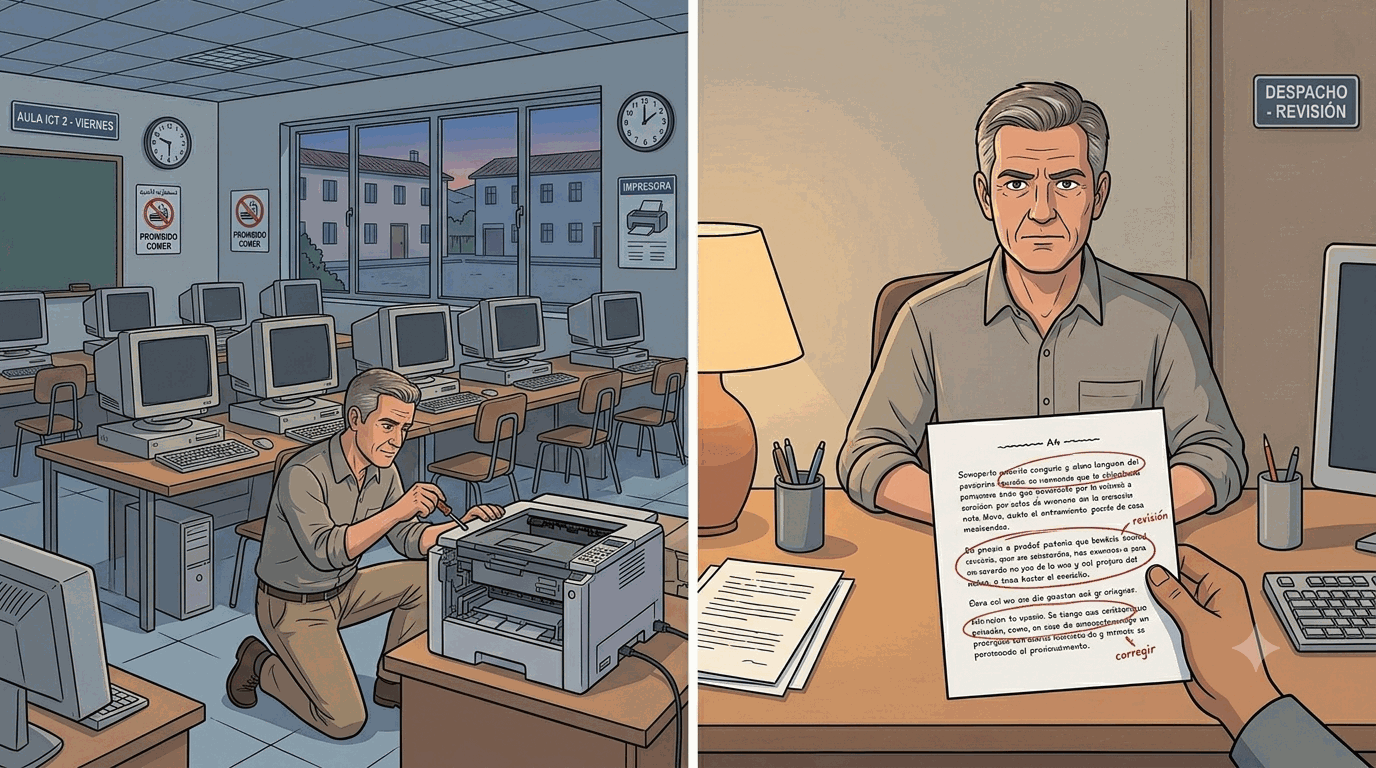
Imagen generada con Google Gemini Flash-Lite
🎧 Coloca el archivo audio/sda4_sesion2_story.mp3 junto a este HTML para que suene aquí.
Julio spent that whole first year travelling to the other building every Friday morning,
fixing printers and slow computers that had nothing to do with his own subject. It wasn't in
his job description, but he did it anyway, hoping the head teacher would eventually support
the bigger project. He never did. By the second year, Julio asked for something simple: to
stop the Friday visits and stay at his own school, coordinating with his teaching team
instead. The head teacher's answer left no room for discussion — either Julio kept coming
every Friday, or he gave up the project altogether. Julio chose to leave.
A year later, he took on a different role: Training Coordinator, working as a liaison with
the local teacher training centre. It suited him well — he already knew several advisors
there, and had years of experience in ongoing professional development. He designed a
detailed Training Action Plan, and included two honest paragraphs explaining why the staff
showed so little interest in requesting formal "working groups" for training. It wasn't an
easy thing to write, but it was true: the previous coordinator had tried to organise one the
year before, and in the end nobody had signed up. She resigned from the role soon
afterwards.
The head teacher read the plan and demanded that Julio remove both paragraphs before
submitting it. Julio refused; the information was accurate, and hiding it felt dishonest.
Once again, the answer was the same: either he changed the document, or he left the role.
Julio left the role.
"Twice in three years," he told Itto quietly. "Twice for exactly the same reason."
Mustn't expresa prohibición. Should have + participio expresa una crítica o un lamento sobre algo del pasado que no ocurrió como debería. Shouldn't have es la negativa (algo que ocurrió pero no debería haber ocurrido).
Pulsa cada palabra para consultarla en WordReference.
1. proposal /prəˈpəʊzl/ — propuesta.
2. draft (n.) /drɑːft/ — borrador (de un documento).
3. paragraph /ˈpærəɡrɑːf/ — párrafo.
4. censor (v.) /ˈsensə/ — censurar.
5. refuse (v.) /rɪˈfjuːz/ — negarse, rehusar.
6. resign (v.) /rɪˈzaɪn/ — dimitir.
7. force (v.) /fɔːs/ — obligar, forzar.
8. liaison /liˈeɪzɒn/ — enlace (persona de contacto).
9. take part (in) /teɪk pɑːt/ — participar (en).
10. volunteer (v.) /ˌvɒlənˈtɪə/ — ofrecerse voluntario/a.
11. withdraw (v.) /wɪðˈdrɔː/ — retirar(se).
12. overstep (v.) /ˌəʊvəˈstep/ — extralimitarse.
13. authority /ɔːˈθɒrəti/ — autoridad.
14. document (n.) /ˈdɒkjumənt/ — documento.
15. access (n.) /ˈækses/ — acceso.
Cuenta una vez en la que tuviste que elegir entre mantener un principio (decir la verdad, hacer lo correcto) y conservar algo importante (un puesto, una relación, una amistad). ¿Qué hiciste?
1. Escribe 2 frases con "should have" / "shouldn't have" sobre algo que, en tu opinión, el director debería haber hecho de otra manera.
2. Escribe una frase con "mustn't" sobre algo que una institución pública nunca debería hacer.
3. Reflexiona brevemente (2-3 frases): ¿por qué crees que Julio prefirió dejar los dos cargos antes que ceder?
Alguien ajeno al sistema educativo español te pregunta por qué Julio "simplemente no se quedó callado" para evitar el conflicto.
"The head teacher read the plan and demanded that Julio remove both paragraphs before submitting it. Julio refused; the information was accurate, and hiding it felt dishonest."
Tarea: Explícaselo en español, con tus propias palabras, sin traducir literalmente.
John Lennon – Imagine (1971)
Escucha la canción y localiza los verbos en presente simple. "Imagine" habla de imaginar un mundo distinto — ¿qué tendría que cambiar, en tu opinión, para que un centro educativo funcionara como el que Julio proponía?
Trabajo opcional para casa — Libro 4: 50 Selected AI Songs for A2
Everhits – You Are the Breath
Escucha esta canción en casa y compárala con la de clase: ¿qué tipo de sentimiento transmite cada una?
Imagen generada con Google Gemini Flash-Lite
En parejas: uno es Julio, explicando a un compañero por qué ha dejado el segundo cargo; el otro es el compañero, sorprendido, que le pregunta si no podría haber cedido "solo un poco". Usad al menos 2 frases con should have / shouldn't have.
SdA A2·4 · Clase 3
2023-2025, dos denuncias sin fundamento
| Bloque | Min | Contenido |
|---|---|---|
| Warm-up + Listening | 15 | Audio + T/F |
| Reading & comprensión | 20 | Lectura + preguntas |
| Language Lab | 20 | would (hipótesis) + 15 drills |
| Vocabulary Lab | 10 | 15 palabras nuevas |
| Production | 15 | Speaking + Writing |
| Mediation | 5 | Tarea de mediación |
| Sing Along + Roleplay | 5 | Canción + cierre |
Escucha el audio de la narración (sin leer el texto) y marca True (T) o False (F).
🎧 Coloca el archivo audio/sda4_sesion3_listening.mp3 junto a este HTML para que suene aquí.
1. The new digital skills programme reduced everybody's workload. →
2. Two students made formal complaints against Julio. →
3. Both complaints were eventually dismissed for lack of evidence. →
4. Julio never had to explain himself to anyone about the complaints. →
5. Julio started to doubt where the complaints had really come from. →
2023-2025, dos denuncias sin fundamento
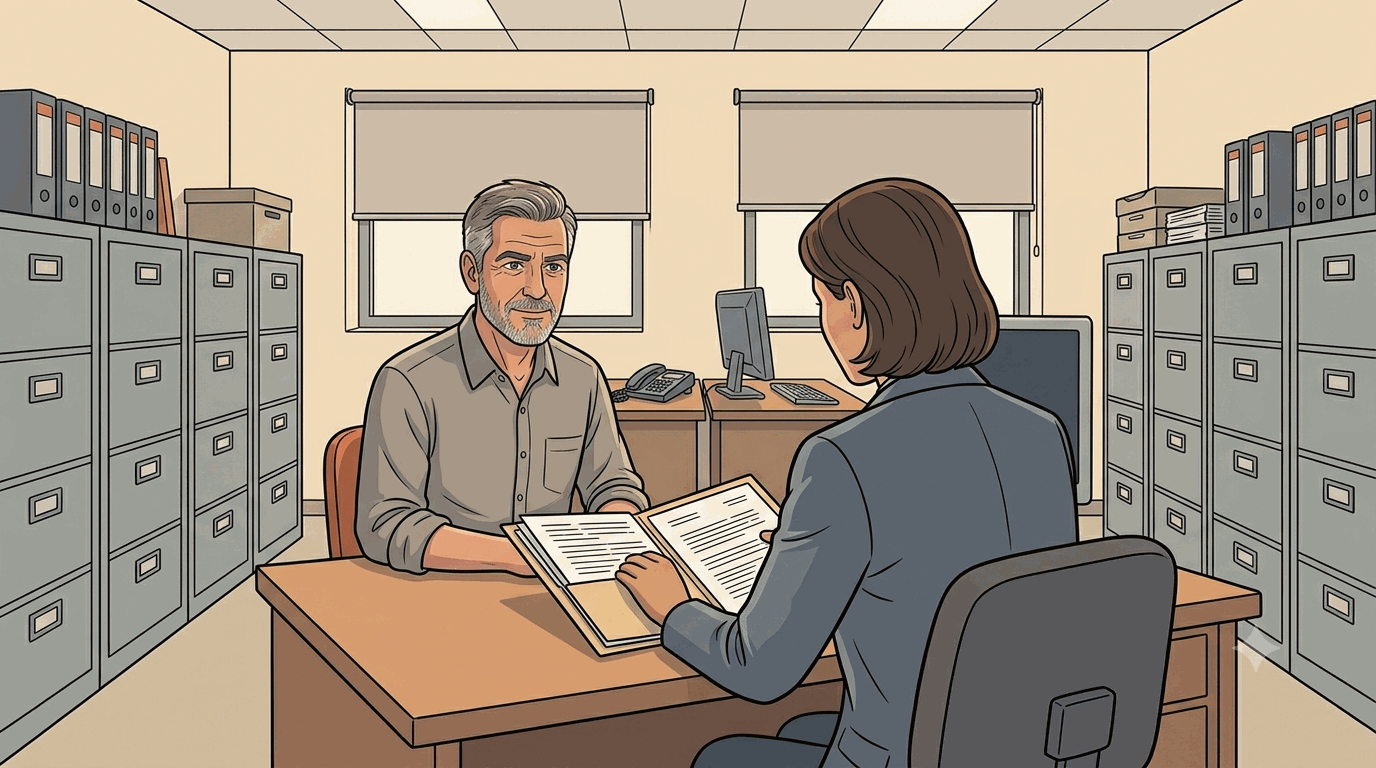
Imagen generada con Google Gemini Flash-Lite
🎧 Coloca el archivo audio/sda4_sesion3_story.mp3 junto a este HTML para que suene aquí.
"It didn't stop there," Julio continued, shifting slightly in the hospital bed. Over the
next two years, a new digital skills training programme arrived at the school — useful in
itself, and it came with extra payment for the staff involved. But it also became one more
source of friction: who would coordinate it, how the extra hours would be recorded, who would
get credit for the work. Small disagreements, one after another, kept building up.
Then, in a single school year, two students made formal complaints against Julio. He never
learned exactly why. Both complaints went straight to the regional education department, and
both times Julio had to sit down with an inspector and explain, calmly, what had actually
happened in his classroom. It wasn't pleasant, having to defend himself against accusations
he didn't fully understand. But both complaints were eventually dismissed — there was no real
evidence behind either of them.
"If it had only happened once, I would have thought it was just bad luck," Julio told Itto.
"Twice, in the same year, from two different students who barely knew each other? That's not
luck. That's a pattern."
He didn't say it directly to anyone at the time — he had no proof, only a strong feeling. But
that feeling stayed with him, quietly, through every following meeting with the head teacher.
If the complaints had come from somewhere else, he thought, they would keep coming, one way
or another, until something eventually stuck.
He was right.
Would se usa para hablar de situaciones hipotéticas o imaginadas (a menudo con "if" + pasado simple), y también para hacer predicciones suaves sobre lo que alguien haría en una situación determinada.
Pulsa cada palabra para consultarla en WordReference.
1. complaint /kəmˈpleɪnt/ — denuncia, queja formal.
2. dismiss (v.) /dɪsˈmɪs/ — desestimar.
3. accusation /ˌækjuˈzeɪʃn/ — acusación.
4. baseless (adj.) /ˈbeɪsləs/ — infundado/a.
5. investigate (v.) /ɪnˈvestɪɡeɪt/ — investigar.
6. inspector /ɪnˈspektə/ — inspector/a.
7. incentive /ɪnˈsentɪv/ — incentivo.
8. friction (fig.) /ˈfrɪkʃn/ — fricción, tensión.
9. tension /ˈtenʃn/ — tensión.
10. pressure /ˈpreʃə/ — presión.
11. escalate (v.) /ˈeskəleɪt/ — intensificarse, agravarse.
12. procedure /prəˈsiːdʒə/ — procedimiento.
13. feedback /ˈfiːdbæk/ — retroalimentación.
14. consult (v.) /kənˈsʌlt/ — consultar.
15. follow up /ˈfɒləʊ ʌp/ — hacer seguimiento.
Habla de una vez en la que sospechaste que algo "no cuadraba" pero no tenías pruebas claras. ¿Qué hiciste?
1. Escribe 2 frases condicionales con "if... would..." sobre cómo sería un centro educativo justo.
2. Escribe una frase con "wouldn't" sobre algo que, en tu opinión, un buen líder nunca haría.
3. Reflexiona (2-3 frases): ¿por qué crees que a Julio le costó tanto hablar de sus sospechas sin pruebas?
Un amigo te pregunta por qué Julio no denunció sus sospechas inmediatamente, si ya creía que había un patrón.
"He didn't say it directly to anyone at the time — he had no proof, only a strong feeling. But that feeling stayed with him, quietly, through every following meeting with the head teacher."
Tarea: Explícaselo en español, con tus propias palabras.
Josh Groban – The Impossible Dream (2020)
Escucha la canción y localiza los verbos en infinitivo. El título habla de un "sueño imposible" — ¿por qué crees que esta canción podría encajar con la lucha de Julio por mejorar su centro?
Trabajo opcional para casa — Libro 4: 50 Selected AI Songs for A2
Let Babylon Burn – I'll See You Again
Escucha esta canción en casa y compárala con la de clase: ¿qué tipo de sentimiento transmite cada una?
Imagen generada con Google Gemini Flash-Lite
En parejas: uno es Julio, explicando a un amigo de confianza su sospecha sobre las dos denuncias; el otro escucha y le dice qué habría hecho él/ella en su lugar, usando "would".
SdA A2·4 · Clase 4
Curso 2024-25, la denuncia contra Julio
| Bloque | Min | Contenido |
|---|---|---|
| Warm-up + Listening | 15 | Audio + T/F |
| Reading & comprensión | 20 | Lectura + preguntas |
| Language Lab | 20 | Repaso combinado de modales + 15 drills |
| Vocabulary Lab | 10 | 15 palabras nuevas |
| Production | 15 | Speaking + Writing |
| Mediation | 5 | Tarea de mediación |
| Sing Along + Roleplay | 5 | Canción + cierre |
Escucha el audio de la narración (sin leer el texto) y marca True (T) o False (F).
🎧 Coloca el archivo audio/sda4_sesion4_listening.mp3 junto a este HTML para que suene aquí.
1. A colleague filed a formal harassment complaint against Julio during the 2024-25 school year. →
2. Julio found out about the complaint through a detailed conversation with the head teacher. →
3. Julio's Head of Studies encouraged him to ask the colleague directly what had happened. →
4. The complaint was resolved in Julio's favour on the 13th of July 2025. →
5. Julio immediately understood the whole situation as soon as the colleague went on leave. →
Curso 2024-25, la denuncia contra Julio

Imagen generada con Google Gemini Flash-Lite
🎧 Coloca el archivo audio/sda4_sesion4_story.mp3 junto a este HTML para que suene aquí.
"That same year, something new happened," Julio said, looking towards the hospital
window. "Someone filed a complaint against me."
A colleague, encouraged by the head teacher, made a formal harassment complaint. Julio only
found out through a routine administrative notification — nobody explained the details to
him directly. Around the same time, the colleague went on sick leave, and stayed away for
weeks. When Julio asked his Head of Studies what was going on, she told him firmly: don't
ask. So he didn't — not out loud, anyway.
He wasn't completely alone during those uncertain months, though. Another colleague —
someone who had faced similar pressure from the head teacher for years, but had never felt
able to put anything in writing herself — went with him to the regional education department
to raise concerns with an inspector. She didn't file her own complaint. She simply sat beside
him, added her own account when asked, and made sure Julio didn't have to explain everything
on his own.
Then, on the 13th of July 2025, an official electronic notification finally arrived. The
complaint had been dismissed entirely, in Julio's favour. Reading the formal document
carefully — the dates, the details, the timing of the colleague's absence — Julio finally
pieced it all together. It hadn't been about him at all, not really. It had been a way for
someone else to get exactly what she wanted: months of sick leave, and an escape from a job
she had never wanted in the first place.
Julio read the notification twice, sitting alone at his kitchen table. He didn't feel
relief. He felt something closer to anger — quiet, controlled, but real.
Repasamos los cuatro modales trabajados hasta ahora, combinados en un mismo contexto.
Pulsa cada palabra para consultarla en WordReference.
1. harassment /həˈræsmənt/ — acoso.
2. notify (v.) /ˈnəʊtɪfaɪ/ — notificar.
3. outcome /ˈaʊtkʌm/ — resultado, desenlace.
4. in someone's favour /ɪn ˈfeɪvə/ — a favor de alguien.
5. motive /ˈməʊtɪv/ — motivo.
6. colleague /ˈkɒliːɡ/ — compañero/a (de trabajo).
7. accompany (v.) /əˈkʌmpəni/ — acompañar.
8. psychological (adj.) /ˌsaɪkəˈlɒdʒɪkl/ — psicológico/a.
9. sick leave /sɪk liːv/ — baja médica.
10. representative /ˌreprɪˈzentətɪv/ — representante.
11. personnel department /ˌpɜːsəˈnel dɪˈpɑːtmənt/ — departamento de personal.
12. resolve (v.) /rɪˈzɒlv/ — resolver.
13. confidential (adj.) /ˌkɒnfɪˈdenʃl/ — confidencial.
14. entitled (to be entitled to) /ɪnˈtaɪtld/ — tener derecho a.
15. seek (v.) /siːk/ — buscar (ayuda, consejo).
¿Has vivido alguna vez una situación de espera larga e incierta en el trabajo o los estudios (una evaluación, un proceso, una decisión)? Cuéntalo.
1. Escribe 2 frases sobre lo que, en tu opinión, una institución "must" hacer cuando alguien presenta una denuncia.
2. Escribe una frase con "should have" sobre cómo debería haberse tratado a Julio durante la investigación.
3. Reflexiona (2-3 frases): ¿por qué crees que Julio sintió cansancio en lugar de alivio al recibir la notificación?
Alguien te pregunta por qué la compañera que acompañó a Julio no presentó ella misma una denuncia, si también sufría la misma presión.
"Another colleague — someone who had faced similar pressure from the head teacher for years, but had never felt able to put anything in writing herself — went with him to the regional education department to raise concerns with an inspector."
Tarea: Explícaselo en español con tus propias palabras, con respeto y sin juzgar su decisión.
Lionel Richie – Hello (1983)
Escucha la canción y localiza las preguntas en presente. "Hello" habla de intentar comunicarse con alguien sin obtener respuesta clara — ¿en qué se parece esto a la larga espera de Julio por una explicación?
Trabajo opcional para casa — Libro 4: 50 Selected AI Songs for A2
Melodyspot – Shadows of You
Escucha esta canción en casa y compárala con la de clase: ¿qué tipo de sentimiento transmite cada una?
Imagen generada con Google Gemini Flash-Lite
En parejas: uno es Julio, recibiendo la notificación del 13 de julio y comprendiendo lo que ha pasado realmente; el otro es un amigo de confianza que le pregunta cómo se siente. Usad al menos 2 modales distintos.
SdA A2·4 · Clase 5
23 de julio de 2025, la denuncia formal
| Bloque | Min | Contenido |
|---|---|---|
| Warm-up + Listening | 15 | Audio + T/F |
| Reading & comprensión | 20 | Lectura + preguntas |
| Language Lab | 20 | Repaso general de modales + 15 drills |
| Vocabulary Lab | 10 | 15 palabras nuevas |
| Production | 15 | Speaking + Writing |
| Mediation | 5 | Tarea de mediación |
| Sing Along + Roleplay | 5 | Canción + cierre |
Escucha el audio de la narración (sin leer el texto) y marca True (T) o False (F).
🎧 Coloca el archivo audio/sda4_sesion5_listening.mp3 junto a este HTML para que suene aquí.
1. Julio spoke to the Head of Studies about the pressure only once, right at the end. →
2. Julio visited an old acquaintance in the Personnel Department on the 21st of July. →
3. His acquaintance advised him to let the matter go quietly. →
4. Julio wrote his complaint in a single afternoon. →
5. Julio submitted his complaint on the 23rd of July 2025. →
23 de julio de 2025, la denuncia formal
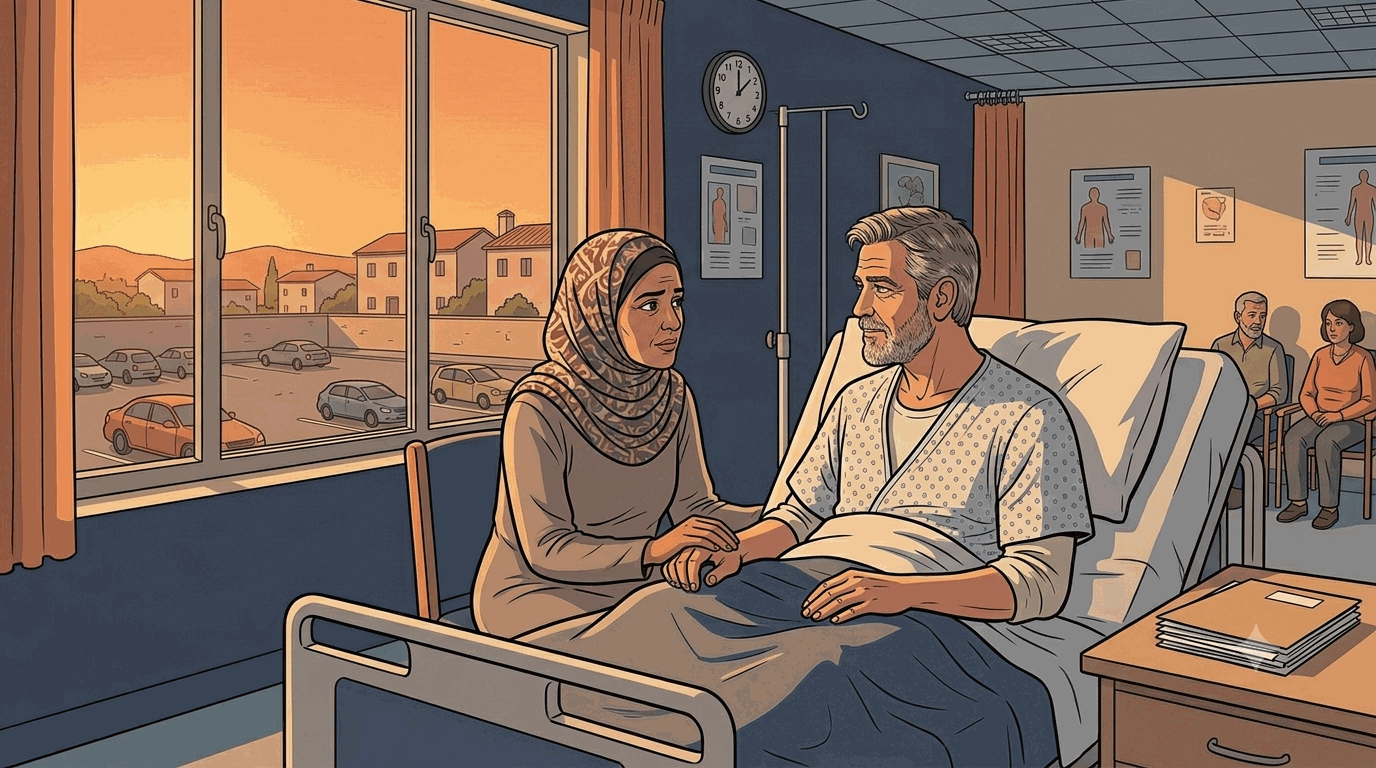
Imagen generada con Google Gemini Flash-Lite
🎧 Coloca el archivo audio/sda4_sesion5_story.mp3 junto a este HTML para que suene aquí.
"It didn't happen overnight," Julio told Itto, his voice quieter now. "Even after I
understood everything, on the 13th, I didn't act straight away."
Almost every summer, for years, he had spoken to the Head of Studies, asking her to help
reduce the pressure from the head teacher. She listened, but little ever changed. Twice
before, complaints from students had led him to sit down with an education inspector, who
eventually told him plainly that a formal complaint was really his only remaining option —
advice he had kept in the back of his mind ever since, without quite being ready to act on
it.
On the 21st of July, just over a week after the notification, Julio went to the regional
education department and asked to see an old acquaintance from the Personnel Department —
someone he had known and trusted for years. He explained everything: the complaint, the sick
leave, the pattern he now recognised so clearly. His acquaintance listened carefully, then
told him something simple and direct: the only way anything would really change was if he
put it all in writing, properly, with dates and documents.
Julio spent the next two full days at home, writing. He went through years of emails,
meeting notes and cancelled projects, building a case, point by point. By the evening of the
23rd of July, he had over twenty pages, with twelve specific requests for action. He
submitted it that same day.
"I know you're scared," he told Itto, taking her hand. "You know him personally. You know
what he's capable of."
Itto didn't answer straight away. She had never agreed with this decision — she still
didn't, not fully — but she also knew there was no point arguing with him about it now,
lying in a hospital bed, the complaint already filed.
"I had to do it," Julio said, mostly to himself. "Not for me. For everyone who comes after
me, and everyone still there now, too tired to write it themselves."
Outside the window, the sun was setting over the hospital car park. Whatever happened next,
it was out of his hands now.
Repaso general de los cuatro modales trabajados a lo largo de la unidad, en el contexto de la decisión final de Julio.
Pulsa cada palabra para consultarla en WordReference.
1. commission /kəˈmɪʃn/ — comisión.
2. occupational risk /ˌɒkjuˈpeɪʃənl rɪsk/ — riesgo laboral.
3. file (a complaint) (v.) /faɪl/ — presentar (una denuncia formalmente).
4. extensive (adj.) /ɪkˈstensɪv/ — extenso/a, amplio/a.
5. acquaintance /əˈkweɪntəns/ — conocido/a (persona).
6. conciliation /kənˌsɪliˈeɪʃn/ — conciliación.
7. wash your hands of something /wɒʃ jɔː hændz/ — lavarse las manos de algo.
8. recommend (v.) /ˌrekəˈmend/ — recomendar.
9. consequence /ˈkɒnsɪkwəns/ — consecuencia.
10. courage /ˈkʌrɪdʒ/ — valentía.
11. head of studies /hed əv ˈstʌdiz/ — jefe/a de estudios.
12. worn down /wɔːn daʊn/ — desgastado/a, agotado/a.
13. determined (adj.) /dɪˈtɜːmɪnd/ — decidido/a.
14. weigh (v.) /weɪ/ — sopesar.
15. out of someone's hands /aʊt əv ˈhændz/ — fuera del control de alguien.
¿Alguna vez has tenido que tomar una decisión difícil sabiendo que no todo el mundo cercano a ti estaba de acuerdo? Cuéntalo con calma.
1. Escribe 2 frases sobre lo que, en tu opinión, "must" incluir una denuncia formal bien documentada.
2. Escribe una frase con "would" sobre cómo crees que se sintió Itto al escuchar la decisión de Julio.
3. Cierre de la unidad, por escrito (3-4 frases): en tu opinión, ¿mereció la pena que Julio presentara la denuncia? No hay respuesta correcta ni incorrecta.
Alguien ajeno al sistema educativo español te pregunta cómo funciona el proceso de presentar una denuncia formal ante una Comisión de Riesgos Laborales.
"Over two intense days, he documented everything — every cancelled project, every censored document, every unfair meeting — building a case of more than twenty pages, with twelve specific, concrete requests for action."
Tarea: Explícaselo en español, en un registro formal y claro, sin traducir palabra por palabra.
Little Shop of Horrors – Suddenly Seymour (1986)
Escucha la canción y localiza los verbos en pasado. Habla de encontrar fuerza inesperada gracias a otra persona — ¿qué papel crees que jugó Itto en la decisión final de Julio, aunque no estuviera de acuerdo?
Trabajo opcional para casa — Libro 4: 50 Selected AI Songs for A2
Morgan Luna – I'm Not Your Toy
Escucha esta canción en casa y compárala con la de clase: ¿qué tipo de sentimiento transmite cada una?
Imagen generada con Google Gemini Flash-Lite
En parejas: uno es Julio, explicando por qué ha decidido presentar la denuncia a pesar del miedo de Itto; el otro es Itto, expresando su preocupación pero respetando la decisión. Usad al menos 3 modales distintos (must / have to / should have / would).
SdA A2·4 · Clase 6
Repaso general del conflicto laboral
| Bloque | Min | Contenido |
|---|---|---|
| Warm-up | 5 | Recordatorio de la unidad |
| Review Fair (5 estaciones) | 45 | Roleplay por estaciones, repaso de las 5 sesiones |
| Review Language Lab | 25 | Quiz mixto de repaso (10 ítems) |
| Sing Along de cierre | 10 | Canción + resumen de la unidad |
| Despedida | 5 | Cierre y enlace con la SdA A2·5 |
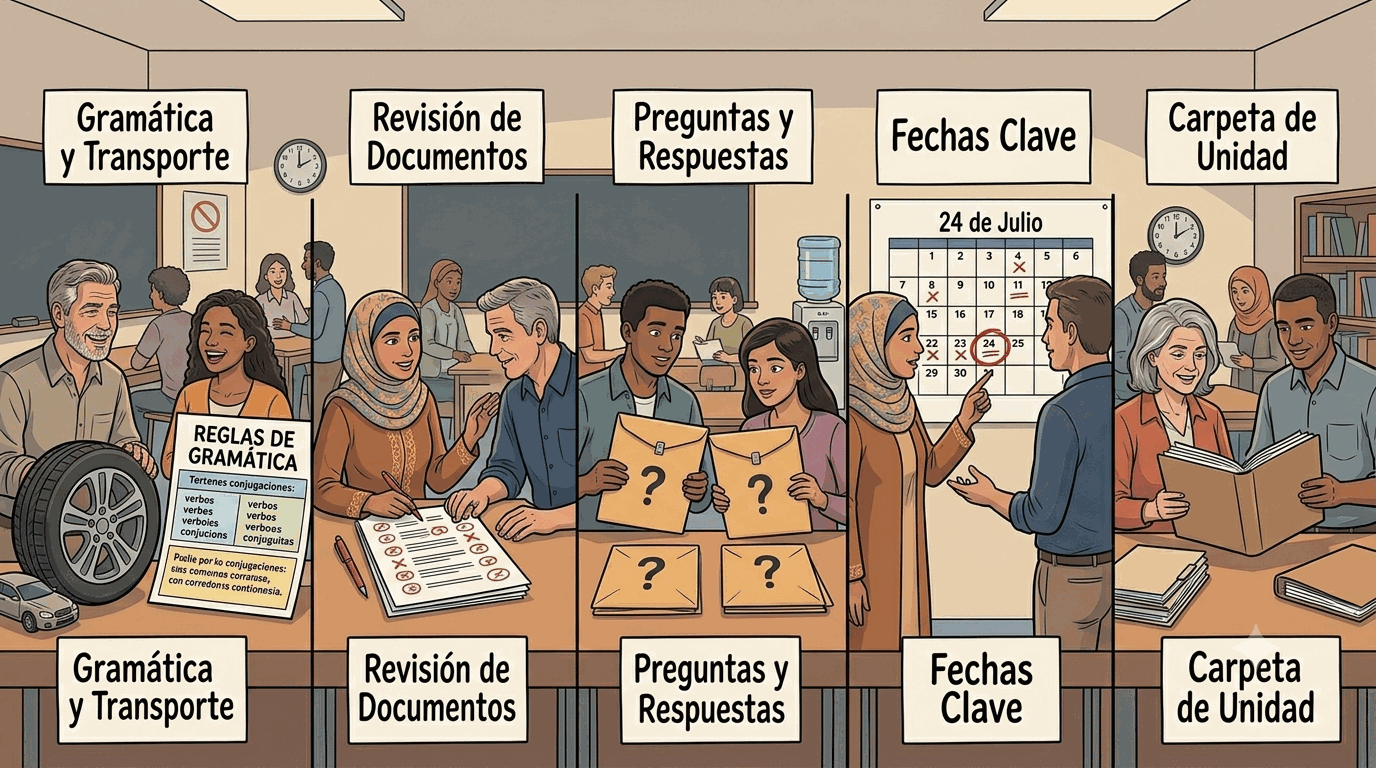
Imagen generada con Google Gemini Flash-Lite
La clase se organiza como una pequeña feria de repaso, con cinco estaciones montadas en
distintos puntos del aula:
Estación 1 — "A Flat Tyre and an Old Pattern": una rueda de cartulina y un
cartel con "must / have to", para repasar la Sesión 1.
Estación 2 — "Two Roles, Two Resignations": un documento con dos párrafos
tachados en rojo, para repasar la Sesión 2.
Estación 3 — "The Tension That Doesn't Go Away": dos sobres cerrados con un
signo de interrogación, para repasar la Sesión 3.
Estación 4 — "The Complaint He Received": un calendario de pared con el 13 de
julio marcado, para repasar la Sesión 4.
Estación 5 — "The Decision": una carpeta gruesa de papeles ("20 páginas") junto
a un segundo calendario con el 21 y el 23 de julio marcados, para repasar la Sesión 5, con
especial cuidado y respeto en el tono.
Los alumnos rotan en grupos pequeños por las cinco estaciones, improvisando una breve escena
de 2-3 minutos en cada una.
Repaso de must / have to / should have / would, en los contextos de normativa escolar, procedimientos administrativos y decisiones personales.
Lynyrd Skynyrd – Simple Man (1973)
Como cierre de la unidad, comentad en gran grupo: de las cinco sesiones, ¿cuál os ha
parecido más significativa? "Simple Man" habla de mantenerse fiel a uno mismo — ¿creéis que
esto resume bien la actitud de Julio a lo largo de esta historia?
Julio's complaint was now in the hands of the Occupational Risk Commission, and there was nothing more he could do but wait — and rest. He still had weeks of recovery ahead of him, and a new school year would begin without knowing how, or when, any of this would be resolved. For now, all he could do was get better, and go home.
Trabajo opcional para casa — Libro 4: 50 Selected AI Songs for A2
Raselhits – Fading In The Rain
Escucha esta canción en casa como cierre de la unidad, y guárdala en tu lista de canciones favoritas del curso.