
SEP Alkayasí · CEPER 500 Viviendas
SEP Alkayasí · CEPER 500 Viviendas
SdA A2·3 · Clase 1
Finales de agosto de 2025, el viaje empieza


| Bloque | Min | Contenido |
|---|---|---|
| Warm-up + Listening | 15 | Audio + T/F |
| Reading & comprensión | 20 | Lectura + preguntas |
| Language Lab | 20 | Pasado simple + 15 drills |
| Vocabulary Lab | 10 | 15 palabras nuevas |
| Production | 15 | Speaking + Writing |
| Mediation | 5 | Tarea de mediación |
| Sing Along + Roleplay | 5 | Canción + cierre |
Escucha el audio de la narración (sin leer el texto) y marca True (T) o False (F).
🎧 Coloca el archivo audio/sda3_sesion1_listening.mp3 junto a este HTML para que suene aquí.
1. Julio, Itto and Zahra left in the last week of August. →
2. They flew from Almería to Melilla. →
3. The wait at the border into Morocco lasted about eleven hours. →
4. Zahra stayed awake the whole time. →
5. They reached Meknès before crossing the border. →
Finales de agosto de 2025, el viaje empieza
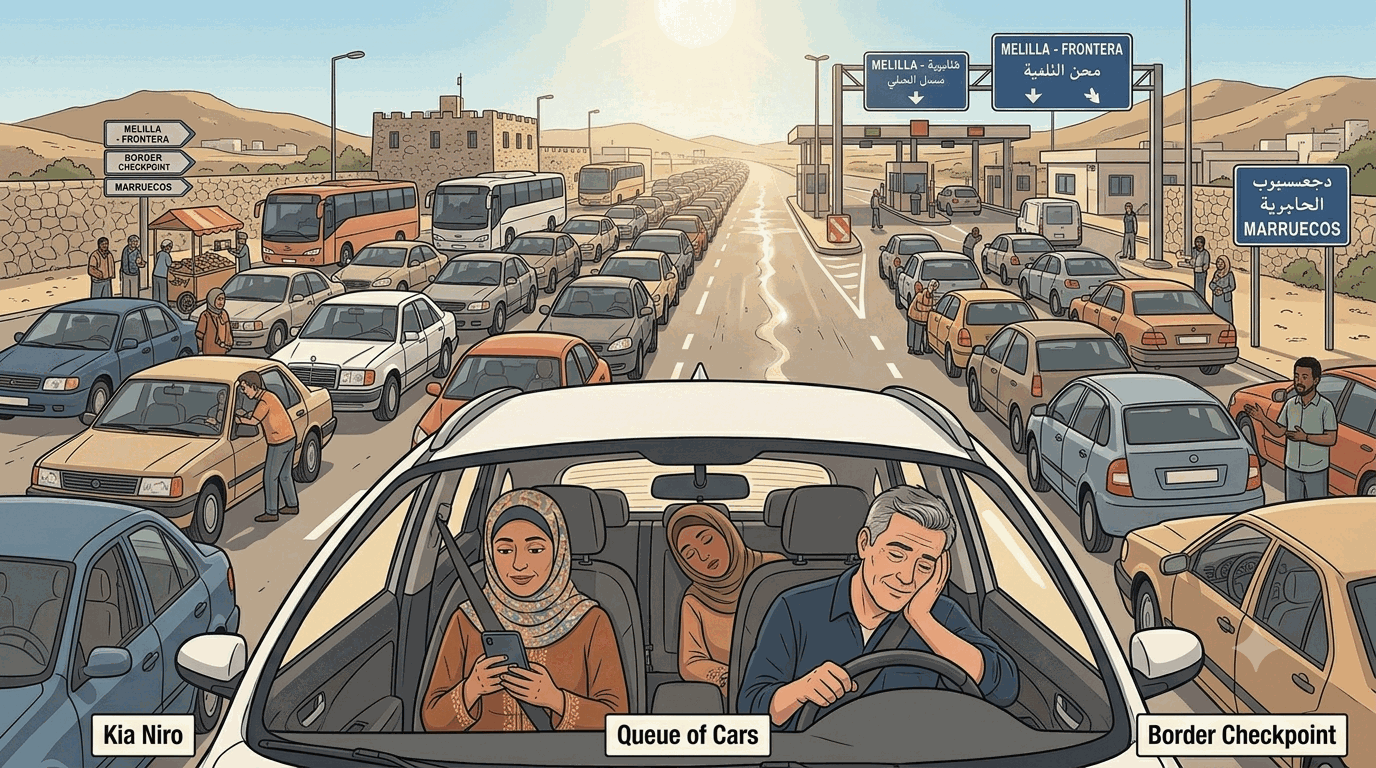
Imagen generada con Google Gemini Flash-Lite
🎧 Coloca el archivo audio/sda3_sesion1_story.mp3 junto a este HTML para que suene aquí.
In the last days of August, Julio, Itto and Zahra packed the white Kia Niro once again —
this time for Morocco, to visit Itto's parents in Ouaoumana. It hadn't been an easy summer
for Julio. Since July, he had been carrying a heavy weight of work-related stress, and
although he tried to leave it behind for the trip, it travelled with him quietly, at the back
of his mind.
They caught an early ferry from Almería to Melilla. The crossing was smooth, and for a while
Julio almost relaxed, watching the coast of Africa slowly grow closer. But the calm didn't
last. As soon as they joined the line of cars waiting to cross from Melilla into Morocco, they
realised this wouldn't be quick. Hour after hour, the cars moved forward just a few metres at
a time, under a sun that grew hotter as the morning became afternoon.
Zahra slept through most of it, curled up in the back seat. Itto scrolled through her phone,
messaging her mother to say they were close, even though they weren't. Julio just watched,
drumming his fingers on the wheel, feeling his patience — and his energy — running lower with
every passing hour.
Eleven hours after they first joined the queue, they finally crossed into Morocco. Tired,
hungry and a little dazed, they pointed the car towards Meknès, and from there, towards
Ouaoumana.
Seguimos repasando el pasado simple con verbos frecuentes del viaje y los trámites de frontera, y recordamos how long...? + un periodo de tiempo para preguntar por duración (How long did the wait last?).
Pulsa cada palabra para consultarla en WordReference.
1. passport /ˈpɑːspɔːt/ — pasaporte.
2. identity card /aɪˈdentəti kɑːd/ — carné de identidad.
3. customs /ˈkʌstəmz/ — aduana.
4. border control /ˈbɔːdə kənˌtrəʊl/ — control fronterizo.
5. immigration officer /ˌɪmɪˈɡreɪʃn ˈɒfɪsə/ — agente de inmigración.
6. tailback /ˈteɪlbæk/ — retención, caravana de tráfico.
7. lane (traffic) /leɪn/ — carril.
8. toll /təʊl/ — peaje.
9. ferry terminal /ˈferi ˈtɜːmɪnl/ — terminal del ferry.
10. board (v.) /bɔːd/ — embarcar.
11. disembark /ˌdɪsɪmˈbɑːk/ — desembarcar.
12. cabin (ferry) /ˈkæbɪn/ — camarote.
13. patience /ˈpeɪʃns/ — paciencia.
14. exhausting /ɪɡˈzɔːstɪŋ/ — agotador/a.
15. stamp (passport) /stæmp/ — sello (en el pasaporte).
Cuenta una vez que hayas tenido que esperar mucho tiempo para algo (una cola, un aeropuerto, una frontera): ¿cuánto tiempo esperaste?, ¿cómo te sentiste?
1. Describe, en pasado simple, una espera larga que hayas vivido.
2. Escribe 3 frases sobre cómo crees que se sintió Julio durante esas once horas.
3. Escribe una pregunta con "How long...?" sobre el viaje de Julio, Itto y Zahra.
Un compañero de trabajo te pregunta por qué Julio parecía tan cansado incluso antes de salir de viaje.
"Since July, Julio had been carrying a heavy weight of work-related stress, and although he tried to leave it behind for the trip, it travelled with him quietly, at the back of his mind."
Tarea: Explícaselo en español a tu compañero, de forma clara y natural, sin traducir palabra por palabra.
Elvis Presley – My Way (1977)
Escucha la canción y localiza al menos dos verbos en pasado. ¿Por qué crees que esta canción, sobre mirar atrás en la propia vida, encaja con el inicio de este viaje?
Trabajo opcional para casa — Libro 4: 50 Selected AI Songs for A2
Raselhits – Evadne My Morning Rose
Escucha esta canción en casa y compárala con la de clase: ¿qué tipo de sentimiento transmite cada una?
Imagen generada con Google Gemini Flash-Lite
En parejas, representad la espera en la frontera: una persona es Julio, cansado e impaciente; la otra es Itto, que intenta animarle. Usad al menos 5 frases en pasado simple para describir lo que ha pasado hasta ese momento.
SdA A2·3 · Clase 2
La llegada a Ouaoumana y los primeros días en Khenifra




| Bloque | Min | Contenido |
|---|---|---|
| Warm-up + Listening | 15 | Audio + T/F |
| Reading & comprensión | 20 | Lectura + preguntas |
| Language Lab | 20 | Pasado continuo/simple + 15 drills |
| Vocabulary Lab | 10 | 15 palabras nuevas |
| Production | 15 | Speaking + Writing |
| Mediation | 5 | Tarea de mediación |
| Sing Along + Roleplay | 5 | Canción + cierre |
Escucha el audio de la narración (sin leer el texto) y marca True (T) o False (F).
🎧 Coloca el archivo audio/sda3_sesion2_listening.mp3 junto a este HTML para que suene aquí.
1. Ali Boukrim and Fátima Aachouch were waiting for them in Khenifra. →
2. The first apartment had air conditioning. →
3. They changed to an apartment on the second floor. →
4. Amín and Alí are Mustapha's children. →
5. They didn't visit anyone else during their stay in Khenifra. →
Reencuentros, un piso equivocado y una visita a Tadla
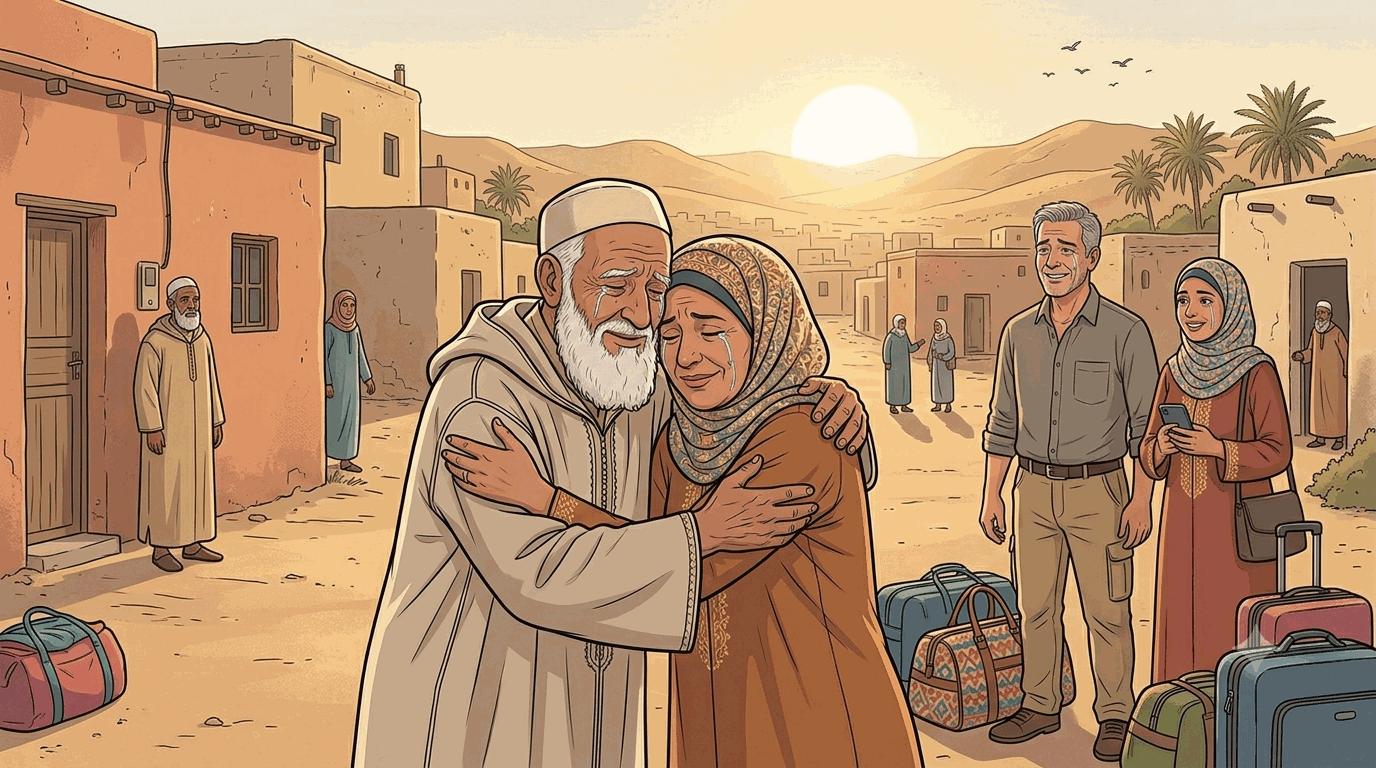
Imagen generada con Google Gemini Flash-Lite
🎧 Coloca el archivo audio/sda3_sesion2_story.mp3 junto a este HTML para que suene aquí.
After the long wait at the border, arriving in Ouaoumana felt like stepping into another
world. Ali Boukrim, now ninety-one, and Fátima Aachouch, eighty-four, were waiting outside
their house, and the reunion was full of tears and tight hugs. From there, the whole family
drove together to Khenifra, where they would be staying for most of the trip.
The apartment Julio had booked online turned out to be, once again, not quite what the photos
had promised. The ground-floor flat had no air conditioning, and after just ten minutes
inside, everyone was dripping with sweat. The owner, apologetic, offered them a different
apartment on the second floor instead — a little untidy, and not the most modern, but
blissfully cool, and large enough for the whole family to fit comfortably. They accepted at
once.
The days that followed settled into a warm rhythm. Mornings were slow; afternoons were spent
walking through the souk, buying fruit and fresh bread; evenings meant long dinners around a
shared table. One afternoon, they drove to Tadla to visit Mustapha, the journalist, his wife
Fátima, and their two children — Amín, now twelve, and Alí, nine — before continuing on to
Beni Mellal together, where the children ran ahead of the adults through the busy streets,
laughing.
For the first time in weeks, Julio noticed that he had stopped checking his phone for messages
from Spain.
El pasado continuo (was/were + -ing) describe una acción en desarrollo, a menudo interrumpida por otra en pasado simple, o dos acciones paralelas: "While the children were running, the adults were talking."
Pulsa cada palabra para consultarla en WordReference.
1. relative (n.) /ˈrelətɪv/ — familiar, pariente.
2. cousin /ˈkʌzn/ — primo/a.
3. journalist /ˈdʒɜːnəlɪst/ — periodista.
4. extended family /ɪkˈstendɪd ˈfæməli/ — familia extensa.
5. rural area /ˈrʊərəl ˈeəriə/ — zona rural.
6. swimming pool /ˈswɪmɪŋ puːl/ — piscina.
7. modest /ˈmɒdɪst/ — modesto/a, sencillo/a.
8. dip (n./v.) /dɪp/ — chapuzón, darse un chapuzón.
9. shade /ʃeɪd/ — sombra.
10. scorching /ˈskɔːtʃɪŋ/ — abrasador/a.
11. gathering /ˈɡæðərɪŋ/ — reunión familiar.
12. host (v.) /həʊst/ — hospedar, recibir en casa.
13. tradition /trəˈdɪʃn/ — tradición.
14. dressed /drest/ — vestido/a.
15. reunion /riːˈjuːniən/ — reencuentro.
Cuenta una reunión familiar grande que recuerdes: ¿quién estaba?, ¿qué hicisteis?, ¿cómo os sentisteis?
1. Describe, en pasado, la llegada de Julio y su familia a Khenifra.
2. Escribe 3 frases con pasado continuo sobre lo que hacía cada miembro de la familia durante la visita.
3. Escribe una pregunta con "While...?" sobre algún momento de la Sesión 2.
Una alumna te pregunta por qué cambiaron de apartamento en Khenifra si ya lo habían reservado.
"The ground-floor flat had no air conditioning, and after just ten minutes inside, everyone was dripping with sweat. The owner offered them a different apartment on the second floor instead."
Tarea: Explícaselo en español, de forma clara y natural, sin traducir palabra por palabra.
Eric Clapton – Wonderful Tonight (1977)
Escucha la canción y localiza al menos dos verbos en pasado simple o continuo. ¿Qué momento de esta sesión podría acompañar esta canción?
Trabajo opcional para casa — Libro 4: 50 Selected AI Songs for A2
Silk & Scars – The Sound of Nothing
Escucha esta canción en casa y compárala con la de clase: ¿qué tipo de sentimiento transmite cada una?
Imagen generada con Google Gemini Flash-Lite
En grupos de tres, representad la llegada a casa de los padres de Itto: uno hace de Ali Boukrim o Fátima Aachouch, otro de Itto, y el tercero de Julio o Zahra observando la escena. Usad pasado simple y pasado continuo.
SdA A2·3 · Clase 3
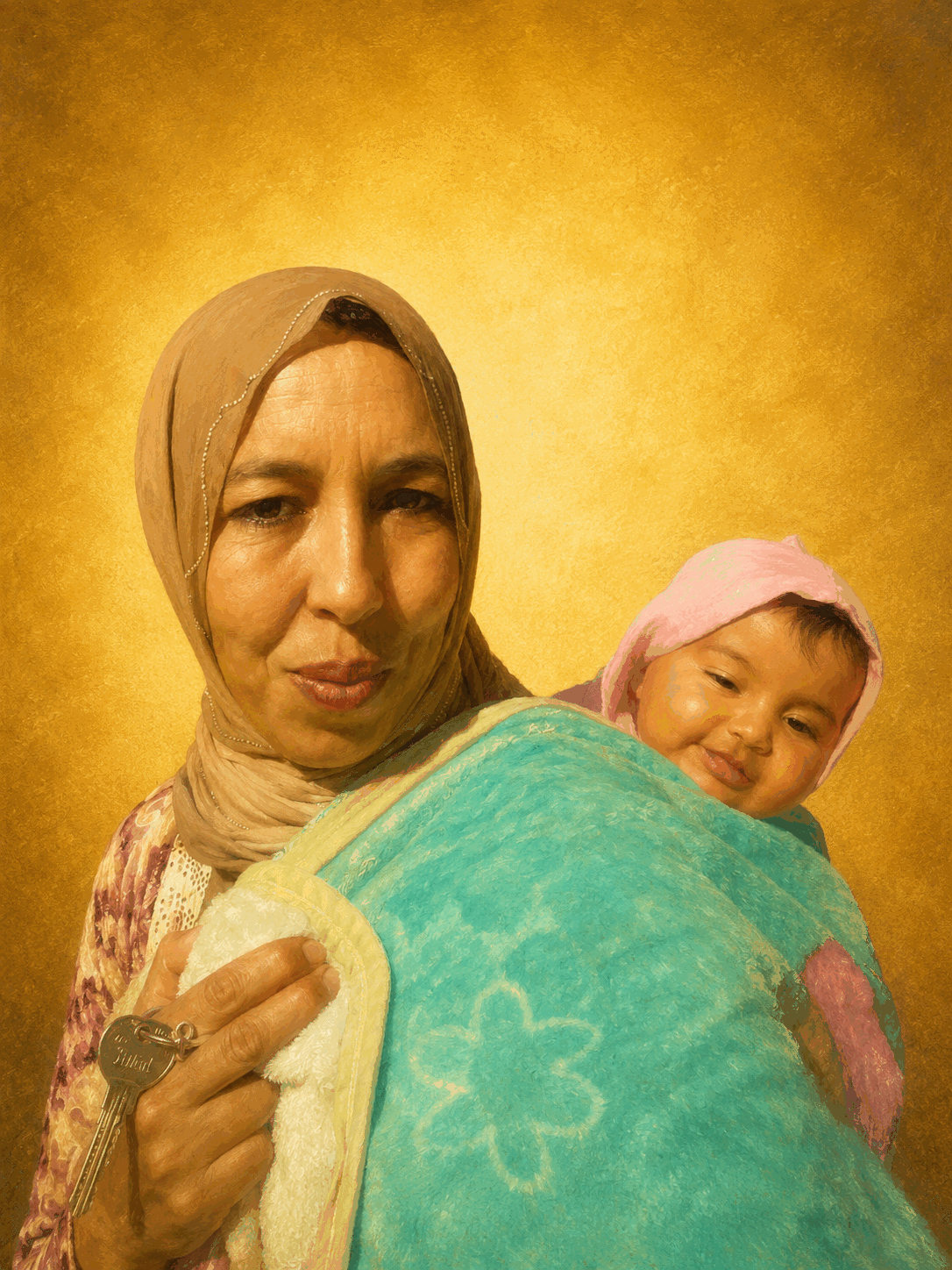
La visita al cortijo de Abderrahim y el encuentro con Souad

| Bloque | Min | Contenido |
|---|---|---|
| Warm-up + Listening | 15 | Audio + T/F |
| Reading & comprensión | 20 | Lectura + preguntas |
| Language Lab | 20 | Pasado simple/continuo + 15 drills |
| Vocabulary Lab | 10 | 15 palabras nuevas |
| Production | 15 | Speaking + Writing |
| Mediation | 5 | Tarea de mediación |
| Sing Along + Roleplay | 5 | Canción + cierre |
Escucha el audio de la narración (sin leer el texto) y marca True (T) o False (F).
🎧 Coloca el archivo audio/sda3_sesion3_listening.mp3 junto a este HTML para que suene aquí.
1. Abderrahim is younger than Souad. →
2. Souad was expecting her first baby. →
3. Mustapha arranged the marriage between Abderrahim and Souad. →
4. They slept indoors, in proper beds. →
5. Julio found it easy to sleep on the floor. →
Un cortijo, una boda concertada y una noche bajo las estrellas
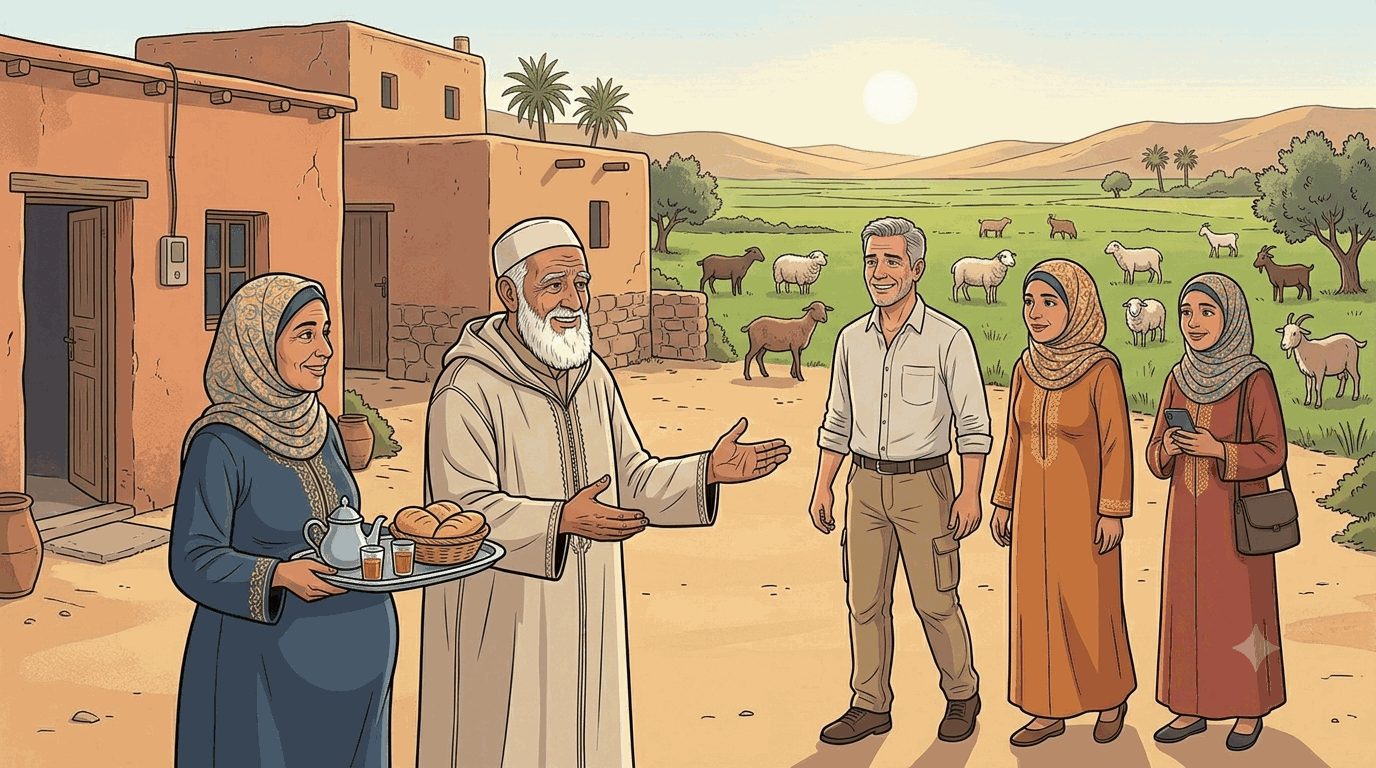
Imagen generada con Google Gemini Flash-Lite
🎧 Coloca el archivo audio/sda3_sesion3_story.mp3 junto a este HTML para que suene aquí.
A couple of days later, they drove out along a dusty track to visit Abderrahim, Itto's
brother, who had spent his whole life working the land and looking after livestock on a small
farm outside Ouaoumana. The last time Julio saw him was at Christmas in 2022, and there was a
surprise waiting: Abderrahim, now fifty years old, had got married only a few months before.
His wife, Souad, was just thirty-five — a striking difference in age that nobody in the family
seemed to think twice about.
Souad's story was, in its own way, remarkable. She had grown up in a desperately poor village
at the edge of the desert, one of many children in a family with almost nothing. Mustapha had
met her during one of his reporting trips, and, following a custom still common in rural
Morocco, he had arranged her marriage to his older, unmarried brother. Now, nine months
pregnant and due to give birth any day, Souad moved slowly but welcomed her guests with warm
flatbread, dates, and glass after glass of sweet mint tea.
That night, the heat inside the farmhouse was unbearable, so the whole family carried thin
mats and blankets up to the rooftop terrace and slept outside, under an enormous sky full of
stars. For Itto and Zahra, sleeping on the ground was completely normal — they had grown up
with it. For Julio, it was another story entirely: he spent most of the night turning from
side to side, his back aching, waiting for the sun to rise.
Seguimos repasando pasado simple y continuo para describir costumbres y hechos de otras personas. Recordamos también cómo comparar edades: much + comparativo + than (much older than).
Pulsa cada palabra para consultarla en WordReference.
1. farmhouse /ˈfɑːmhaʊs/ — casa de labranza, cortijo.
2. livestock /ˈlaɪvstɒk/ — ganado.
3. crops /krɒps/ — cultivos.
4. arranged marriage /əˈreɪndʒd ˈmærɪdʒ/ — matrimonio concertado.
5. pregnant /ˈpreɡnənt/ — embarazada.
6. due date /djuː deɪt/ — fecha prevista de parto.
7. mat /mæt/ — esterilla.
8. rooftop /ˈruːftɒp/ — azotea.
9. blanket /ˈblæŋkɪt/ — manta.
10. hospitality /ˌhɒspɪˈtæləti/ — hospitalidad.
11. humble /ˈhʌmbl/ — humilde.
12. bride /braɪd/ — novia.
13. groom /ɡruːm/ — novio.
14. livelihood /ˈlaɪvlihʊd/ — sustento, medio de vida.
15. barn /bɑːn/ — granero.
¿Conoces alguna costumbre familiar (boda, celebración, tradición) muy distinta a la tuya? Cuéntala a tu compañero/a.
1. Describe, en pasado, la llegada al cortijo de Abderrahim.
2. Escribe 3 frases sobre cómo se conocieron Abderrahim y Souad.
3. Escribe una pregunta con "How did...?" sobre el matrimonio concertado.
Un amigo te pregunta por qué toda la familia durmió en el suelo de la azotea esa noche, en vez de en camas.
"That night, the heat inside the farmhouse was unbearable, so the whole family carried thin mats and blankets up to the rooftop terrace and slept outside."
Tarea: Explícaselo en español, de forma clara y natural, sin traducir palabra por palabra.
Gloria Gaynor – I Will Survive (1994)
Escucha la canción y localiza los verbos en pasado. ¿Por qué crees que esta canción, sobre superar dificultades, podría representar la fortaleza de Souad?
Trabajo opcional para casa — Libro 4: 50 Selected AI Songs for A2
Sons of Ashes – A Sign on my Way
Escucha esta canción en casa y compárala con la de clase: ¿qué tipo de sentimiento transmite cada una?
Imagen generada con Google Gemini Flash-Lite
En parejas, representad el encuentro entre Julio y Souad: uno hace de Julio, curioso y algo sorprendido; el otro hace de Souad, recibiendo con hospitalidad pese al cansancio del embarazo. Usad al menos 5 frases en pasado.
SdA A2·3 · Clase 4
La excursión al manantial y el primer aviso
| Bloque | Min | Contenido |
|---|---|---|
| Warm-up + Listening | 15 | Audio + T/F |
| Reading & comprensión | 20 | Lectura + preguntas |
| Language Lab | 20 | Secuencia narrativa + 15 drills |
| Vocabulary Lab | 10 | 15 palabras nuevas |
| Production | 15 | Speaking + Writing |
| Mediation | 5 | Tarea de mediación |
| Sing Along + Roleplay | 5 | Canción + cierre |
Escucha el audio de la narración (sin leer el texto) y marca True (T) o False (F).
🎧 Coloca el archivo audio/sda3_sesion4_listening.mp3 junto a este HTML para que suene aquí.
1. They found the spring using a shortcut suggested by the GPS. →
2. The forestry track was wide and smooth. →
3. Julio felt calm while driving on the track. →
4. They ate lunch by the river near the spring. →
5. Julio refused to drink water from the shared jug. →
Sal de roca, un bosque de cedros y un vaso de agua compartido

Imagen generada con Google Gemini Flash-Lite
🎧 Coloca el archivo audio/sda3_sesion4_story.mp3 junto a este HTML para que suene aquí.
On what should have been a relaxed day out, the family set off into the mountains near
Khenifra to visit a spring known locally for its cold, sweet water. Julio was driving,
following the directions on his phone, when the GPS suggested a shortcut along a narrow
forestry track.
It turned out to be a serious mistake. The track was barely wide enough for the car, full of
deep potholes and large stones, and in places it tilted so steeply to one side that Julio was
sure they were about to get stuck. For almost an hour, he inched the Kia Niro forward, his
knuckles white on the wheel, his heart pounding. After a difficult year of accumulated work
stress, this felt like one more thing his body simply couldn't absorb calmly. Nobody in the
car said very much.
When the track finally joined a proper road again, the relief was enormous. At the spring,
they bought blocks of rock salt, laid blankets by the riverbank, and ate a simple tagine of
chicken and potatoes while Julio walked slowly along the narrow paths with Ali Boukrim and
Fátima Aachouch, admiring the ancient cedar forest on the way back to Khenifra.
That evening, tired but content, they wandered through the souk one last time, buying a few
clothes for the journey home. On a street corner, someone was offering water for free from a
large plastic jug, and everyone — locals and visitors alike — drank from the same cup. Julio,
thirsty after the long day, didn't hesitate for a second.
Repasamos el pasado simple para narrar una secuencia de sucesos, con conectores como first, then, after that, eventually, finally. Añadimos estructuras para expresar preocupación en pasado: "I was sure (that)...", "I didn't know if...".
Pulsa cada palabra para consultarla en WordReference.
1. spring (n., water) /sprɪŋ/ — manantial.
2. track (n.) /træk/ — pista, camino de tierra.
3. pothole /ˈpɒthəʊl/ — bache.
4. steep /stiːp/ — empinado/a, inclinado/a.
5. bumpy /ˈbʌmpi/ — con baches, irregular.
6. stuck (get stuck) /stʌk/ — atascado/a.
7. relief /rɪˈliːf/ — alivio.
8. rock salt /rɒk sɔːlt/ — sal de roca.
9. riverbank /ˈrɪvəbæŋk/ — orilla del río.
10. cedar /ˈsiːdə/ — cedro.
11. forest /ˈfɒrɪst/ — bosque.
12. stream /striːm/ — arroyo.
13. pitcher /ˈpɪtʃə/ — jarra.
14. communal /kəˈmjuːnl/ — comunal, compartido/a.
15. thirsty /ˈθɜːsti/ — sediento/a.
Cuenta alguna vez que tomaste un atajo y las cosas no salieron como esperabas.
1. Describe, con conectores de secuencia (first, then, after that, finally), la excursión al manantial.
2. Escribe 3 frases sobre cómo se sintió Julio conduciendo por la pista forestal.
3. Escribe una pregunta con "Was/Were... sure...?" sobre algún momento de la excursión.
Un compañero te pregunta por qué Julio tardó tanto en llegar al manantial si solo eran unos kilómetros.
"The GPS suggested a shortcut along a narrow forestry track. It turned out to be a serious mistake — the track was barely wide enough for the car, full of potholes and large stones."
Tarea: Explícaselo en español a tu compañero.
Gotye – Somebody That I Used To Know (2011)
Escucha la canción y localiza los verbos en pasado. Fijaos en el título: ¿por qué "alguien que solía conocer" puede resumir cómo se sentía Julio ese año?
Trabajo opcional para casa — Libro 4: 50 Selected AI Songs for A2
Stella Noir – Starlight Echoes
Escucha esta canción en casa y compárala con la de clase: ¿qué tipo de sentimiento transmite cada una?
Imagen generada con Google Gemini Flash-Lite
En grupos de tres, representad el momento de la pista forestal: uno conduce (Julio), preocupado; los otros son los pasajeros, intentando tranquilizarle o mirando por la ventana en silencio. Terminad la escena con la llegada al manantial y el alivio del grupo.
SdA A2·3 · Clase 5
La crisis de salud y el regreso urgente a España
| Bloque | Min | Contenido |
|---|---|---|
| Warm-up + Listening | 15 | Audio + T/F |
| Reading & comprensión | 20 | Lectura + preguntas |
| Language Lab | 20 | Lenguaje de urgencia/salud + 15 drills |
| Vocabulary Lab | 10 | 15 palabras nuevas |
| Production | 15 | Speaking + Writing |
| Mediation | 5 | Tarea de mediación (con espíritu crítico) |
| Sing Along + Roleplay | 5 | Canción + cierre |
Escucha el audio de la narración (sin leer el texto) y marca True (T) o False (F).
🎧 Coloca el archivo audio/sda3_sesion5_listening.mp3 junto a este HTML para que suene aquí.
1. Julio started feeling unwell during the day, at the spring. →
2. The emergency room in Khenifra was very calm and organised. →
3. A private clinic finally helped ease Julio's pain. →
4. Julio's family visited him on the very first day at the hospital in Almería. →
5. Julio was admitted directly into intensive care in Almería. →
De Khenifra a Almería, y una semana después
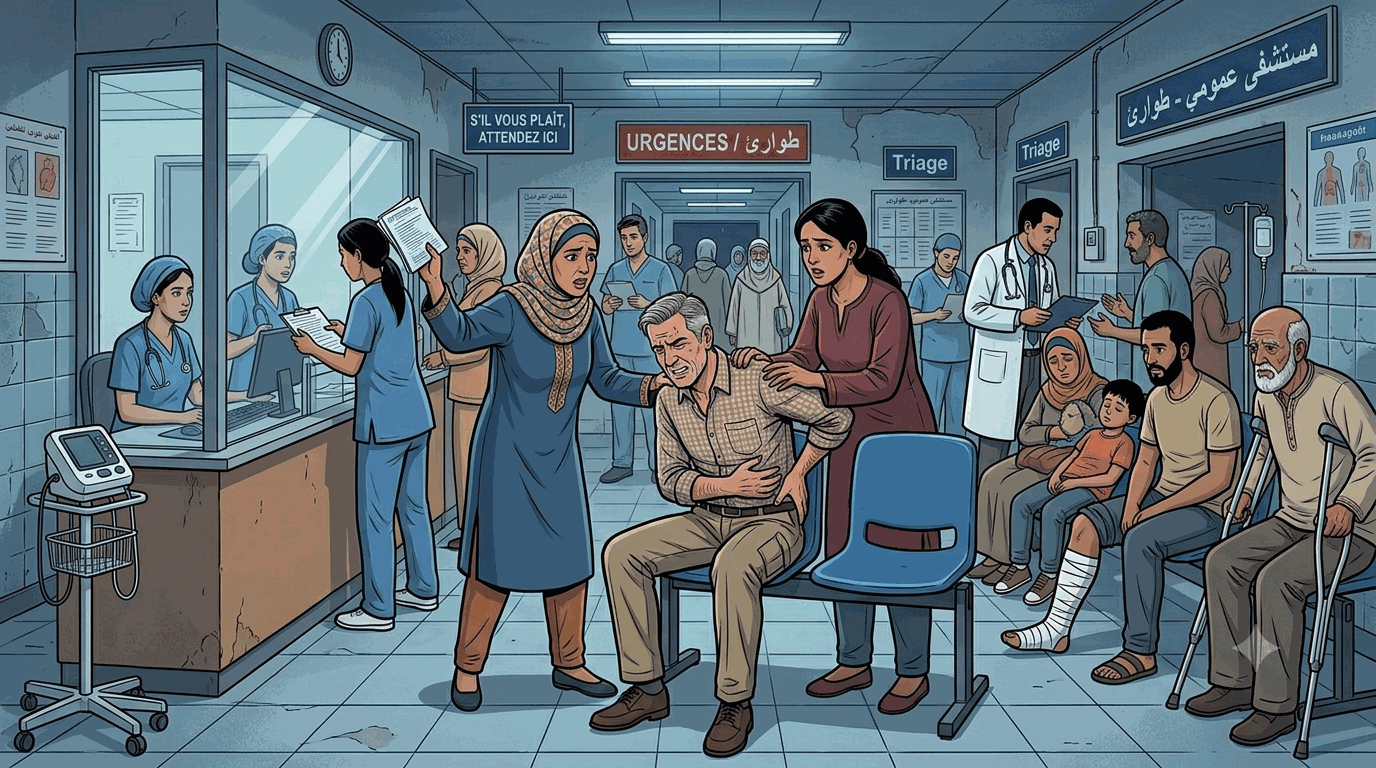
Imagen generada con Google Gemini Flash-Lite
🎧 Coloca el archivo audio/sda3_sesion5_story.mp3 junto a este HTML para que suene aquí.
That night, everything changed. Julio began vomiting uncontrollably, and within a couple
of hours his stomach was so swollen and painful that he could barely breathe. Itto and Zahra,
frightened, drove him straight to the emergency room at Khenifra hospital — but the scene that
greeted them was chaos. People with serious injuries sat waiting, unattended, and after an
hour nobody had even looked at Julio. Eventually, a stranger helped them find a taxi to a
private clinic, where a doctor gave him something for the pain and put him on a drip. He felt
a little calmer, but far from well.
By the next morning, it was clear the trip had to end. They dropped Ali Boukrim and Fátima
Aachouch back at Abderrahim's farm and set off for Spain, Julio pale and barely able to sit
still from the discomfort. That night, in Azrou, he needed a second emergency visit; the kind
owners of their rented flat drove him there themselves. He still couldn't sleep, pacing the
room instead, fighting for breath.
The next day, on the road towards Nador, they passed a small mountain viewpoint with a curious
name: Ito — almost the same as Itto's own name. Nobody laughed. From Nador, the ferry to
Almería took eight long hours, and as soon as they arrived, they drove straight to Hospital
Vírgen del Mar, where doctors admitted Julio directly into intensive care.
He spent three days in intensive care, then moved to a hospital room, hooked up to drips and
monitors, unable to eat. By the end of his first week in hospital, still weak but a little more
stable, he had an unexpected surprise: his cousin Mariquita, his ex-wife Laura, and his
daughter Marina all came to visit him, one after another, in his hospital room. After
everything that had happened over the summer, seeing them there, by his bed, meant more to him
than he could easily put into words.
Looking back, Julio believes it wasn't really the water, or the food, that had brought him so
low. He's convinced it was something deeper: months of accumulated work stress that had
quietly worn down his body, leaving it defenceless the moment something — anything — went
wrong.
Vocabulario y estructuras para describir una urgencia médica en pasado, incluyendo verbos de salud y frases típicas de una sala de urgencias.
Pulsa cada palabra para consultarla en WordReference.
1. symptom /ˈsɪmptəm/ — síntoma.
2. vomit (v.) /ˈvɒmɪt/ — vomitar.
3. dehydration /ˌdiːhaɪˈdreɪʃn/ — deshidratación.
4. swollen /ˈswəʊlən/ — hinchado/a.
5. anxiety /æŋˈzaɪəti/ — ansiedad.
6. emergency room /ɪˈmɜːdʒənsi ruːm/ — sala de urgencias.
7. drip (IV) /drɪp/ — gotero, suero.
8. intensive care unit /ɪnˈtensɪv keə ˈjuːnɪt/ — UCI.
9. kidney /ˈkɪdni/ — riñón.
10. private clinic /ˈpraɪvət ˈklɪnɪk/ — clínica privada.
11. public healthcare /ˈpʌblɪk ˈhelθkeə/ — sanidad pública.
12. medication /ˌmedɪˈkeɪʃn/ — medicación.
13. insurance /ɪnˈʃʊərəns/ — seguro (médico).
14. recover (v.) /rɪˈkʌvə/ — recuperarse.
15. grateful /ˈɡreɪtfl/ — agradecido/a.
¿Has vivido alguna vez una urgencia médica, propia o de alguien cercano? Cuéntalo con calma a tu compañero/a, usando pasado simple.
1. Escribe 3 frases sobre lo que hizo la familia esa noche en Khenifra.
2. Escribe una pregunta con "How long...?" sobre el trayecto de vuelta a España.
3. Reflexiona por escrito (3-4 frases): en tu opinión, ¿qué papel juega el estrés en la salud? No hay respuesta correcta ni incorrecta.
En España, un familiar mayor comenta que ha leído en una red social que "las UCIs son un negocio" y no quiere ir al médico. Un amigo marroquí, que no habla bien español, te pregunta qué piensa Julio sobre la medicina convencional y por qué, aun así, acabó en la UCI.
"Looking back, Julio believes it wasn't really the water, or the food, that had brought him so low. He's convinced it was something deeper: months of accumulated work stress. Even so, when things got serious, he went straight to hospital and trusted the doctors there."
Tarea: Explícaselo en español a tu amigo, sin traducir palabra por palabra, y añade tu propia opinión: ¿cómo se puede tener espíritu crítico con la información de salud sin dejar de acudir al médico cuando de verdad se necesita?
Iyeoka – Simply Falling (2010)
Escucha la canción y localiza los verbos en pasado. El título habla de "caer", sin más explicación — ¿por qué puede encajar con esta sesión?
Trabajo opcional para casa — Libro 4: 50 Selected AI Songs for A2
Youtou Tunes – Crazy Love
Escucha esta canción en casa y compárala con la de clase: ¿qué tipo de sentimiento transmite cada una?
Imagen generada con Google Gemini Flash-Lite
En grupos de tres, representad la llegada a las urgencias de Khenifra: uno es Julio, con dolor; los otros son Itto y Zahra, intentando conseguir ayuda en un ambiente caótico. Terminad la escena con la decisión de buscar una clínica privada.
SdA A2·3 · Clase 6
Repaso general del viaje a Ouaoumana
| Bloque | Min | Contenido |
|---|---|---|
| Warm-up | 5 | Recordatorio de la unidad |
| Review Fair (5 estaciones) | 45 | Roleplay por estaciones, repaso de las 5 sesiones |
| Review Language Lab | 25 | Quiz mixto de repaso (10 ítems) |
| Sing Along de cierre | 10 | Canción + resumen de la unidad |
| Despedida | 5 | Cierre y enlace con la SdA A2·4 |
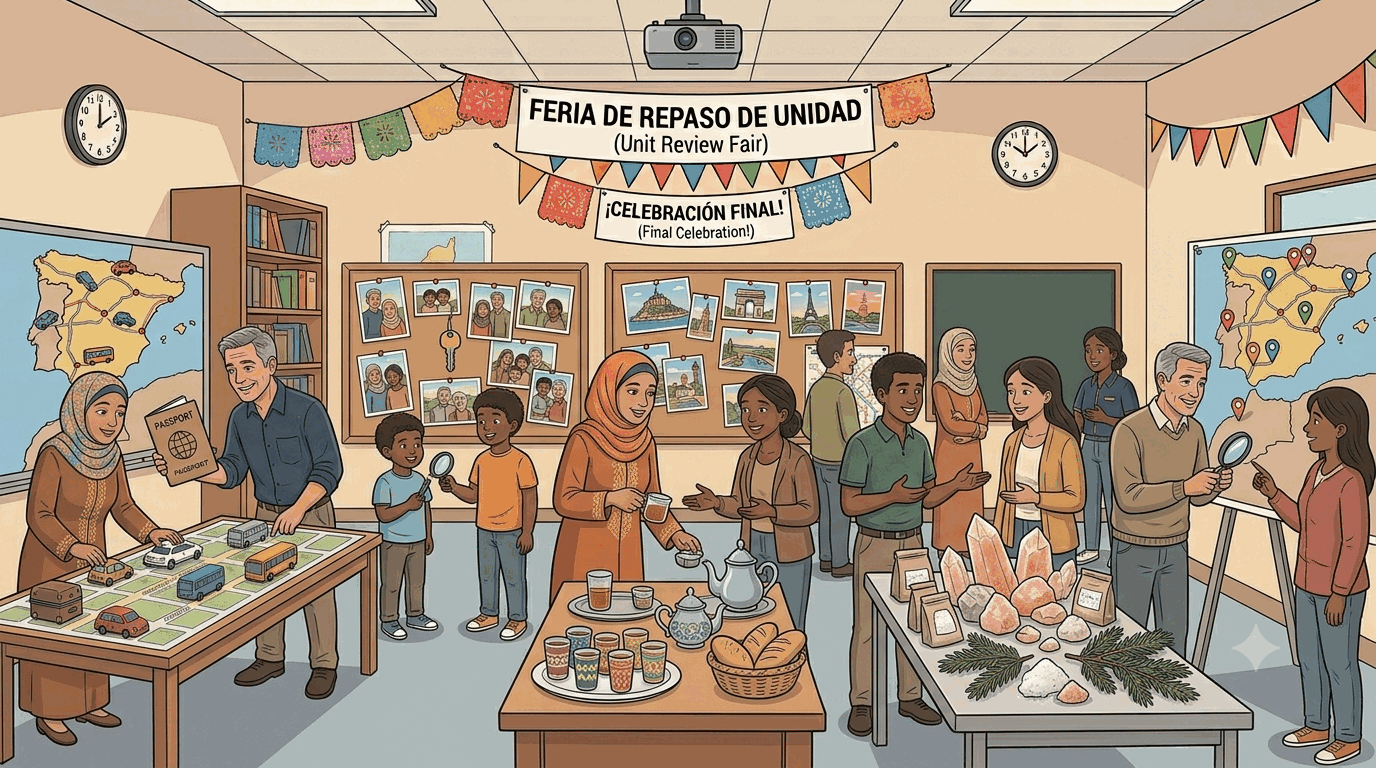
Imagen generada con Google Gemini Flash-Lite
La clase se organiza como una pequeña feria de repaso, con cinco estaciones montadas en
distintos puntos del aula:
Estación 1 — "Eleven Hours": una cola de coches de juguete y un pasaporte de
cartulina, para repasar el vocabulario de frontera y el pasado simple de la Sesión 1.
Estación 2 — "A Full House": fotos de familia y una llave de apartamento, para
repasar la Sesión 2.
Estación 3 — "Abderrahim's Farm": una manta y un vaso de té de cartulina, para
repasar la Sesión 3.
Estación 4 — "The Spring": un trozo de sal de roca y una foto del bosque de
cedros, para repasar la Sesión 4.
Estación 5 — "The Long Way Home": un mapa con el trayecto de vuelta, para repasar
la Sesión 5, con especial cuidado y respeto en el tono.
Los alumnos rotan en grupos pequeños por las cinco estaciones, improvisando una breve escena
de 2-3 minutos en cada una.
Repaso de pasado simple y continuo, y lenguaje de urgencia/salud, en los contextos de frontera, familia, vida rural, naturaleza y salud trabajados en la unidad.
J. J. Cale – Moma Don't (1994)
Como cierre de la unidad, comentad en gran grupo: de las cinco sesiones, ¿cuál os ha parecido más intensa? ¿Qué aprendisteis sobre las diferencias entre la sanidad pública y la privada?
Julio spent thirteen days in hospital in total — ten of them without eating anything at all. He would need weeks to recover physically, and there was still a difficult conversation waiting for him back at school, about the complaint he had filed just before the summer. That conversation, and everything that came with it, would become its own story.
Trabajo opcional para casa — Libro 4: 50 Selected AI Songs for A2
Bleeding Strings – I Walk Through Fire
Escucha esta canción en casa como cierre de la unidad, y guárdala en tu lista de canciones favoritas del curso.