
SEP Alkayasí · CEPER 500 Viviendas
SEP Alkayasí · CEPER 500 Viviendas
SdA A2·2 · Clase 1
La salida hacia el norte, Julio e Itto solos


| Bloque | Min | Contenido |
|---|---|---|
| Warm-up + Listening | 15 | Audio + T/F |
| Reading & comprensión | 20 | Lectura + preguntas |
| Language Lab | 20 | Pasado simple + 15 drills |
| Vocabulary Lab | 10 | 15 palabras nuevas |
| Production | 15 | Speaking + Writing |
| Mediation | 5 | Tarea de mediación |
| Sing Along + Roleplay | 5 | Canción + cierre |
Escucha el audio de la narración (sin leer el texto) y marca True (T) o False (F).
🎧 Coloca el archivo audio/sda2_sesion1_listening.mp3 junto a este HTML para que suene aquí.
1. Julio and Itto left Almería early in the morning. →
2. They stopped to sleep in Valencia. →
3. They only stopped once, for coffee and a sandwich. →
4. Saadia wasn't home when they arrived. →
5. They went straight to bed without eating. →
Julio de 2025, primer día de un viaje de diez
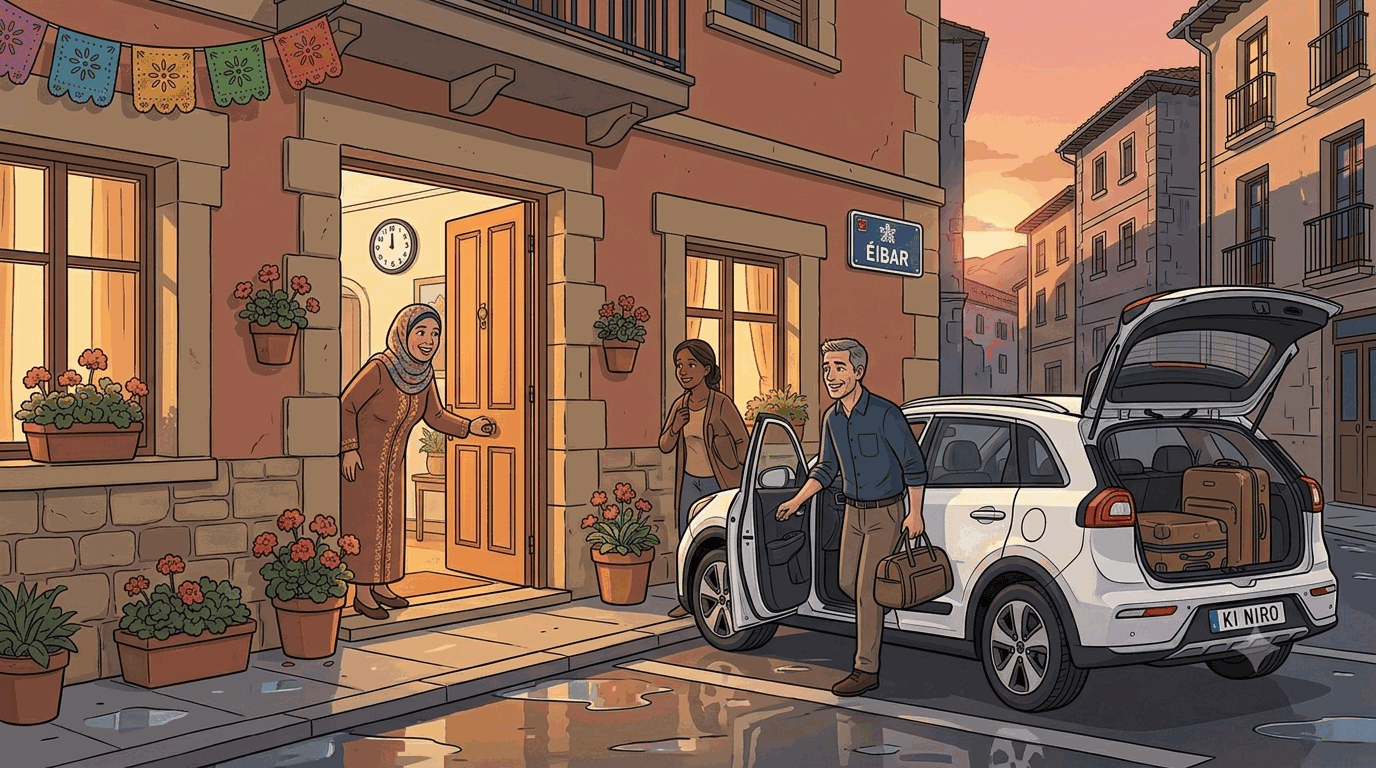
Imagen generada con Google Gemini Flash-Lite
🎧 Coloca el archivo audio/sda2_sesion1_story.mp3 junto a este HTML para que suene aquí.
Every summer, Julio and Itto planned a big trip, and this year's adventure was the
longest one yet: ten days on the road, all the way to Paris and back. They loaded the boot
of their Kia Niro with two suitcases, a cool box and Itto's small backpack, and at six in
the morning, while the city was still quiet, they left home.
The first day was long. They drove north for hours, through the flat plains and the busy
outskirts of Valencia, but this time they didn't stop to visit anyone. Only a few years
earlier, on a different trip, they had slept a night in Valencia and another in Badalona —
but this July, with ten days ahead of them, there wasn't time. They simply waved at the
cities as they passed and kept driving.
By the afternoon, both of them were exhausted. The motorway seemed endless, and the car felt
very hot every time they stopped. Around six o'clock, tired and hungry, they finally reached
Éibar, in the Basque Country. Saadia opened the door before they even knocked — she had
heard the car outside. She hugged them both tightly and said, in her calm voice, "You made
it! Now come in, dinner is ready."
That night, after a simple but delicious meal, Julio and Itto slept deeply. Tomorrow, the
real adventure would begin: crossing the border into France, with Saadia joining them for
the next part of the journey.
El pasado simple describe acciones terminadas en un momento concreto del pasado — perfecto para narrar un viaje. Los verbos regulares añaden -ed (they packed, they arrived); muchos verbos frecuentes son irregulares (drive→drove, leave→left, sleep→slept). Preguntas y negaciones se forman con did (Did they stop in Valencia? — No, they didn't.). Marcadores típicos: yesterday, last week, two years ago, in July...
Pulsa cada palabra para consultarla en WordReference.
1. motorway /ˈməʊtəweɪ/ — autovía, autopista.
2. service station /ˈsɜːvɪs ˌsteɪʃn/ — área de servicio.
3. boot (car) /buːt/ — maletero.
4. suitcase /ˈsuːtkeɪs/ — maleta.
5. route /ruːt/ — ruta, itinerario.
6. journey /ˈdʒɜːni/ — viaje, trayecto.
7. exhausted /ɪɡˈzɔːstɪd/ — agotado/a.
8. fill up (the tank) /fɪl ʌp/ — llenar (el depósito).
9. break (n.) /breɪk/ — parada, descanso.
10. hug /hʌɡ/ — abrazar, abrazo.
11. pack (v.) /pæk/ — hacer las maletas, cargar el coche.
12. plain (n.) /pleɪn/ — llanura.
13. outskirts /ˈaʊtskɜːts/ — afueras.
14. endless /ˈendləs/ — interminable.
15. tightly /ˈtaɪtli/ — fuerte, con fuerza (abrazar fuerte).
Cuéntale a tu compañero/a el mejor o el peor viaje en coche que recuerdes: ¿cuánto duró?, ¿qué llevabais?, ¿pasó algo especial por el camino?
1. Describe, en pasado simple, la salida de un viaje que hayas hecho alguna vez.
2. Escribe 3 frases sobre cómo te sentiste al final de un viaje largo.
3. Escribe una pregunta con "Did...?" sobre el viaje de otra persona.
Un vecino español que no habla inglés te pregunta por qué Julio e Itto no se quedaron a dormir en Valencia esta vez, si siempre lo hacían en otros viajes.
"This time, with ten days of travelling ahead of them, they didn't have time to stop and visit anyone on the way."
Tarea: Explícaselo en español a tu vecino, de forma clara y natural, sin traducir palabra por palabra.
Cat Stevens – Father and Son (1975)
Escucha la canción y localiza al menos dos verbos en pasado simple. ¿Qué sensación transmite sobre los viajes y las despedidas?
Trabajo opcional para casa — Libro 4: 50 Selected AI Songs for A2
EverHits – Still Fallin'
Escucha esta canción en casa y compárala con la de clase: ¿qué tipo de sentimiento transmite cada una?
Imagen generada con Google Gemini Flash-Lite
En parejas, representad la llegada a Éibar: una persona es Saadia, que recibe con cariño a los viajeros; la otra es Julio o Itto, contando cómo fue el primer día de viaje. Usad al menos 5 frases en pasado simple.
SdA A2·2 · Clase 2
De Éibar a Nantes, con Saadia y el reto de las carreteras francesas
| Bloque | Min | Contenido |
|---|---|---|
| Warm-up + Listening | 15 | Audio + T/F |
| Reading & comprensión | 20 | Lectura + preguntas |
| Language Lab | 20 | Pasado simple + continuo + 15 drills |
| Vocabulary Lab | 10 | 15 palabras nuevas |
| Production | 15 | Speaking + Writing |
| Mediation | 5 | Tarea de mediación |
| Sing Along + Roleplay | 5 | Canción + cierre |
Escucha el audio de la narración (sin leer el texto) y marca True (T) o False (F).
🎧 Coloca el archivo audio/sda2_sesion2_listening.mp3 junto a este HTML para que suene aquí.
1. Saadia crossed the border into France with Julio and Itto. →
2. Driving in France was easier than in Spain. →
3. Every village had exactly the same speed limit. →
4. They visited Mont Saint-Michel on the way to Nantes. →
5. They found out about the fines on the same day. →
Un día entero de carretera, de Éibar a Nantes
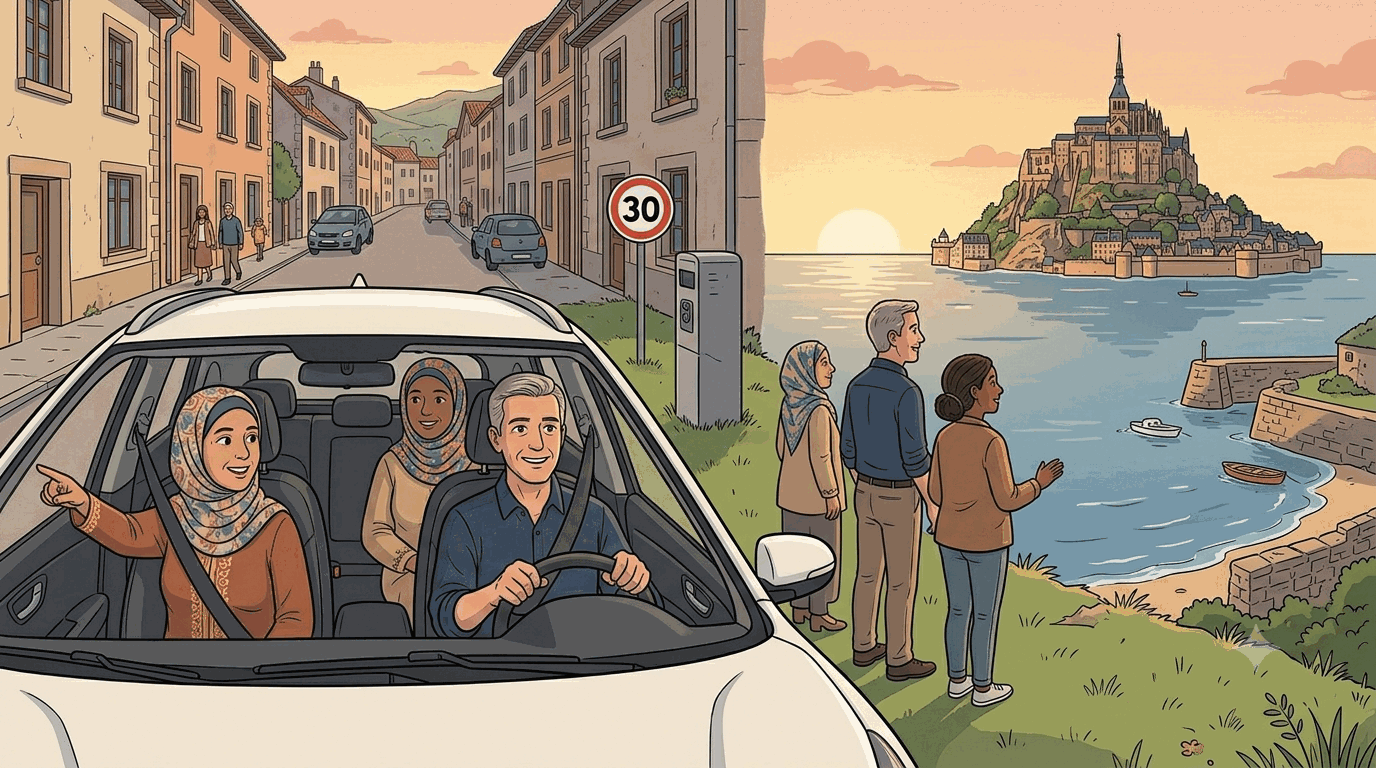
Imagen generada con Google Gemini Flash-Lite
🎧 Coloca el archivo audio/sda2_sesion2_story.mp3 junto a este HTML para que suene aquí.
As soon as they crossed the border, Julio realised that French roads were a different
world. The tarmac was often cracked and uneven, nothing like the smooth Spanish motorways he
was used to. Worse still, the speed limits changed constantly: seventy, then fifty, then
thirty, often with almost no warning. Every tiny village seemed to have its own built-up
area, with a painfully low limit and, very often, a hidden radar right at the entrance.
"Slow down, there's usually a camera near that sign," Saadia said, pointing at a small white
sign with a village name on it. She had made this journey before and knew the tricks. Julio
tried his best, but concentrating for hours, while also enjoying the beautiful countryside,
wasn't easy at all.
Around midday, they stopped at Mont Saint-Michel, and for a while they forgot all about
radars and speed limits. The famous abbey rose out of the sea like something from a fairy
tale, and the three of them walked slowly up the narrow streets, taking photos and admiring
the view of the bay.
Back in the car, they continued towards Nantes, where they were going to spend the night.
Julio was driving carefully, or so he thought. In fact, two hidden cameras had already caught
the white Kia Niro that day, flashing twice without anyone noticing. Nobody in the car knew
it yet — the unwelcome letters, with two French fines inside, wouldn't arrive in Almería
until a month later.
Cuando dos acciones pasadas se cruzan, usamos el pasado continuo (was/were + -ing) para la acción "de fondo", más larga, y el pasado simple para la acción que la interrumpe: While they were driving through the village, a hidden camera flashed. También se usa el pasado continuo para describir una escena en un momento concreto: At midday, they were walking around Mont Saint-Michel.
Pulsa cada palabra para consultarla en WordReference.
1. border /ˈbɔːdə/ — frontera.
2. tarmac /ˈtɑːmæk/ — asfalto.
3. speed limit /spiːd ˈlɪmɪt/ — límite de velocidad.
4. built-up area /bɪlt ʌp ˈeəriə/ — travesía urbana.
5. speed camera /ˈspiːd ˌkæmərə/ — radar.
6. fine (n.) /faɪn/ — multa.
7. warn /wɔːn/ — advertir.
8. abbey /ˈæbi/ — abadía.
9. tide /taɪd/ — marea.
10. narrow /ˈnærəʊ/ — estrecho/a.
11. countryside /ˈkʌntrisaɪd/ — campo, paisaje rural.
12. flash (v.) /flæʃ/ — destellar, hacer un flash.
13. unwelcome /ʌnˈwelkəm/ — inoportuno, no deseado.
14. post (n.) /pəʊst/ — correo postal.
15. concentrate /ˈkɒnsntreɪt/ — concentrarse.
Compara conducir en España y en otro país que conozcas o hayas oído comentar: ¿qué diferencias hay en los límites de velocidad, las señales o las carreteras?
1. Describe, en pasado simple, un día de carretera especialmente difícil o memorable.
2. Escribe 3 frases sobre algo inesperado que te pasó durante un viaje.
3. Escribe una pregunta con "Did...?" sobre la experiencia de otra persona conduciendo.
Un amigo español va a conducir por Francia por primera vez y te pregunta si es muy diferente a conducir aquí.
"The roads were often in worse condition, the speed limits changed constantly, and every village had a hidden radar."
Tarea: Explícaselo en español a tu amigo, de forma clara y natural, sin traducir palabra por palabra.
Chris De Burgh – Borderline (1999)
Escucha la canción y localiza algún verbo en pasado continuo. ¿Qué relación encuentras entre el título de la canción y el momento de la historia de hoy?
Trabajo opcional para casa — Libro 4: 50 Selected AI Songs for A2
Frank Stone – Midnight Sound
Escucha esta canción en casa y compárala con la de clase: ¿qué tipo de sentimiento transmite cada una?
Imagen generada con Google Gemini Flash-Lite
En grupos de tres, representad el momento en el coche cuando Saadia avisa a Julio de un radar oculto justo a tiempo (o demasiado tarde). Usad al menos una frase con pasado continuo interrumpido por pasado simple.
SdA A2·2 · Clase 3
El reencuentro con Majda, entre torres, avenidas y un río

| Bloque | Min | Contenido |
|---|---|---|
| Warm-up + Listening | 15 | Audio + T/F |
| Reading & comprensión | 20 | Lectura + preguntas |
| Language Lab | 20 | Pasado continuo + 15 drills |
| Vocabulary Lab | 10 | 15 palabras nuevas |
| Production | 15 | Speaking + Writing |
| Mediation | 5 | Tarea de mediación |
| Sing Along + Roleplay | 5 | Canción + cierre |
Escucha el audio de la narración (sin leer el texto) y marca True (T) o False (F).
🎧 Coloca el archivo audio/sda2_sesion3_listening.mp3 junto a este HTML para que suene aquí.
1. Majda met them at an airport. →
2. Majda and Itto hadn't seen each other for almost a year. →
3. Majda moved to Paris at the end of 2024. →
4. Majda had a stable, legal office job in France. →
5. Majda showed them her neighbourhood from the train window. →
Julio de 2025, días de vértigo en la capital francesa
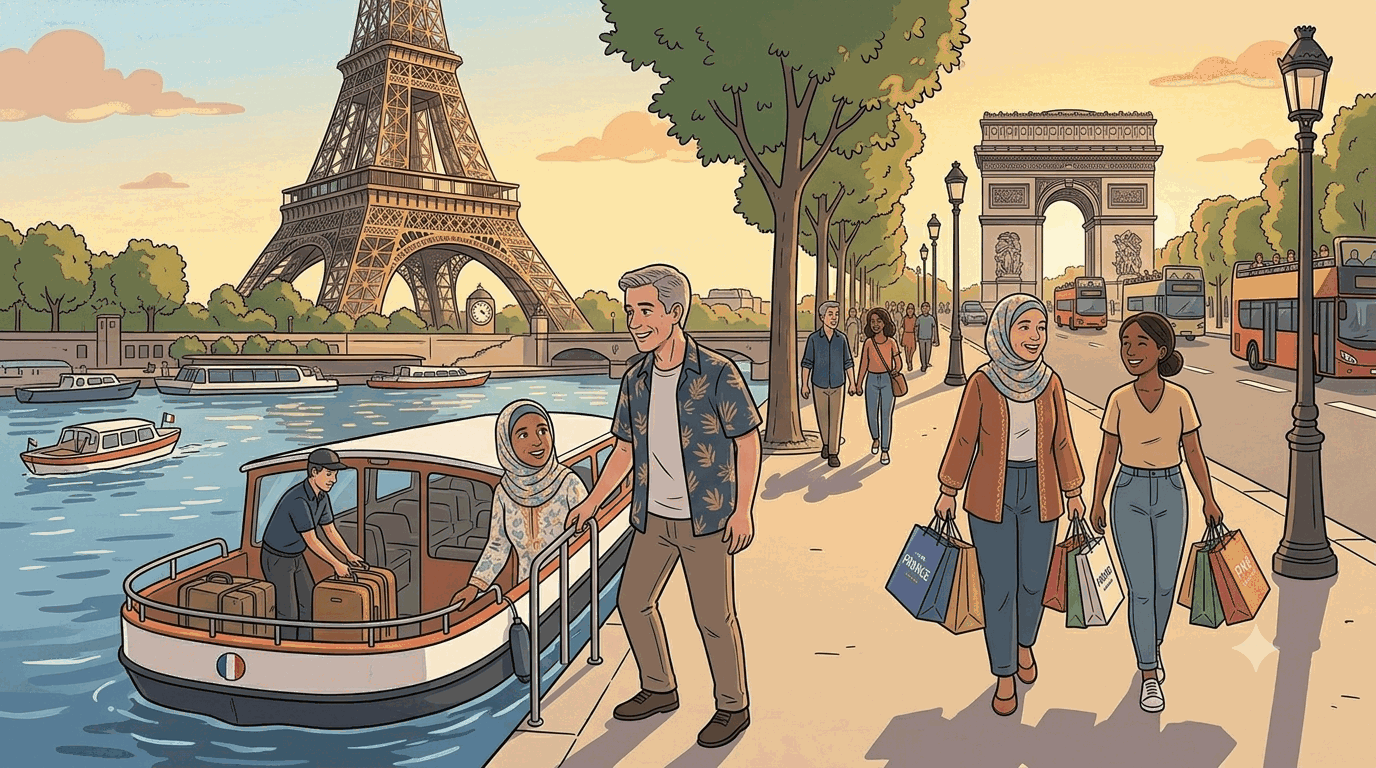
Imagen generada con Google Gemini Flash-Lite
🎧 Coloca el archivo audio/sda2_sesion3_story.mp3 junto a este HTML para que suene aquí.
For two and a half days, Paris became a whirlwind of trains, stairs and famous names.
Majda and Saadia, who got on brilliantly from the very first moment, quickly formed their
own little team, while Julio and Itto followed close behind, map in hand.
Every morning, they took the local train from the outskirts into the city centre, then
changed to the metro to reach each new landmark. They saw the Eiffel Tower up close, walked
under the enormous Arc de Triomphe, and climbed slowly up to the white basilica of
Sacré-Cœur, in Montmartre, where the whole city stretched out below them.
On the second afternoon, Julio suggested a boat trip along the Seine. Majda and Saadia
looked at each other and smiled. "You two go," Majda said. "We're going to walk around the
Champs-Élysées instead — we've seen enough water this morning!" So Julio and Itto enjoyed a
peaceful hour on the river, while Majda and Saadia wandered happily among the shop windows,
laughing about something only they understood.
They also lost an entire afternoon inside a huge shopping centre, more out of curiosity than
anything else, and walked so many kilometres that everyone's feet hurt by the evening. Still,
nobody complained. In the metro, tired but smiling, Itto squeezed her niece's hand. It had
been a long time since they had spent so much time together, and these two and a half days,
however short, felt like a real gift.
El pasado continuo es ideal para describir dos acciones que ocurren a la vez en el pasado, especialmente cuando un grupo se divide, como en esta sesión: While Julio and Itto were cruising along the Seine, Majda and Saadia were walking around the Champs-Élysées. Recordar la estructura: was/were + verbo-ing.
Pulsa cada palabra para consultarla en WordReference.
1. landmark /ˈlændmɑːk/ — monumento emblemático.
2. avenue /ˈævənjuː/ — avenida.
3. basilica /bəˈzɪlɪkə/ — basílica.
4. cruise (v./n.) /kruːz/ — navegar, crucero (por un río).
5. crowded /ˈkraʊdɪd/ — abarrotado, lleno de gente.
6. souvenir /ˌsuːvəˈnɪə/ — recuerdo (objeto).
7. queue /kjuː/ — cola (de gente).
8. view /vjuː/ — vista, panorámica.
9. commute (v.) /kəˈmjuːt/ — desplazarse a diario.
10. sightseeing /ˈsaɪtˌsiːɪŋ/ — hacer turismo.
11. independent /ˌɪndɪˈpendənt/ — independiente.
12. informally /ɪnˈfɔːməli/ — de manera informal.
13. squeeze (v.) /skwiːz/ — apretar (la mano).
14. shop window /ʃɒp ˈwɪndəʊ/ — escaparate.
15. gift (fig.) /ɡɪft/ — regalo (en sentido figurado).
Describe una ciudad que hayas visitado con alguien especial: ¿qué visitasteis?, ¿os separasteis en algún momento para hacer cosas distintas?
1. Describe tu día de turismo ideal en una ciudad que te gustaría visitar.
2. Escribe 3 frases sobre algo que estabas haciendo mientras otra persona hacía algo distinto.
3. Escribe una pregunta con "Were... -ing?" sobre las vacaciones de otra persona.
Una amiga tuya que no habla inglés quiere ir a París y te pregunta qué NO os podéis perder si solo tenéis dos días.
"They saw the Eiffel Tower up close, walked under the Arc de Triomphe, and climbed up to Sacré-Cœur, where the whole city stretched out below them."
Tarea: Explícaselo en español a tu amiga, de forma clara y natural, sin traducir palabra por palabra.
Chris Rea – Looking For The Summer (2006)
Escucha la canción y localiza algún verbo en pasado continuo. ¿Qué tiene que ver el título con un viaje de verano como este?
Trabajo opcional para casa — Libro 4: 50 Selected AI Songs for A2
Let Babylon Burn – Dark Rose
Escucha esta canción en casa y compárala con la de clase: ¿qué tipo de sentimiento transmite cada una?
Imagen generada con Google Gemini Flash-Lite
En grupos de cuatro, representad el reencuentro por la noche en el piso de Majda: dos personas cuentan cómo fue el paseo en barco y las otras dos cuentan qué hicieron por los Campos Elíseos. Usad pasado continuo para describir lo que estaba haciendo cada pareja.
SdA A2·2 · Clase 4
Poitiers, los castillos del Loira y la historia de Saadia
| Bloque | Min | Contenido |
|---|---|---|
| Warm-up + Listening | 15 | Audio + T/F |
| Reading & comprensión | 20 | Lectura + preguntas |
| Language Lab | 20 | Pasado simple + continuo + 15 drills |
| Vocabulary Lab | 10 | 15 palabras nuevas |
| Production | 15 | Speaking + Writing |
| Mediation | 5 | Tarea de mediación |
| Sing Along + Roleplay | 5 | Canción + cierre |
Escucha el audio de la narración (sin leer el texto) y marca True (T) o False (F).
🎧 Coloca el archivo audio/sda2_sesion4_listening.mp3 junto a este HTML para que suene aquí.
1. They said goodbye to Majda at a station. →
2. They visited three castles in the Loire Valley. →
3. Saadia stayed silent during the whole drive back. →
4. Saadia has lived in the Basque Country for thirteen years. →
5. Saadia never talked about her own life during the trip. →
El largo trayecto de vuelta a Éibar

Imagen generada con Google Gemini Flash-Lite
🎧 Coloca el archivo audio/sda2_sesion4_story.mp3 junto a este HTML para que suene aquí.
On the long drive from the Loire Valley to Éibar, with the French countryside rolling
past the windows, Saadia finally opened up about her own story. Itto had heard parts of it
before, but never all together, and she listened closely, holding her aunt's hand from the
back seat.
Saadia had been married once, many years ago, but the marriage hadn't worked out, and the
couple had eventually divorced. Even so, she still spoke to her ex-husband from time to
time, and occasionally sent him a little money when things were hard for him. That was
simply who Saadia was: generous almost to a fault.
For years, she had supported her parents and her brothers and sisters in Morocco, sending
money whenever she could, and she still did the same for Itto, from a distance, with small
gifts and thoughtful surprises. "You've always looked after me," Itto said quietly. "Even
from here."
The "family troubles" she mentioned had a name: El Houssaine, her brother. Everybody loved
him — their father especially, who adored him despite years of disappointment — because he
had a good heart and a warm character. But he had also struggled with alcohol for as long as
anyone could remember, and it kept bringing trouble. Saadia, who worked as a translator at
the port in those days, had to speak to the police on his behalf again and again, until it
became too much. Itto, listening from the back seat, understood better than anyone: for her,
drinking is haram, something her faith clearly forbids, and she has never had much patience
for it. Still, nobody in the family had ever stopped loving El Houssaine — they simply
learned to love him from a careful distance.
Saadia had eventually left her old job, packed a suitcase, and moved to Éibar thirteen years
earlier, where she found work cleaning houses. "I'm happy here," she said simply, watching
the green hills go by. "That's enough for me."
Julio, driving quietly, caught Itto's eye in the mirror. Some stories, he thought, didn't
need many words to be understood.
Para contar una biografía usamos sobre todo pasado simple (she married, she moved); el pasado continuo aparece cuando queremos "enmarcar" la escena en la que se cuenta esa historia (As they were driving back, Saadia started to talk...).
Pulsa cada palabra para consultarla en WordReference.
1. divorce (v./n.) /dɪˈvɔːs/ — divorciarse, divorcio.
2. translator /trænsˈleɪtə/ — traductor/a.
3. support (v.) /səˈpɔːt/ — apoyar, mantener económicamente.
4. generous /ˈdʒenərəs/ — generoso/a.
5. occasionally /əˈkeɪʒnəli/ — de vez en cuando.
6. distance /ˈdɪstəns/ — distancia.
7. thoughtful /ˈθɔːtfl/ — atento, considerado.
8. alcohol /ˈælkəhɒl/ — alcohol.
9. troubles (n. pl.) /ˈtrʌblz/ — problemas, dificultades.
10. cleaner (job) /ˈkliːnə/ — persona que limpia (oficio).
11. choice /tʃɔɪs/ — elección, decisión.
12. forbid /fəˈbɪd/ — prohibir.
13. quietly /ˈkwaɪətli/ — en silencio, tranquilamente.
14. hold someone's hand /həʊld hænd/ — coger la mano de alguien.
15. strength /streŋθ/ — fortaleza, fuerza (de carácter).
Habla de alguien de tu familia que te haya apoyado mucho a lo largo de los años: ¿qué hizo por ti?, ¿cómo se lo agradeces?
1. Escribe un párrafo breve sobre la historia de vida de un familiar (real o inventado).
2. Escribe 3 frases sobre una decisión difícil que alguien haya tomado alguna vez.
3. Escribe una pregunta con "Did...?" sobre el pasado de otra persona.
Alguien que solo sabe que "Saadia tuvo problemas familiares" te pregunta, en español, por qué se marchó de Almería.
"Her brother's problems with alcohol had brought a lot of trouble for years, so she left her old job, packed a suitcase, and moved to Éibar to start again."
Tarea: Explícaselo en español de forma clara, breve y respetuosa, sin dar más detalles de los necesarios.
Deep Purple – Child in Time (1970)
Escucha (un fragmento de) la canción y localiza algún verbo en pasado simple. Comentad en clase, con respeto: ¿por qué a veces cuesta hablar de las etapas difíciles de la vida?
Trabajo opcional para casa — Libro 4: 50 Selected AI Songs for A2
Melodyspot – Eternal Memory
Escucha esta canción en casa y compárala con la de clase: ¿qué tipo de sentimiento transmite cada una?
Imagen generada con Google Gemini Flash-Lite
En parejas, representad la despedida en la puerta de casa de Saadia en Éibar: una persona es Saadia, agradeciendo el viaje juntos; la otra es Itto o Julio, dándole las gracias por todo lo compartido. Usad al menos 5 frases en pasado simple.
SdA A2·2 · Clase 5
Toledo, el último tramo y la llegada a casa
| Bloque | Min | Contenido |
|---|---|---|
| Warm-up + Listening | 15 | Audio + T/F |
| Reading & comprensión | 20 | Lectura + preguntas |
| Language Lab | 20 | Pasado simple + continuo + 15 drills |
| Vocabulary Lab | 10 | 15 palabras nuevas |
| Production | 15 | Speaking + Writing |
| Mediation | 5 | Tarea de mediación |
| Sing Along + Roleplay | 5 | Canción + cierre |
Escucha el audio de la narración (sin leer el texto) y marca True (T) o False (F).
🎧 Coloca el archivo audio/sda2_sesion5_listening.mp3 junto a este HTML para que suene aquí.
1. Saadia said a quick, simple goodbye. →
2. Itto had visited Toledo many times before. →
3. They arrived home exactly on Itto's birthday. →
4. Nobody was waiting for them when they got home. →
5. The whole trip lasted about two weeks. →
El último tramo, de Éibar a Almería
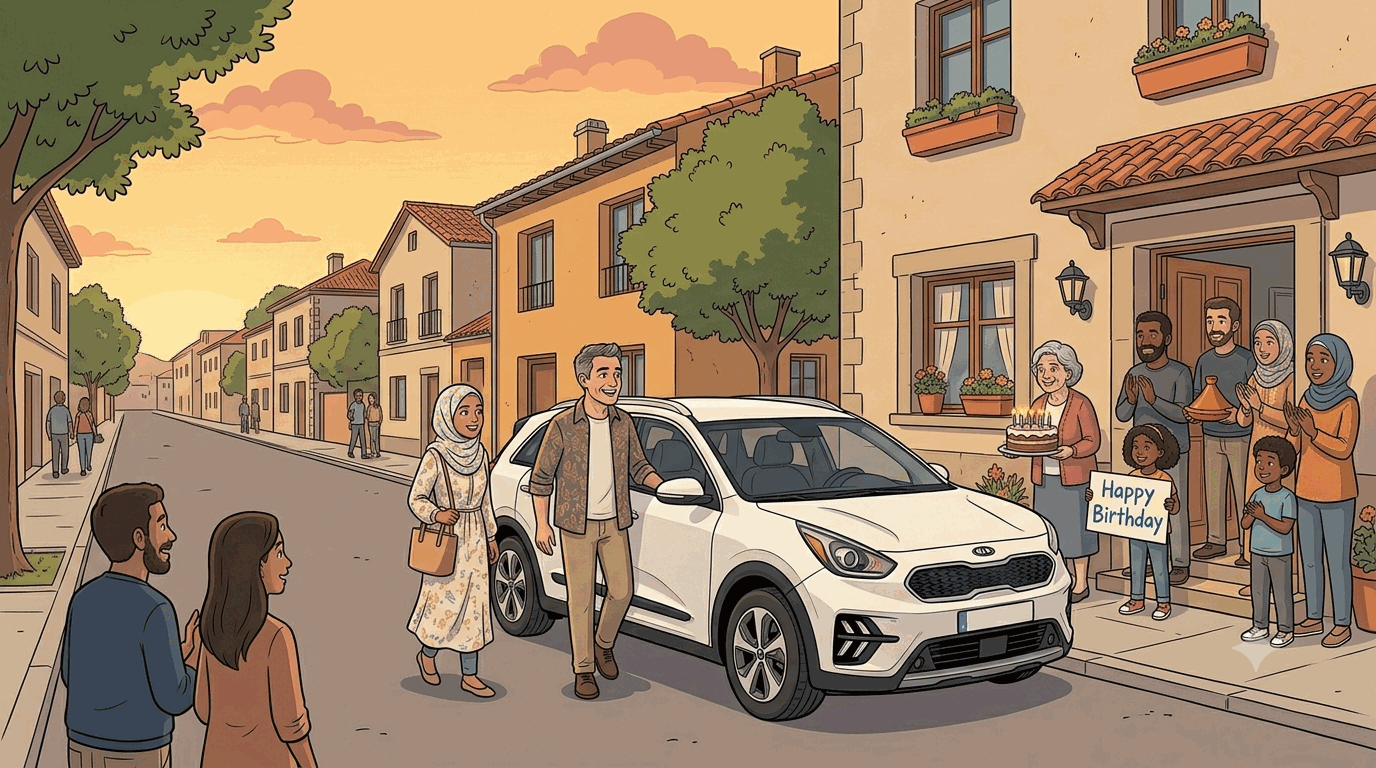
Imagen generada con Google Gemini Flash-Lite
🎧 Coloca el archivo audio/sda2_sesion5_story.mp3 junto a este HTML para que suene aquí.
Leaving Éibar felt strange. After so many days together, the car seemed quieter without
Saadia's calm voice giving directions and warning about hidden radars. Itto looked back at
the house until it disappeared behind them, and Julio squeezed her hand without saying
anything.
They drove south for most of the day and stopped for the night in Toledo, a city neither of
them had visited properly before. In the golden evening light, they walked slowly through
the narrow medieval streets, admired the cathedral, and ate a simple dinner on a small
terrace overlooking the river. For a few hours, tired as they were, they almost forgot they
were still on a journey — it felt more like a quiet, unexpected holiday.
The next morning, they woke up early, ready for the final stretch. The closer they got to
Almería, the more excited Itto became. She recognised every landmark: the last motorway
junction, the dry hills, the first palm trees. When they finally turned onto their own
street, in the early evening of the 25th of July, they found a small surprise waiting for
them: several neighbours stood outside the house with a cake and a hand-painted sign that
read "Happy Birthday, Itto!"
Itto laughed and cried at the same time. Ten days, thousands of kilometres, one border
crossed twice, two French fines still on their way, and a lifetime of memories — and now,
finally, home. Julio put his arm around her and smiled. "Best birthday present I could give
you," he said. "A safe trip back."
Repaso combinado de ambos tiempos para cerrar la historia del viaje: pasado simple para los hechos (they arrived, they stopped) y pasado continuo para el ambiente y las acciones en curso (several neighbours were waiting).
Pulsa cada palabra para consultarla en WordReference.
1. unpack /ʌnˈpæk/ — deshacer las maletas.
2. medieval /ˌmediˈiːvl/ — medieval.
3. terrace /ˈterəs/ — terraza.
4. junction /ˈdʒʌŋkʃn/ — cruce, salida (de autopista).
5. stretch (the final stretch) /stretʃ/ — tramo.
6. sign (n.) /saɪn/ — cartel, letrero.
7. surprise (n.) /səˈpraɪz/ — sorpresa.
8. doorstep /ˈdɔːstep/ — puerta de casa, umbral.
9. golden /ˈɡəʊldən/ — dorado/a.
10. palm tree /pɑːm triː/ — palmera.
11. memory /ˈmeməri/ — recuerdo (mental).
12. safe /seɪf/ — seguro/a, sin peligro.
13. hand-painted /hænd ˈpeɪntɪd/ — pintado a mano.
14. excited /ɪkˈsaɪtɪd/ — emocionado/a.
15. arm /ɑːm/ — brazo.
Cuenta cómo te sientes al volver a casa después de un viaje largo: ¿qué es lo primero que haces?, ¿qué es lo que más echas de menos?
1. Escribe una entrada de diario sobre el último día de un viaje.
2. Escribe 3 frases sobre una sorpresa que te hayan preparado alguna vez.
3. Escribe una pregunta con "Were... -ing?" sobre el momento de la llegada a casa.
Un vecino que no habla inglés te pregunta por qué había una tarta y un cartel delante de la casa de Julio e Itto ese día.
"They arrived home in the early evening of the 25th of July — Itto's birthday — and their neighbours were waiting outside with a small cake and a sign."
Tarea: Explícaselo en español a tu vecino, de forma clara y natural, sin traducir palabra por palabra.
Dire Straits – Telegraph Road (1982)
Escucha (un fragmento de) la canción y localiza algún verbo en pasado simple. ¿Qué tiene que ver una canción sobre una larga carretera con el final de esta unidad?
Trabajo opcional para casa — Libro 4: 50 Selected AI Songs for A2
Morgan Luna – I Won't Cry for You
Escucha esta canción en casa y compárala con la de clase: ¿qué tipo de sentimiento transmite cada una?
Imagen generada con Google Gemini Flash-Lite
En grupos pequeños, representad la llegada a casa: unos son los vecinos con la tarta, otros son Julio e Itto, sorprendidos y agradecidos. Usad pasado simple y pasado continuo para describir el momento.
SdA A2·2 · Clase 6
Repaso general del viaje, de Almería a Almería
| Bloque | Min | Contenido |
|---|---|---|
| Warm-up | 5 | Recordatorio de la unidad |
| Review Fair (5 estaciones) | 45 | Roleplay por estaciones, repaso de las 5 sesiones |
| Review Language Lab | 25 | Quiz mixto pasado simple/continuo (10 ítems) |
| Sing Along de cierre | 10 | Canción + resumen de la unidad |
| Despedida | 5 | Cierre y enlace con la SdA A2·3 |
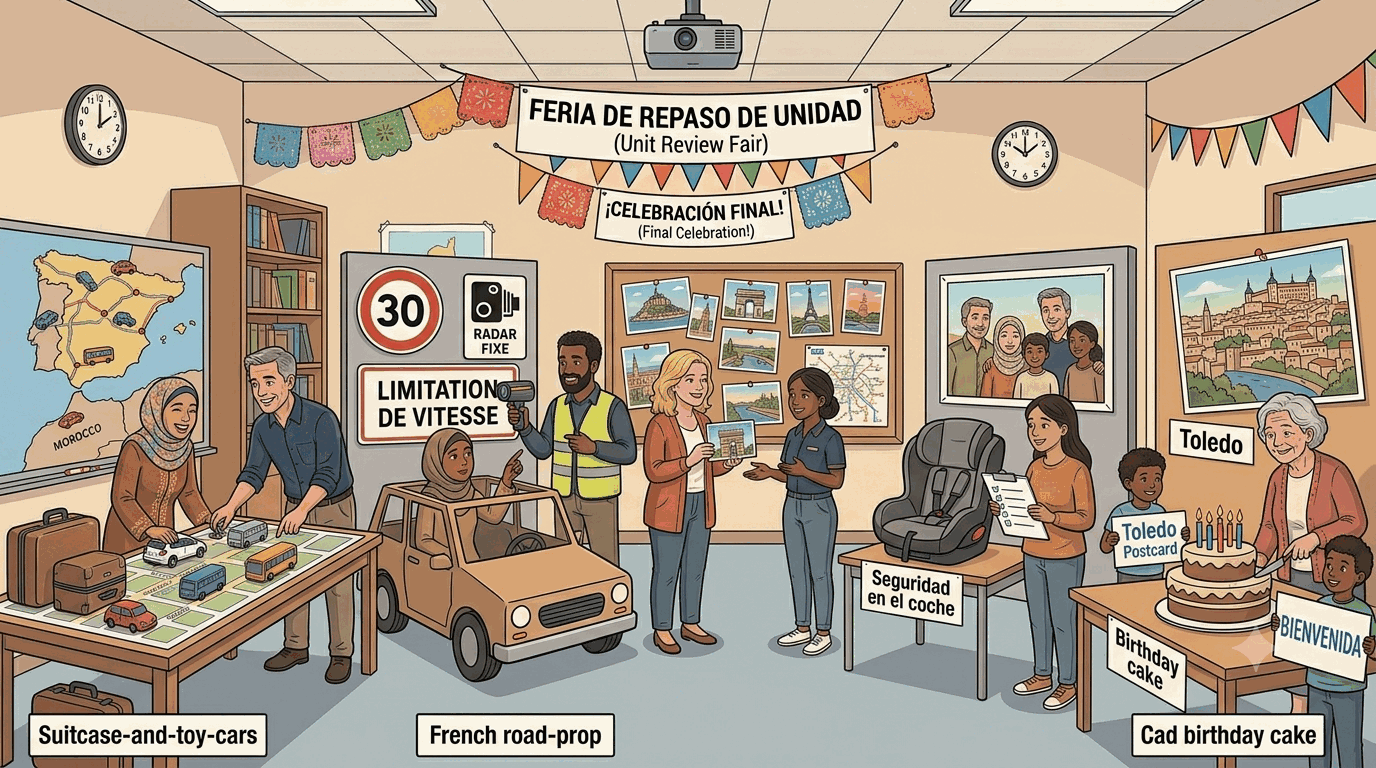
Imagen generada con Google Gemini Flash-Lite
La clase se organiza como una pequeña feria de repaso, con cinco estaciones montadas en
distintos puntos del aula, recordando las escenas trabajadas en la unidad:
Estación 1 — "Packing the Car": una maleta, un mapa y un cochecito de juguete
blanco, para repasar el vocabulario de viaje y el pasado simple de la Sesión 1.
Estación 2 — "French Radars": carteles de señales de tráfico y un radar de
cartón, para repasar vocabulario de carretera y pasado continuo de la Sesión 2.
Estación 3 — "Paris in a Day": postales de la Torre Eiffel, el Arco del
Triunfo y Montmartre, y un plano del metro, para repasar la Sesión 3.
Estación 4 — "Saadia's Road": una foto de familia y un pequeño mapa del Loira,
para repasar la Sesión 4.
Estación 5 — "Coming Home": una tarta de cartulina y una postal de Toledo,
para repasar la Sesión 5.
Los alumnos rotan en grupos pequeños por las cinco estaciones, y en cada una improvisan una
breve escena de 2-3 minutos usando el vocabulario y la gramática de esa sesión, con la ayuda
de una tarjeta de apoyo que resume las estructuras clave.
Repaso de pasado simple (hechos y biografía) y pasado continuo (acciones paralelas y de fondo), en los contextos de viaje, carretera, turismo y familia trabajados en la unidad.
Elton John – Sorry Seems To Be The Hardest Word (2002)
Como cierre de la unidad, comentad en gran grupo: ¿qué es lo que más os ha gustado de este viaje? ¿Qué frase en pasado simple o continuo resumiría mejor cada sesión?
Only a month later, in late August, Julio and Itto set off again — this time to Morocco, to visit Itto's parents in Ouaoumana. But that journey would turn out to be very different from this one.
Trabajo opcional para casa — Libro 4: 50 Selected AI Songs for A2
Rainy Dog Blues Radio – Memory Remains
Escucha esta canción en casa como cierre de la unidad, y guárdala en tu lista de canciones favoritas del curso.