
SEP Alkayasí · CEPER 500 Viviendas
A2 · SdA 1 — Cocina, estudios y amistad
←
A2·2 →
SEP Alkayasí · CEPER 500 Viviendas
SdA A2·1 · Clase 1
Itto empieza la FP de Cocina y conoce a Trini



| Bloque | Min | Contenido |
|---|---|---|
| Warm-up + Listening | 15 | Audio + V/F |
| Reading & comprensión | 20 | Lectura + preguntas |
| Language Lab | 20 | Presente simple + 15 drills |
| Vocabulary Lab | 10 | 15 palabras nuevas |
| Production | 15 | Speaking + Writing |
| Mediation | 5 | Tarea de mediación |
| Sing Along + Roleplay | 5 | Canción + cierre |
Escucha el audio de la narración (sin leer el texto) y marca True (T) o False (F).
🎧 Coloca el archivo audio/sda1_sesion1_listening.mp3 junto a este HTML para que suene aquí.
1. Julio drives Itto and Martha to the IES Almeraya. →
2. Trini usually arrives early because she doesn't work. →
3. The vocational course starts at half past four. →
4. Julio goes straight home after dropping the students off. →
5. Itto is happy with her new course and her new friend. →
Septiembre de 2024, primer día de curso en el IES Almeraya
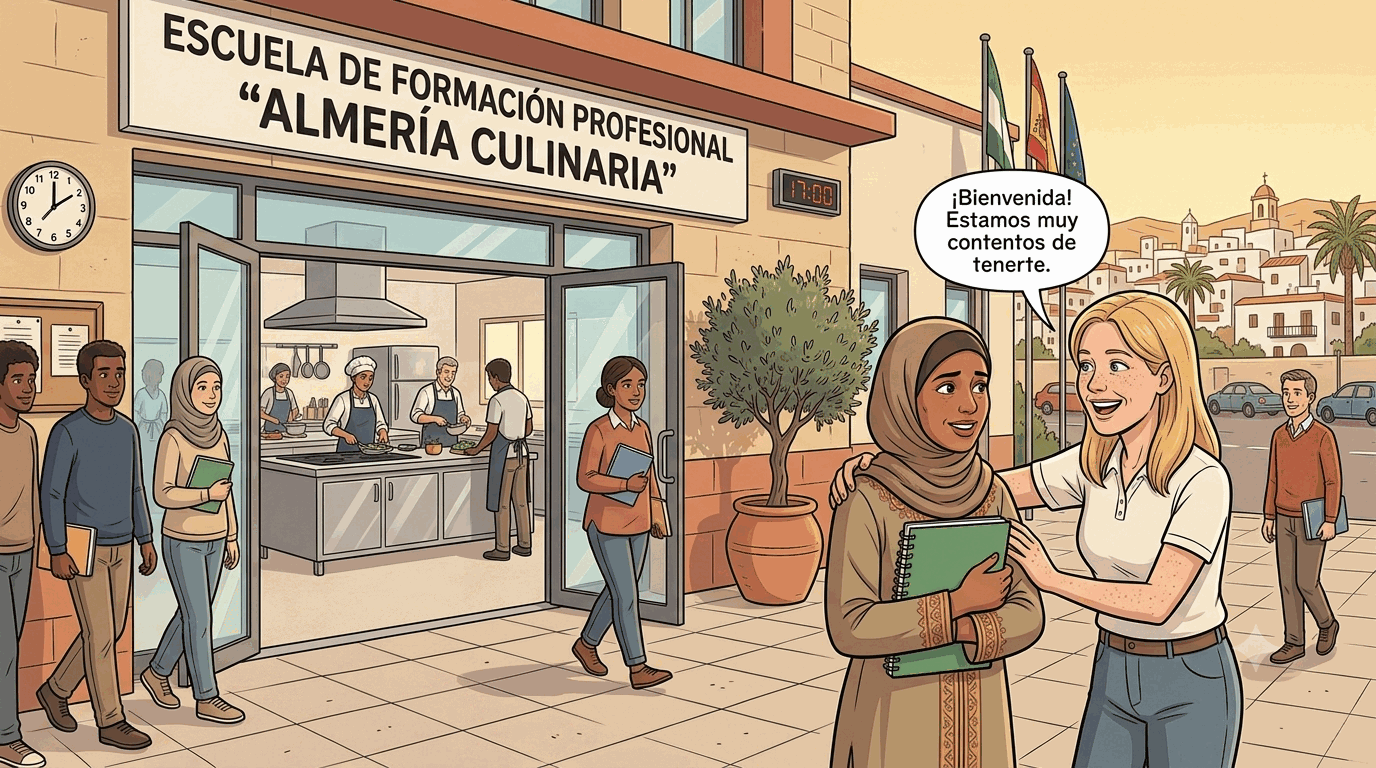
Imagen generada con Google Gemini Flash-Lite
🎧 Coloca el archivo audio/sda1_sesion1_story.mp3 junto a este HTML para que suene aquí.
In September 2024, Itto starts a new adventure. She enrols on a Vocational Training
course in Cooking and Gastronomy at the IES Almeraya, a school on the other side of
Almería. On the first day, she feels a little nervous, but everything changes when she
meets Trini.
Trini isn't a stranger. She was Julio's student for three years, and last year she also
joined his TAE-EOI group, the special English class for people who study at the Official
School of Languages. Trini works as a librarian at the University of Almería, and she has
done that job for twenty years. Now, at fifty-five, she starts a completely new adventure
too: she wants to be a professional cook.
The two women quickly become good friends. They sit together in every class, they share
their books, and they help each other with the new vocabulary. Because Itto doesn't drive,
and Trini's schedule at the library is very tight, Julio usually gives Itto a lift to the
school, together with another classmate, Martha. Then he rushes back across the city for
his own class.
It's a busy timetable for everyone, but a happy one. Itto discovers that she loves the
kitchen workshop, the smell of fresh ingredients, and the friendly atmosphere of the
classroom. Trini, with her calm and cheerful character, becomes the perfect study partner.
Their friendship, born in an English classroom years before, now grows in a very different
place: between pots, pans, and new recipes.
El presente simple describe rutinas, horarios y hechos generales — exactamente la vida de Itto, Trini y Julio los martes y jueves. Recordar: 3ª persona singular (she/he/it) añade -s/-es al verbo (she works, she finishes); las preguntas y negaciones se forman con do/does (Does Trini drive to school? — No, she doesn't.). Marcadores típicos: every day, usually, always, on Tuesdays...
Pulsa cada palabra para consultarla en WordReference.
1. timetable /ˈtaɪmˌteɪbl/ — horario.
2. classmate /ˈklɑːsˌmeɪt/ — compañero/a de clase.
3. librarian /laɪˈbreəriən/ — bibliotecario/a.
4. library /ˈlaɪbrəri/ — biblioteca.
5. course /kɔːs/ — curso (de estudios).
6. vocational /vəʊˈkeɪʃənəl/ — de formación profesional.
7. term /tɜːm/ — trimestre.
8. enrol /ɪnˈrəʊl/ — matricularse.
9. workshop /ˈwɜːkʃɒp/ — taller.
10. apron /ˈeɪprən/ — delantal.
11. tight /taɪt/ — ajustado, justo (de tiempo).
12. lift (give sb a lift) /lɪft/ — llevar a alguien en coche.
13. shift /ʃɪft/ — turno (de trabajo).
14. rush /rʌʃ/ — correr, darse prisa.
15. friendly /ˈfrendli/ — amistoso, simpático.
Cuéntale a tu compañero/a tu horario semanal: ¿a qué hora empiezas y terminas tus actividades más importantes? ¿Alguien te ayuda a desplazarte, como Julio ayuda a Itto?
1. Describe tu propio horario de un día normal, usando presente simple.
2. Escribe 3 frases sobre un amigo o amiga que te ayuda con algo, como Trini ayuda a Itto.
3. Escribe una frase con "Does...?" preguntando sobre el horario de otra persona.
Un amigo español que no habla inglés quiere saber qué días y a qué hora tiene clase Itto, porque quiere invitarla a tomar un café.
"The course starts at half past three, three days a week, and it usually finishes at half past seven."
Tarea: Explícaselo en español a tu amigo, de forma clara y natural, sin traducir palabra por palabra.
Abba – Dancing Queen (1976)
Escucha la canción y localiza tres verbos en presente simple. Coméntalos con tu compañero/a: ¿qué rutina o hábito describen?
Trabajo opcional para casa — Libro 4: 50 Selected AI Songs for A2
Raselhits – Withering Hour
Escucha esta versión alternativa en casa y compárala con la canción trabajada en clase: ¿qué tipo de sentimiento transmite cada una?
Imagen generada con Google Gemini Flash-Lite
En parejas, representad la escena del primer día de clase: una persona es Itto, nerviosa por ser su primer día; la otra es Trini, que la recibe con simpatía y le explica cómo funciona el horario del curso. Usad al menos 5 frases en presente simple.
SdA A2·1 · Clase 2
Un día cualquiera en el taller de cocina
| Bloque | Min | Contenido |
|---|---|---|
| Warm-up + Listening | 15 | Audio + V/F |
| Reading & comprensión | 20 | Lectura + preguntas |
| Language Lab | 20 | Presente continuo + 15 drills |
| Vocabulary Lab | 10 | 15 palabras nuevas |
| Production | 15 | Speaking + Writing |
| Mediation | 5 | Tarea de mediación |
| Sing Along + Roleplay | 5 | Canción + cierre |
Escucha el audio de la narración (sin leer el texto) y marca True (T) o False (F).
🎧 Coloca el archivo audio/sda1_sesion2_listening.mp3 junto a este HTML para que suene aquí.
1. The students are cooking a traditional Spanish dish today. →
2. Itto is washing dishes at her station. →
3. Trini is stirring a pan of rice. →
4. The teacher is sitting down and reading a book. →
5. Itto is smiling because she is going to taste the dish soon. →
Una clase práctica en octubre de 2024
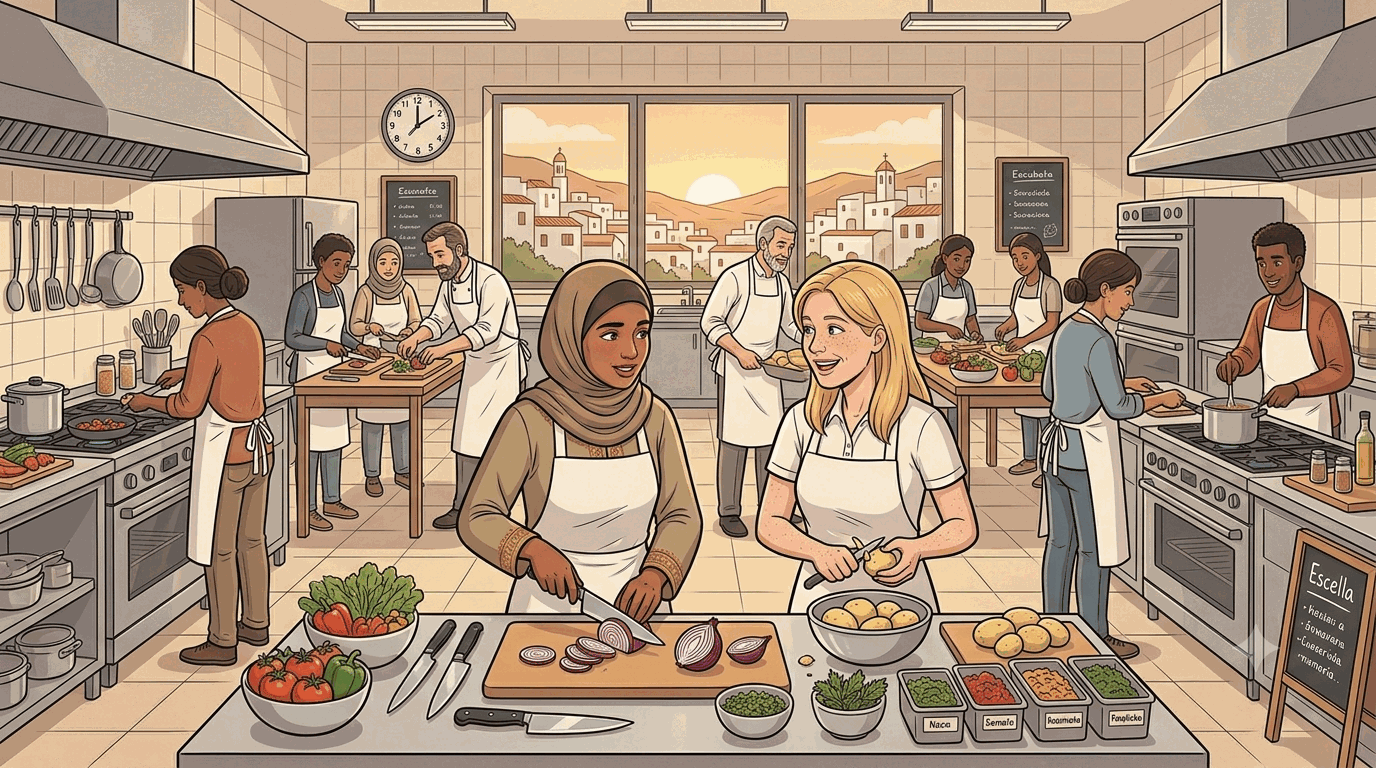
Imagen generada con Google Gemini Flash-Lite
🎧 Coloca el archivo audio/sda1_sesion2_story.mp3 junto a este HTML para que suene aquí.
This afternoon, the kitchen workshop at the IES Almeraya looks like a small, busy
restaurant. Twelve students, all wearing white aprons, are working around four large
tables. The teacher, Chef Ana, is explaining today's recipe: a simple Andalusian stew with
fresh vegetables and chickpeas.
Itto is standing at her station with Trini. She is holding a knife carefully, and she is
chopping an onion into small pieces. It's not easy for her — she is still learning
the correct technique — but she is trying hard. Trini, who is more confident with
knives after twenty years of cutting through paperwork at the library, is peeling potatoes
quickly and telling Itto a funny story at the same time.
Around them, other classmates are boiling water, measuring ingredients, and checking their
recipe cards. One student is frying garlic in a pan, and the smell is filling the whole
room. Chef Ana is moving from table to table, correcting a grip here, suggesting a little
more salt there. She never shouts. She just watches, and she explains again, patiently.
Itto looks at Trini and smiles. "I'm not chopping very well," she says, "but I'm having
a wonderful time." Trini laughs and agrees. Neither of them imagined, a year ago, that
they would be standing in a kitchen together, learning to become cooks. But here they are,
both a little messy, both completely happy.
El presente continuo (be + verbo-ing) describe acciones que están pasando ahora mismo, en el momento de hablar — perfecto para describir la actividad del taller de cocina. Recordar la forma: am/is/are + verbo-ing (She is chopping an onion). Ojo con los verbos de estado (know, like, want...), que normalmente NO se usan en continuo.
Pulsa cada palabra para consultarla en WordReference.
1. ingredient /ɪnˈɡriːdiənt/ — ingrediente.
2. knife /naɪf/ — cuchillo.
3. chop /tʃɒp/ — picar, cortar.
4. peel /piːl/ — pelar.
5. slice /slaɪs/ — cortar en rodajas.
6. stir /stɜː/ — remover.
7. boil /bɔɪl/ — hervir.
8. fry /fraɪ/ — freír.
9. bake /beɪk/ — hornear.
10. oven /ˈʌvən/ — horno.
11. pan /pæn/ — sartén, cazuela.
12. recipe /ˈresəpi/ — receta.
13. teaspoon /ˈtiːspuːn/ — cucharadita.
14. mix /mɪks/ — mezclar.
15. taste /teɪst/ — probar (sabor).
Describe a tu compañero/a lo que está pasando ahora mismo en la clase de inglés (personas, acciones, objetos), usando presente continuo.
1. Describe una escena de cocina (real o imaginada) usando al menos 5 verbos en -ing.
2. Escribe 3 frases sobre lo que tú NO estás haciendo ahora mismo (forma negativa).
3. Escribe una pregunta en presente continuo para hacérsela a un compañero/a.
Una compañera de clase que solo habla español pregunta qué está diciendo Chef Ana sobre la receta de hoy.
"You're adding too much salt — try a little less, and taste it again before you serve it."
Tarea: Tradúceselo de forma natural, como si se lo explicaras a una amiga en la cocina.
Adele – Million Years Ago (2015)
Mientras suena la canción, anota cualquier verbo en -ing que reconozcas. ¿Describe acciones del presente o recuerdos del pasado?
Trabajo opcional para casa — Libro 4: 50 Selected AI Songs for A2
Armando Basilio – Say You Love Me
Escucha esta canción en casa y anota si predomina el presente simple o el presente continuo en su letra.
Imagen generada con Google Gemini Flash-Lite
En grupos de tres, representad la escena del taller: una persona es Chef Ana, que va describiendo en voz alta lo que está viendo ("You're chopping too fast..."); las otras dos son Itto y Trini, cocinando y respondiendo. Usad presente continuo en todo momento.
SdA A2·1 · Clase 3
La clase semanal de TAE-EOI y el repaso para el examen oficial
| Bloque | Min | Contenido |
|---|---|---|
| Warm-up + Listening | 15 | Audio + V/F |
| Reading & comprensión | 20 | Lectura + preguntas |
| Language Lab | 20 | Repaso presente simple/continuo + preguntas + 15 drills |
| Vocabulary Lab | 10 | 15 palabras nuevas |
| Production | 15 | Speaking + Writing |
| Mediation | 5 | Tarea de mediación |
| Sing Along + Roleplay | 5 | Canción + cierre |
Escucha el audio de la narración (sin leer el texto) y marca True (T) o False (F).
🎧 Coloca el archivo audio/sda1_sesion3_listening.mp3 junto a este HTML para que suene aquí.
1. Trini and Itto come to Julio's class every day. →
2. Their course is blended: online tasks and in-person exams. →
3. Itto feels very confident with listening exercises. →
4. Julio corrects their doubts during the class. →
5. By the end of the class, they feel more relaxed. →
La rutina de repaso semanal antes del examen oficial
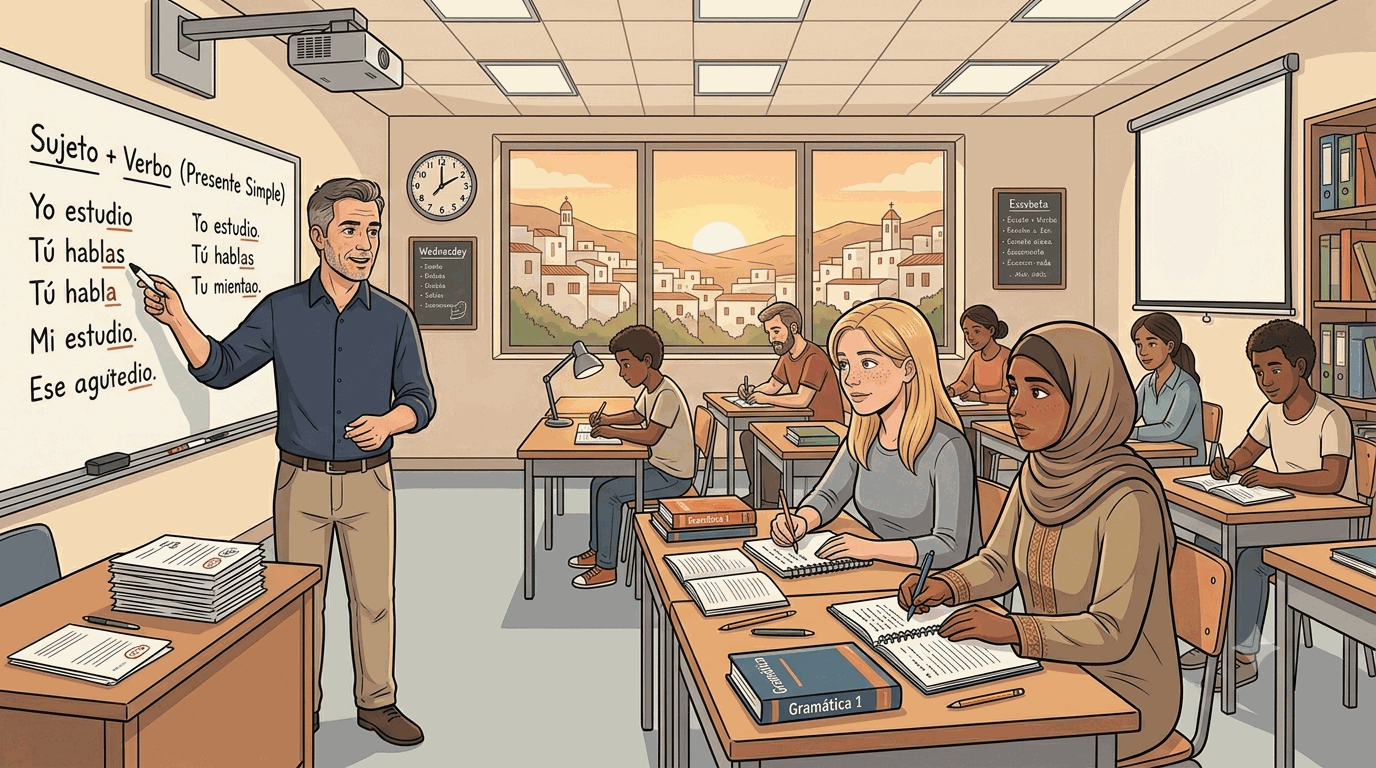
Imagen generada con Google Gemini Flash-Lite
🎧 Coloca el archivo audio/sda1_sesion3_story.mp3 junto a este HTML para que suene aquí.
Every Wednesday, the kitchen apron stays at home, and Trini and Itto swap it for a
notebook and a pen. They come to Alkayasí for Julio's TAE-EOI group, a special class for
adults who are officially enrolled at the School of Languages, but who study in a blended
way: they do most of their work online, at home, and they only attend the school for the
official exams.
Trini usually arrives first. She works close to the centre, so she doesn't need Julio's
help today. She takes out her folder, and she immediately asks about a mistake in her last
piece of writing. "Is it 'does' or 'is'?" she asks, a little embarrassed. Julio smiles
— it's a very common doubt, and he doesn't mind explaining it again.
Itto arrives a few minutes later, straight from the kitchen workshop. She still smells
slightly of onions, and she laughs about it. Unlike the practical classes at the IES
Almeraya, this class makes her more nervous. She finds listening exercises difficult, and
she worries about the official exam in May.
Julio doesn't rush them. He reviews present simple and present continuous with real
examples from their own lives — cooking classes, library shifts, weekend plans.
Slowly, question by question, the doubts become clearer. By half past seven, both women
leave with a lighter feeling. The exam is still months away, but every Wednesday, they are
a little more ready for it.
Esta sesión repasa la diferencia entre presente simple (rutinas, hechos generales — Trini works at the library) y presente continuo (acciones en curso, cambios temporales — Itto is studying for her exam this term). Se practica también la formación de preguntas con do/does y be, esenciales para el formato de examen oficial de la EOI.
Pulsa cada palabra para consultarla en WordReference.
1. exam /ɪɡˈzæm/ — examen.
2. official /əˈfɪʃəl/ — oficial.
3. certificate /səˈtɪfɪkət/ — certificado, título.
4. mark /mɑːk/ — nota, calificación.
5. mistake /mɪˈsteɪk/ — error.
6. correct (verb) /kəˈrekt/ — corregir.
7. revise /rɪˈvaɪz/ — repasar.
8. task /tɑːsk/ — tarea, actividad.
9. online /ˌɒnˈlaɪn/ — en línea.
10. submit /səbˈmɪt/ — entregar (un trabajo).
11. doubt /daʊt/ — duda.
12. improve /ɪmˈpruːv/ — mejorar.
13. blended (learning) /ˈblendɪd/ — semipresencial.
14. nervous /ˈnɜːvəs/ — nervioso/a.
15. confident /ˈkɒnfɪdənt/ — seguro/a de sí mismo/a.
¿Qué te resulta más difícil del inglés: el listening, el writing, el speaking o el reading? Coméntalo con tu compañero/a y dad consejos mutuos.
1. Escribe 3 frases usando presente simple sobre tu rutina de estudio.
2. Escribe 3 frases en presente continuo sobre algo que estás preparando "this term" o "this month".
3. Escribe dos preguntas de examen tipo EOI usando do/does y is/are.
Un familiar de Itto que no habla inglés quiere saber cómo funciona exactamente su curso semipresencial de inglés.
"We submit our tasks online during the term, but we have to attend the school in person for the official exams."
Tarea: Explícaselo con tus propias palabras en español, de forma clara.
Avicii – Hey Brother (2013)
Localiza en la letra alguna pregunta o negación. Compara con las estructuras trabajadas hoy en Language Lab.
Trabajo opcional para casa — Libro 4: 50 Selected AI Songs for A2
Bleeding Strings – Heal the World with Kindness
Escucha esta canción en casa y anota cualquier estructura de presente simple o continuo que reconozcas.
Imagen generada con Google Gemini Flash-Lite
En parejas, representad una tutoría rápida: una persona es el alumno/a con una duda de gramática (usad una duda real vuestra), la otra es Julio, que la explica con ejemplos de la vida cotidiana, como hace en la lectura.
SdA A2·1 · Clase 4
Trini y su familia visitan a Julio e Itto
| Bloque | Min | Contenido |
|---|---|---|
| Warm-up + Listening | 15 | Audio + V/F |
| Reading & comprensión | 20 | Lectura + preguntas |
| Language Lab | 20 | Presente simple/continuo en contexto social + 15 drills |
| Vocabulary Lab | 10 | 15 palabras nuevas |
| Production | 15 | Speaking + Writing |
| Mediation | 5 | Tarea de mediación |
| Sing Along + Roleplay | 5 | Canción + cierre |
Escucha el audio de la narración (sin leer el texto) y marca True (T) o False (F).
🎧 Coloca el archivo audio/sda1_sesion4_listening.mp3 junto a este HTML para que suene aquí.
1. The table is ready for four people. →
2. Itto is putting a homemade dessert in the fridge. →
3. Julio is chatting with Trini's daughters in the garden. →
4. Everybody is in a hurry to finish lunch quickly. →
5. Trini makes a toast "to new friendships". →
Una comida de domingo, meses después de conocerse
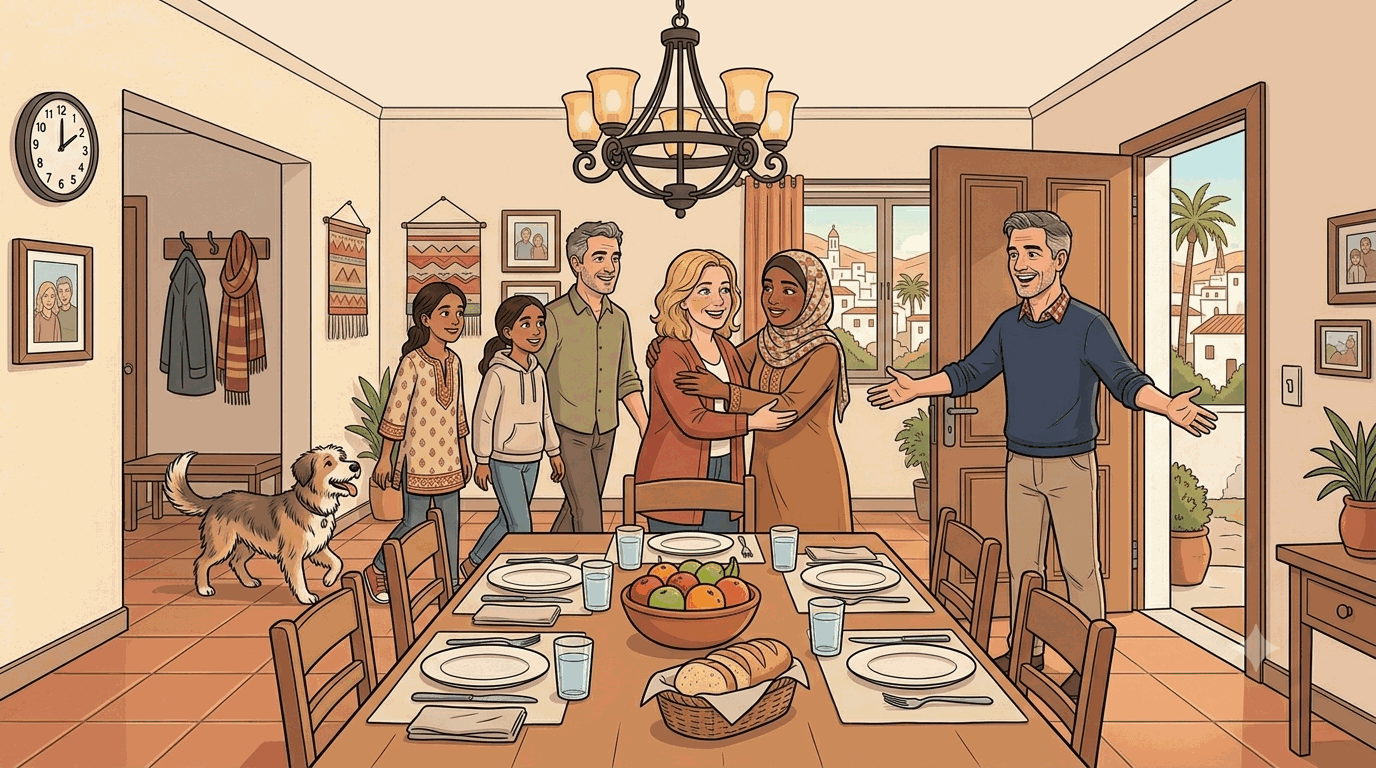
Imagen generada con Google Gemini Flash-Lite
🎧 Coloca el archivo audio/sda1_sesion4_story.mp3 junto a este HTML para que suene aquí.
By November, Itto and Trini's friendship isn't only about knives and recipes anymore.
This Sunday, Trini visits Julio and Itto's house for lunch, together with her husband and
their two teenage daughters. It's the first time the two families meet properly, and Itto
has been preparing all morning.
When the guests arrive, Itto welcomes them warmly, and the girls immediately relax when
they see the dog in the garden. Julio and Trini's husband find a lot to talk about —
football, gardening, and, of course, the famous cooking course. "Your wife chops onions
faster than a professional now," Julio jokes, and everyone laughs.
In the kitchen, Itto is finishing a typical Moroccan starter, something she learnt from her
mother years ago, long before any cooking course. Trini watches her carefully. "You never
told me you already knew how to cook like this," she says, half surprised, half proud.
Itto just smiles. "I'm still learning a lot of things at school," she answers, "but some
recipes, I already carry inside me."
Lunch lasts almost three hours. Nobody checks the time. The girls help clear the table
without being asked twice, and Trini's husband insists on washing the dishes. Before they
leave, Trini hugs Itto tightly. "We don't see each other much outside the kitchen," she
says, "but today feels like we've known each other for years." Itto agrees completely.
Some friendships, she thinks, grow fastest in the most unexpected places.
En una conversación cotidiana solemos mezclar ambos tiempos sin darnos cuenta: presente simple para lo habitual y las opiniones (Trini's husband loves football), presente continuo para lo que ocurre en ese preciso momento (The girls are relaxing in the garden). Practicamos hoy la mezcla natural de ambos, tal y como aparece en la lectura.
Pulsa cada palabra para consultarla en WordReference.
1. guest /ɡest/ — invitado/a.
2. teenager /ˈtiːnˌeɪdʒə/ — adolescente.
3. husband /ˈhʌzbənd/ — marido.
4. lay the table /leɪ/ — poner la mesa.
5. dessert /dɪˈzɜːt/ — postre.
6. starter /ˈstɑːtə/ — entrante.
7. main course /ˌmeɪn ˈkɔːs/ — plato principal.
8. polite /pəˈlaɪt/ — educado/a, cortés.
9. neighbour /ˈneɪbə/ — vecino/a.
10. homemade /ˌhəʊmˈmeɪd/ — casero/a.
11. relax /rɪˈlæks/ — relajarse.
12. laugh /lɑːf/ — reírse.
13. weekend /ˈwiːkend/ — fin de semana.
14. visit (verb) /ˈvɪzɪt/ — visitar.
15. welcome (verb) /ˈwelkəm/ — dar la bienvenida.
Cuéntale a tu compañero/a la última vez que invitaste a alguien a comer a tu casa, o te invitaron a ti. ¿Qué preparasteis? ¿Qué tal fue?
1. Describe una comida familiar típica en tu casa, usando presente simple.
2. Describe qué está pasando ahora mismo en una comida imaginaria (presente continuo).
3. Escribe una frase sobre una amistad tuya que, como la de Itto y Trini, "creció en un lugar inesperado".
Un vecino que no habla inglés pregunta por qué había tanta gente comiendo en el jardín de Julio e Itto el domingo pasado.
"My wife's cooking classmate came for lunch with her family — we don't see each other much outside class, so it was a lovely afternoon."
Tarea: Explícaselo de forma natural al vecino, en español.
Barbra Streisand – A Piece of Sky (1983)
¿Qué sentimiento transmite la canción? Relaciónalo con el ambiente de la comida familiar de la lectura de hoy.
Trabajo opcional para casa — Libro 4: 50 Selected AI Songs for A2
Raselhits – Whispers Of You
Escucha esta canción en casa: ¿te transmite un ambiente parecido al de la comida familiar de esta sesión, o muy distinto?
Imagen generada con Google Gemini Flash-Lite
En grupos de cuatro, representad la mesa del domingo: repartíos los papeles de Itto, Julio, Trini y su marido, y improvisad una conversación de sobremesa combinando presente simple (gustos, costumbres) y presente continuo (lo que está pasando en ese momento).
SdA A2·1 · Clase 5
Mayo de 2025, las primeras prácticas laborales
| Bloque | Min | Contenido |
|---|---|---|
| Warm-up + Listening | 15 | Audio + V/F |
| Reading & comprensión | 20 | Lectura + preguntas |
| Language Lab | 20 | Contraste presente continuo (dos escenarios) + 15 drills |
| Vocabulary Lab | 10 | 15 palabras nuevas |
| Production | 15 | Speaking + Writing |
| Mediation | 5 | Tarea de mediación |
| Sing Along + Roleplay | 5 | Canción + cierre |
Escucha el audio de la narración (sin leer el texto) y marca True (T) o False (F).
🎧 Coloca el archivo audio/sda1_sesion5_listening.mp3 junto a este HTML para que suene aquí.
1. Trini and Itto do their work placement together, in the same kitchen. →
2. Trini is working at a small restaurant in the centre of Almería. →
3. Itto is doing her placement alone, without any classmate. →
4. The Hotel Barceló is in the city centre. →
5. Both women feel a little nervous but also excited. →
Las prácticas de mayo de 2025
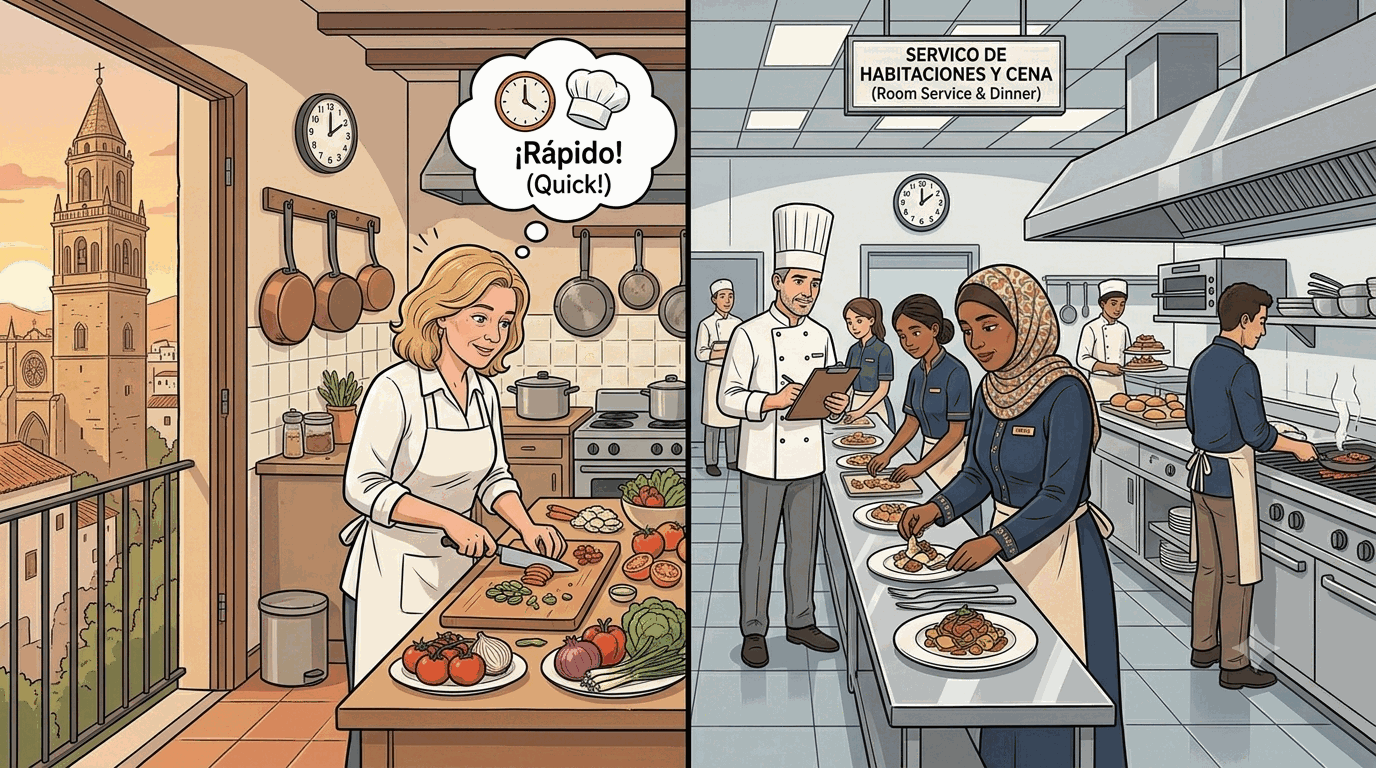
Imagen generada con Google Gemini Flash-Lite
🎧 Coloca el archivo audio/sda1_sesion5_story.mp3 junto a este HTML para que suene aquí.
The first year of the course is almost over, and it's time for the students' first
real work experience. This May, Trini and Itto don't share the same kitchen for the first
time since September — and, strangely, that feels like a small milestone.
Trini is doing her placement in a small, traditional restaurant near the cathedral. The
kitchen is tiny, and the chef expects total silence during the busiest hours. Every day,
she is chopping vegetables before opening time, and later, she is helping to plate the
dishes as waiters rush in and out. It's tiring, but Trini loves the intensity. "At the
library, nobody ever shouts 'table five, now!'" she tells Itto on the phone, laughing.
Meanwhile, Itto is completing her placement at the Hotel Barceló, in Retamar, together with
Martha, another classmate. The hotel kitchen is enormous compared to the classroom
workshop: dozens of staff, uniforms, and a strict hierarchy. Itto is learning to work as
part of a big team, following orders quickly and calmly. The supervisor, a serious but fair
woman, is teaching her proper knife skills and correct food safety habits.
Every evening, Itto arrives home exhausted, but proud. "Today I served almost sixty
plates," she tells Julio one night, still wearing her hotel uniform. He looks at her, a
little amazed. The nervous student from last September is becoming, slowly and surely, a
real professional cook.
Hoy usamos el presente continuo para describir dos situaciones que ocurren al mismo tiempo, en lugares distintos — un recurso narrativo muy útil (While Trini is working in the restaurant, Itto is working in the hotel). Repasamos también el contraste con presente simple para hechos generales sobre cada trabajo.
Pulsa cada palabra para consultarla en WordReference.
1. placement /ˈpleɪsmənt/ — prácticas (laborales).
2. trainee /ˌtreɪˈniː/ — aprendiz, en prácticas.
3. chef /ʃef/ — chef, jefe de cocina.
4. restaurant /ˈrestrɒnt/ — restaurante.
5. hotel /həʊˈtel/ — hotel.
6. kitchen staff /ˈkɪtʃɪn stɑːf/ — personal de cocina.
7. uniform /ˈjuːnɪfɔːm/ — uniforme.
8. order (a meal) /ˈɔːdə/ — pedido, encargo.
9. serve /sɜːv/ — servir.
10. busy /ˈbɪzi/ — ocupado, con mucho trabajo.
11. teamwork /ˈtiːmwɜːk/ — trabajo en equipo.
12. experience /ɪkˈspɪəriəns/ — experiencia.
13. supervisor /ˈsuːpəvaɪzə/ — supervisor/a.
14. proud /praʊd/ — orgulloso/a.
15. tiring /ˈtaɪərɪŋ/ — agotador, cansado.
¿Has hecho alguna vez unas prácticas o un primer trabajo? Describe cómo te sentiste el primer día.
1. Describe, en presente continuo, lo que probablemente está haciendo ahora mismo alguien que trabaja en un restaurante o un hotel.
2. Escribe 3 frases comparando dos trabajos diferentes (uno tranquilo, uno muy ocupado).
3. Escribe una frase con "proud" sobre algo que hayas conseguido tú.
La madre de una compañera de clase, que no habla inglés, pregunta cómo le está yendo a Itto en sus prácticas.
"She's working really hard at the hotel, and her supervisor says she's learning very quickly."
Tarea: Cuéntaselo en español, de forma cercana y natural.
Billy Joel – Piano Man (1973)
La canción describe a varios personajes en un mismo lugar. Comparad esta idea con las "dos cocinas, la misma mañana" de la lectura de hoy.
Trabajo opcional para casa — Libro 4: 50 Selected AI Songs for A2
Caelis – Hidden Tears
Escucha esta canción en casa: ¿qué tipo de ambiente o emoción transmite, comparado con el esfuerzo de las prácticas de esta sesión?
Imagen generada con Google Gemini Flash-Lite
En parejas, una persona describe un día de trabajo en el restaurante (como Trini) y la otra un día de trabajo en el hotel (como Itto), usando presente continuo para las acciones del momento y presente simple para las rutinas generales de cada sitio.
SdA A2·1 · Clase 6
Fin de curso, resultados y despedida hasta septiembre
| Bloque | Min | Contenido |
|---|---|---|
| Warm-up | 5 | Recordatorio de la unidad |
| Review Fair (4 estaciones) | 45 | Roleplay por estaciones, repaso de las 5 sesiones |
| Review Language Lab | 25 | Quiz mixto presente simple/continuo (10 ítems) |
| Sing Along de cierre | 10 | Canción + resumen de la unidad |
| Despedida | 5 | Cierre y enlace con la SdA A2·2 |
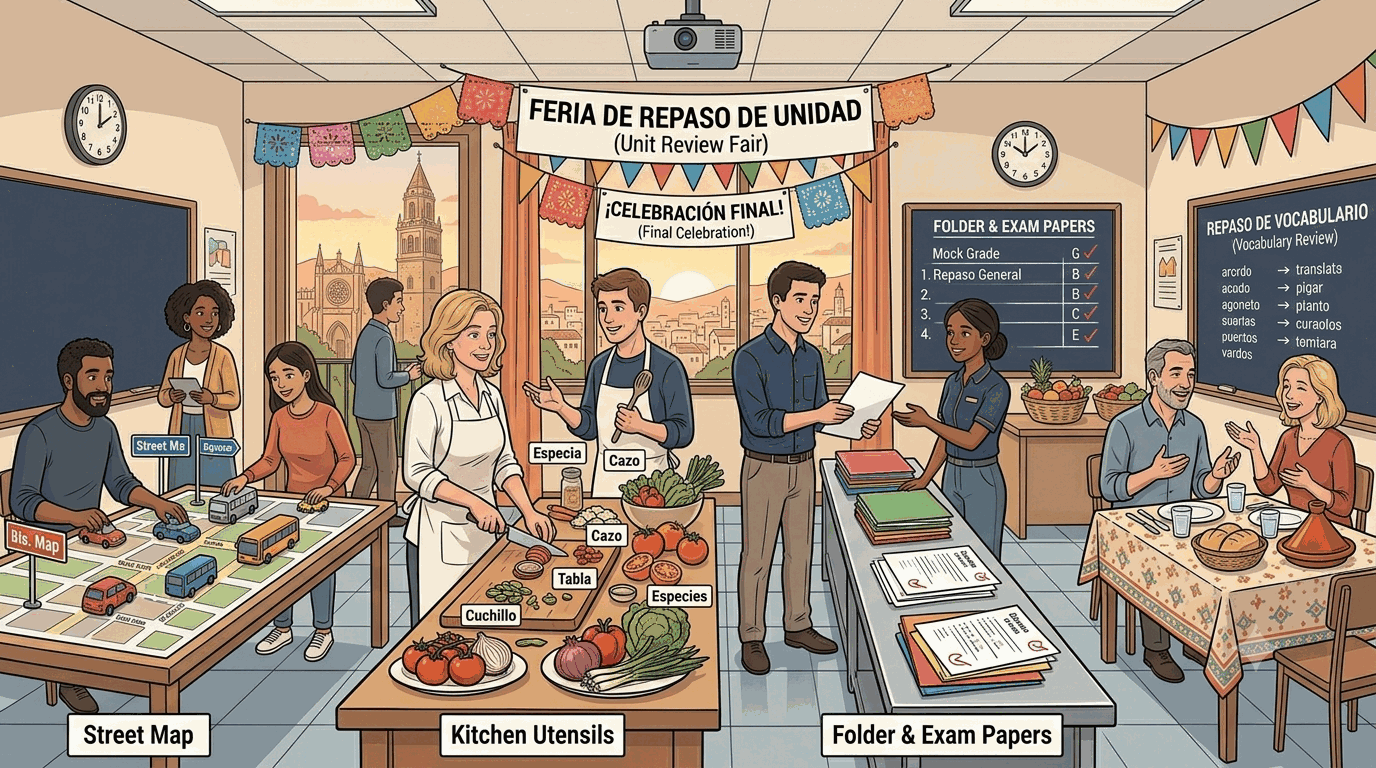
Imagen generada con Google Gemini Flash-Lite
La clase se organiza como una pequeña feria de repaso, con cuatro estaciones montadas
en distintos puntos del aula, recordando las escenas trabajadas en la unidad:
Estación 1 — "The Journey": una mesa con un mapa sencillo de Almería y dos
coches de juguete o recortes, para repasar la rutina de los traslados de Julio, Itto, Trini
y Martha (Sesión 1).
Estación 2 — "The Kitchen Workshop": una mesa con utensilios de cocina reales
o de mentira (delantal, cuchillo de plástico, receta impresa), para repasar vocabulario y
presente continuo (Sesión 2).
Estación 3 — "The EOI Corner": una mesa con una carpeta y ejemplos de
preguntas de examen, para repasar dudas de gramática típicas (Sesión 3).
Estación 4 — "Sunday Table": una mesa puesta de forma sencilla, con platos y
vasos de cartón, para repasar vocabulario de comida y visitas (Sesión 4) y las prácticas
laborales de mayo (Sesión 5).
Los alumnos rotan en grupos pequeños por las cuatro estaciones, y en cada una improvisan una
breve escena de 2-3 minutos usando el vocabulario y la gramática de esa sesión, con la ayuda
de una tarjeta de apoyo que resume las estructuras clave.
Repaso de presente simple (rutinas y hechos habituales) y presente continuo (acciones en curso), en los contextos de estudios, cocina y vida social trabajados en la unidad.
Bob Seger & The Silver Bullet Band – Against The Wind (1980)
Como cierre de la unidad, comentad en gran grupo: ¿qué habéis aprendido sobre la rutina, la cocina y la amistad de Itto y Trini?
Itto and Trini pass their first year together, and Trini already knows she'll be back in September for her second year. Itto isn't so sure about hers — but that's a story for later in the course.
Trabajo opcional para casa — Libro 4: 50 Selected AI Songs for A2
eSJe Radio – Beneath the Streetlamp Shadows
Escucha esta canción en casa como cierre de la unidad, y guárdala en tu lista de canciones favoritas del curso.