
SEP Alkayasí · CEPER 500 Viviendas
SEP Alkayasí · CEPER 500 Viviendas
SdA 2 · Clase 1
Presente simple (afirmativa) · Partes del día y la hora



| Bloque | Min | Contenido |
|---|---|---|
| 1. Listening | 10 | Escucha de la narración + comprensión global |
| 2. Reading | 15 | The Story + comprensión detallada |
| 3. Language Lab | 25 | Presente simple (afirmativa) · Partes del día y la hora |
| 4. Vocabulary Lab | 15 | 10 palabras clave |
| 5. Production | 15 | Speaking + Writing guiados |
| 6. Mediation | 8 | Mediación lingüística |
| 7. Sing Along | 2 | Billy Joel — "Honesty" (1979) |
Escucha el audio de la narración (sin leer el texto) y marca Verdadero (V) o Falso (F).
🎧 Coloca el archivo audio/sda2_sesion1_story.mp3 junto a este HTML para que suene aquí.
1. Rogelio always arrives at four o'clock. →
2. Rogelio sometimes arrives late. →
3. He has breakfast at seven o'clock. →
4. He goes to the health centre on Tuesdays. →
5. He goes to bed at midnight. →
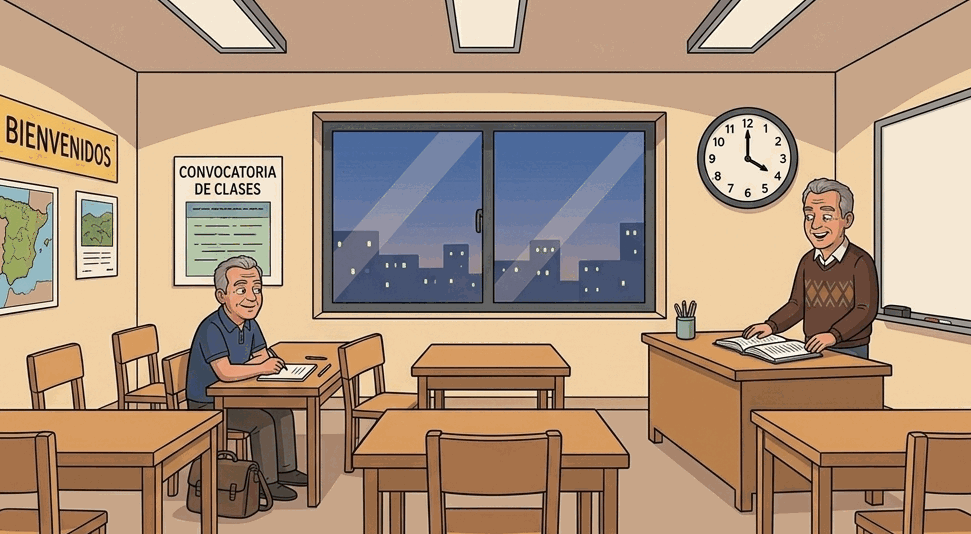
Rogelio y Pilar representan dos rutinas diarias distintas en La Cañada.
🎧 Coloca el archivo audio/sda2_sesion1_story.mp3 junto a este HTML para que suene aquí.
It is seven o'clock in the morning. Rogelio gets up and has breakfast. He always reads the newspaper before work. Pilar gets up a little later, at half past seven. She makes coffee and prepares breakfast for her family. In the afternoon, Pilar cleans the house and goes shopping. Rogelio finishes his errands and rests for an hour. In the evening, both of them come to the centre for their English class. Julio starts the class at four o'clock, and Rogelio is always the first student to arrive. At night, after class, Pilar watches the news with her husband, and Rogelio reads a book before he goes to bed at eleven o'clock. Every day in La Cañada follows a similar pattern, but everyone has their own small routine.
Usamos el presente simple para hablar de rutinas, hábitos y hechos generales. Con I / you / we / they, el verbo no cambia: I get up , they work . Con he / she / it, añadimos -s (o -es / cambiamos y por i+es en algunos casos): he gets up , she watches , Rogelio studies .
1. morning /ˈmɔːnɪŋ/ — mañana.
2. afternoon /ˌɑːftəˈnuːn/ — tarde.
3. evening /ˈiːvnɪŋ/ — tarde-noche.
4. night /naɪt/ — noche.
5. o'clock /əˈklɒk/ — en punto.
6. half past /hɑːf pɑːst/ — y media.
7. quarter past /ˈkwɔːtə pɑːst/ — y cuarto.
8. quarter to /ˈkwɔːtə tuː/ — menos cuarto.
9. midday /ˌmɪdˈdeɪ/ — mediodía.
10. midnight /ˈmɪdnaɪt/ — medianoche.
En parejas, preguntad y responded: 'What time do you get up?' / 'What time do you have dinner?' Usad las partes del día y la hora.
1. Escribe 5 frases sobre tu rutina diaria usando el presente simple y expresiones de hora.
Rogelio necesita cambiar su cita del centro de salud porque coincide con la clase. En grupo, ayudadle a redactar una nota breve para la recepcionista explicando su horario semanal y proponiendo un nuevo horario, usando correctamente las expresiones de tiempo.
Billy Joel — "Honesty" (1979)
Busca en la letra alguna palabra relacionada con partes del día o rutinas diarias; si no aparece ninguna, anota 2 verbos en presente simple que reconozcas.
SdA 2 · Clase 2
Presente simple (negativa/interrogativa) · Adverbios de frecuencia




| Bloque | Min | Contenido |
|---|---|---|
| 1. Listening | 10 | Escucha de la narración + comprensión global |
| 2. Reading | 15 | The Story + comprensión detallada |
| 3. Language Lab | 25 | Presente simple (negativa/interrogativa) · Adverbios de frecuencia |
| 4. Vocabulary Lab | 15 | 10 palabras clave |
| 5. Production | 15 | Speaking + Writing guiados |
| 6. Mediation | 8 | Mediación lingüística |
| 7. Sing Along | 2 | Chris De Burgh — "Lady In Red" (1999) |
Escucha el audio de la narración (sin leer el texto) y marca Verdadero (V) o Falso (F).
🎧 Coloca el archivo audio/sda2_sesion2_story.mp3 junto a este HTML para que suene aquí.
1. Cristóbal exercises every day. →
2. Cristóbal walks twice a week. →
3. Consuelo sometimes smokes. →
4. Consuelo often eats sweets. →
5. Consuelo always goes to bed at ten. →
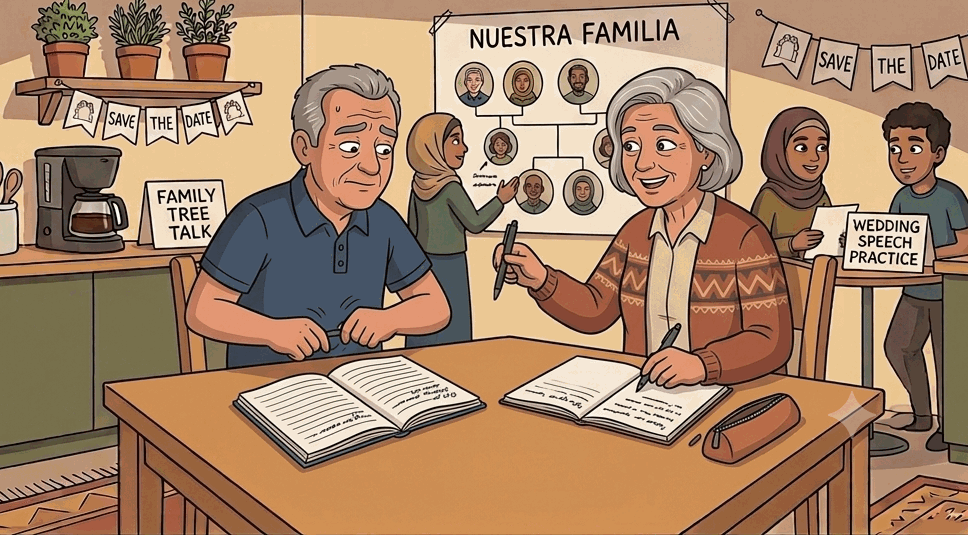
Francisco y Carmen comparten su rutina de estudio en el centro.
🎧 Coloca el archivo audio/sda2_sesion2_story.mp3 junto a este HTML para que suene aquí.
Francisco and Carmen are good friends. They usually arrive at class together, and they always sit at the same table, near the window. Francisco always brings his notebook, but he sometimes forgets his glasses at home. Carmen never forgets anything — she is very organised, and she often lends Francisco a spare pen. 'Do you often study at home?' Julio asks. 'I don't often study,' says Francisco, 'but I always do my homework on the bus, on my way to the centre.' Carmen laughs. 'I don't do that. I usually study in the evening, after dinner, with the radio on.' Julio smiles. 'Everyone has a different routine, but you both work hard. That's what matters.' Francisco doesn't like exams, but he always tries his best. Carmen rarely misses a class, and she often helps her classmates with grammar.
Negativa: don't/doesn't + infinitivo (I don't smoke / she doesn't smoke). Interrogativa: Do/Does + sujeto + infinitivo? (Do you study? / Does he study?). Los adverbios de frecuencia (always, usually, often, sometimes, rarely, never) van antes del verbo principal , pero después del verbo 'to be' : 'She always studies' / 'She is always punctual'.
1. always /ˈɔːlweɪz/ — siempre.
2. usually /ˈjuːʒuəli/ — normalmente.
3. often /ˈɒf(ə)n/ — a menudo.
4. sometimes /ˈsʌmtaɪmz/ — a veces.
5. rarely /ˈreəli/ — raramente.
6. never /ˈnevə/ — nunca.
7. every day /ˈevri deɪ/ — todos los días.
8. once a week /wʌns ə wiːk/ — una vez por semana.
9. twice a month /twaɪs ə mʌnθ/ — dos veces al mes.
10. hardly ever /ˈhɑːdli ˈevə/ — casi nunca.
En parejas, haced una pequeña encuesta: 'How often do you...?' (exercise / cook / read / travel).
1. Escribe un párrafo breve sobre los hábitos de tu compañero/a, usando adverbios de frecuencia.
Rogelio quiere que le hagan más preguntas sobre su rutina. En grupos, preparad cinco preguntas con 'Do/Does' para entrevistarle sobre sus hábitos, y anotad sus respuestas.
Chris De Burgh — "Lady In Red" (1999)
Anota si aparece algún adverbio de frecuencia (always, never, sometimes...) en la letra; si no, anota 2 verbos en forma negativa o interrogativa que reconozcas.
SdA 2 · Clase 3
Preposiciones de tiempo (at/on/in) · Aficiones y ocio

| Bloque | Min | Contenido |
|---|---|---|
| 1. Listening | 10 | Escucha de la narración + comprensión global |
| 2. Reading | 15 | The Story + comprensión detallada |
| 3. Language Lab | 25 | Preposiciones de tiempo (at/on/in) · Aficiones y ocio |
| 4. Vocabulary Lab | 15 | 10 palabras clave |
| 5. Production | 15 | Speaking + Writing guiados |
| 6. Mediation | 8 | Mediación lingüística |
| 7. Sing Along | 2 | Chris Rea — "Nothing To Fear" (1992) |
Escucha el audio de la narración (sin leer el texto) y marca Verdadero (V) o Falso (F).
🎧 Coloca el archivo audio/sda2_sesion3_story.mp3 junto a este HTML para que suene aquí.
1. Tarik likes watching football on Sundays. →
2. Tarik walks in the morning. →
3. Pilar likes cooking at the weekend. →
4. Pilar never paints. →
5. Pilar reads in bed at night. →
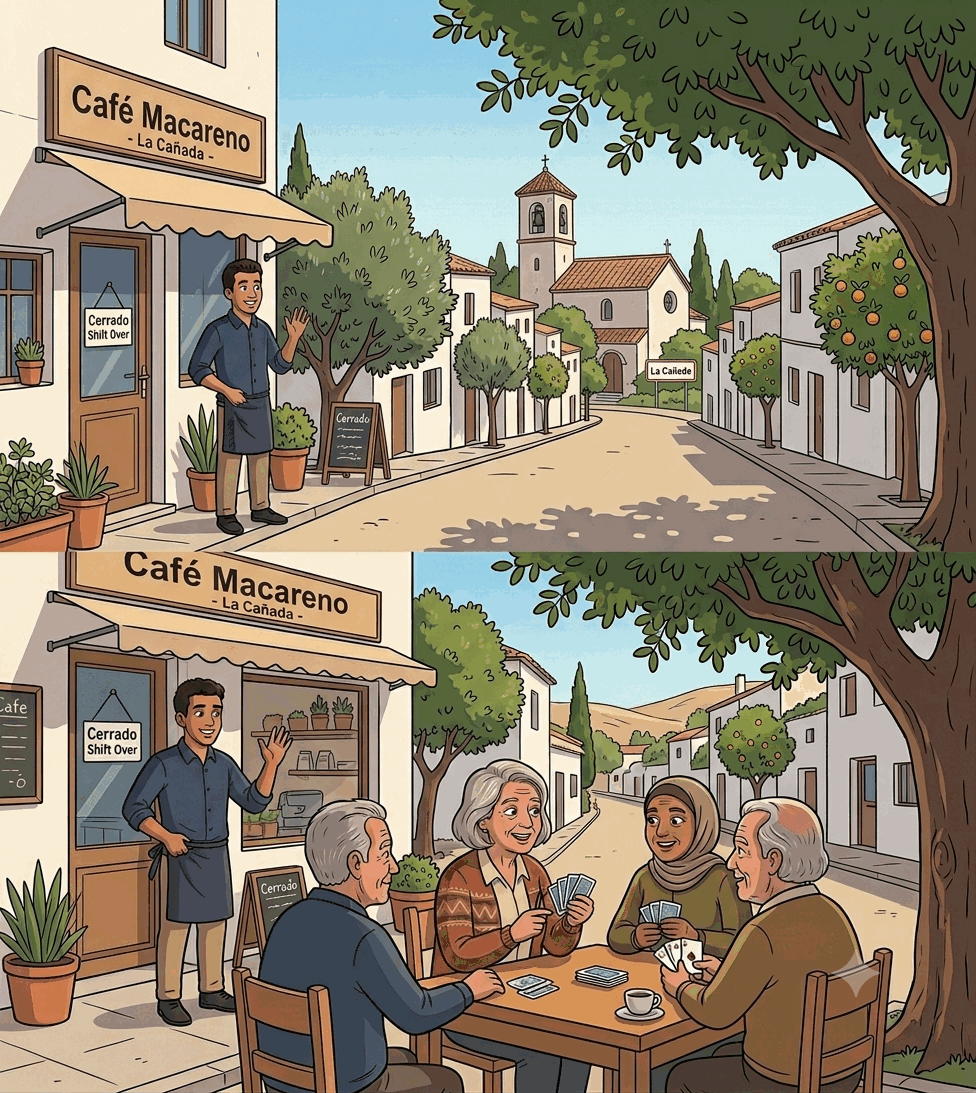
Tarik y Pilar cuentan cómo usan su tiempo libre.
🎧 Coloca el archivo audio/sda2_sesion3_story.mp3 junto a este HTML para que suene aquí.
In La Cañada, people enjoy simple hobbies. Tarik works as a waiter during the week, and he often finishes very late at night. On his day off, he likes to relax and watch football on television. In the evening, he sometimes walks near the river to clear his mind. Pilar has a different routine. In the morning, she does housework, but in the afternoon she sometimes paints or plays cards with her neighbours. At the weekend, she enjoys cooking traditional dishes for her family. 'What about you, Julio?' asks Pilar. 'In my free time, I like reading and listening to music,' says Julio. 'At the weekend, I go for walks with Itto.' Everyone agrees that free time, even a little, is important for a happy life.
at : horas y momentos concretos (at four o'clock, at night, at the weekend). on : días y fechas (on Sunday, on Mondays, on 5th November). in : partes del día, meses, años y estaciones (in the morning, in November, in 2020).
1. gardening /ˈɡɑːd(ə)nɪŋ/ — jardinería.
2. walking /ˈwɔːkɪŋ/ — caminar.
3. reading /ˈriːdɪŋ/ — leer.
4. cooking /ˈkʊkɪŋ/ — cocinar.
5. swimming /ˈswɪmɪŋ/ — nadar.
6. dancing /ˈdɑːnsɪŋ/ — bailar.
7. painting /ˈpeɪntɪŋ/ — pintar.
8. playing cards /ˈpleɪɪŋ kɑːdz/ — jugar a las cartas.
9. watching TV /ˈwɒtʃɪŋ tiːˈviː/ — ver la tele.
10. listening to music /ˈlɪsn̩ɪŋ tə ˈmjuːzɪk/ — escuchar música.
En parejas, contad qué aficiones tenéis y cuándo las practicáis, usando at/on/in correctamente.
1. Escribe una pequeña entrada de diario sobre tu afición favorita y cuándo la practicas.
El centro organiza un 'Día de las Aficiones'. En grupo, diseñad un cartel sencillo con un horario de actividades (jardinería, cocina, baile...) usando correctamente las preposiciones de tiempo.
Chris Rea — "Nothing To Fear" (1992)
Busca en la letra alguna preposición de tiempo (at, on, in) y anótala junto con la palabra que la acompaña.
SdA 2 · Clase 4
Pronombres posesivos · Preposiciones de lugar
| Bloque | Min | Contenido |
|---|---|---|
| 1. Listening | 10 | Escucha de la narración + comprensión global |
| 2. Reading | 15 | The Story + comprensión detallada |
| 3. Language Lab | 25 | Pronombres posesivos · Preposiciones de lugar |
| 4. Vocabulary Lab | 15 | 10 palabras clave |
| 5. Production | 15 | Speaking + Writing guiados |
| 6. Mediation | 8 | Mediación lingüística |
| 7. Sing Along | 2 | Dire Straits — "Brothers In Arms" (1985) |
Escucha el audio de la narración (sin leer el texto) y marca Verdadero (V) o Falso (F).
🎧 Coloca el archivo audio/sda2_sesion4_story.mp3 junto a este HTML para que suene aquí.
1. The pencil is Cristóbal's. →
2. The pencil is Consuelo's. →
3. The book on the table is Cristóbal's. →
4. The notebook is on the table. →
5. The glasses are in the bag. →
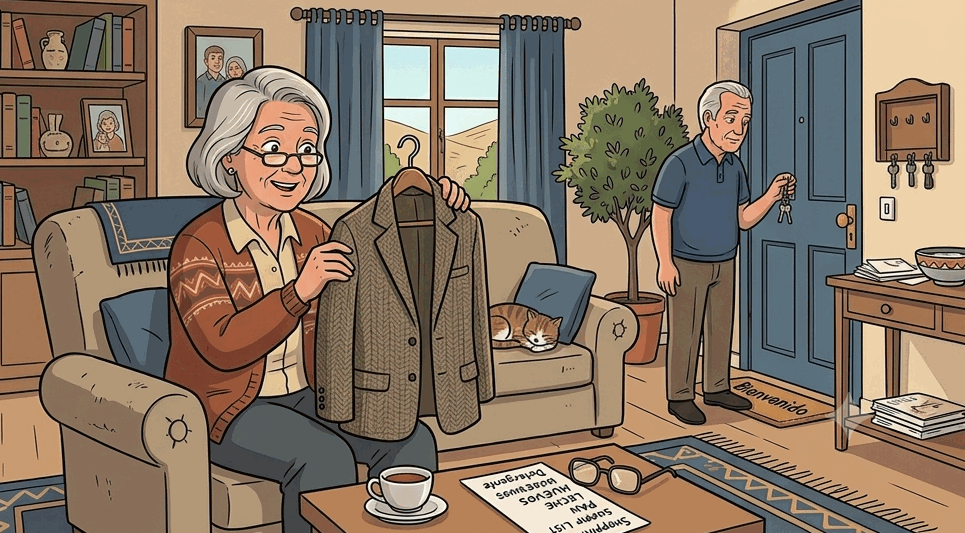
Consuelo y Cristóbal a veces confunden sus propias pertenencias en casa.
🎧 Coloca el archivo audio/sda2_sesion4_story.mp3 junto a este HTML para que suene aquí.
At home, Consuelo and Cristóbal sometimes mix up their belongings. 'Is this jacket mine or yours?' asks Consuelo. 'It's not mine — I think it's hers,' says Cristóbal, looking at a photo of their daughter on the wall. In the kitchen, the reading glasses are on the table, next to the fruit bowl, and a shopping list is under a magnet on the fridge. The newspaper is under a cushion, between the sofa and the armchair. 'Whose keys are these, in front of the door?' asks Cristóbal. 'They're ours,' says Consuelo, smiling. 'We always leave them there, so we never lose them.' Behind the kitchen door, there is a small calendar with all their appointments, and next to it, an old photograph of their wedding day. Everything has its place, more or less, in their little house near the church.
Pronombres posesivos (sustituyen al sustantivo): mine, yours, his, hers, its, ours, theirs. 'This book is mine' (no decimos 'mine book'). Preposiciones de lugar: in, on, under, next to, between, in front of, behind, near, far from, opposite.
1. in /ɪn/ — en/dentro de.
2. on /ɒn/ — sobre/encima de.
3. under /ˈʌndə/ — debajo de.
4. next to /nekst tuː/ — al lado de.
5. between /bɪˈtwiːn/ — entre.
6. in front of /ɪn frʌnt ɒv/ — delante de.
7. behind /bɪˈhaɪnd/ — detrás de.
8. near /nɪə/ — cerca de.
9. far from /fɑː frɒm/ — lejos de.
10. opposite /ˈɒpəzɪt/ — enfrente de.
En parejas, describid dónde están los objetos de la clase usando preposiciones de lugar.
1. Describe tu salón o tu cocina: dónde están los muebles y objetos, usando preposiciones de lugar.
En la 'oficina de objetos perdidos' del centro hay varios objetos sin dueño. En grupo, clasificad los objetos preguntando y respondiendo con pronombres posesivos: 'Is this yours?' 'No, it isn't mine, it's hers.'
Dire Straits — "Brothers In Arms" (1985)
Anota si aparece algún pronombre posesivo (mine, yours, his, hers...) o alguna preposición de lugar en la letra.
SdA 2 · Clase 5
Pronombres objeto · Vocabulario del tiempo atmosférico

| Bloque | Min | Contenido |
|---|---|---|
| 1. Listening | 10 | Escucha de la narración + comprensión global |
| 2. Reading | 15 | The Story + comprensión detallada |
| 3. Language Lab | 25 | Pronombres objeto · Vocabulario del tiempo atmosférico |
| 4. Vocabulary Lab | 15 | 10 palabras clave |
| 5. Production | 15 | Speaking + Writing guiados |
| 6. Mediation | 8 | Mediación lingüística |
| 7. Sing Along | 2 | Disturbed — "The Sound Of Silence" (2015) |
Escucha el audio de la narración (sin leer el texto) y marca Verdadero (V) o Falso (F).
🎧 Coloca el archivo audio/sda2_sesion5_story.mp3 junto a este HTML para que suene aquí.
1. It's rainy this weekend. →
2. Itto will call Francisco and Carmen. →
3. Julio will call them. →
4. Itto will tell him about the plan. →
5. They have no back-up plan if it rains. →
Julio e Itto organizan un plan de fin de semana según la previsión del tiempo.

🎧 Coloca el archivo audio/sda2_sesion5_story.mp3 junto a este HTML para que suene aquí.
On Thursday, Julio checks the weather forecast on his phone. 'It's sunny and warm this weekend,' he tells Itto. 'Let's invite Francisco and Carmen for a walk near the fields.' Itto smiles. 'I'll call them this evening. I'll tell him about the walk, and I'll ask her to bring a cake.' On Saturday morning, it is a little cloudy, but not cold, so they decide to go anyway. 'Don't worry,' says Francisco, 'it isn't going to rain today.' They walk together near the fields, and later they have coffee at a small café in the square. 'If it's windy tomorrow,' says Carmen, 'we can visit them at home instead, and play cards.' Julio laughs. 'Good idea — the weather in November is never very predictable here.'
Los pronombres objeto sustituyen al complemento: me, you, him, her, it, us, them. 'I call Francisco' → 'I call him '. 'She helps Carmen and me' → 'She helps us '.
1. sunny /ˈsʌni/ — soleado.
2. rainy /ˈreɪni/ — lluvioso.
3. cloudy /ˈklaʊdi/ — nublado.
4. windy /ˈwɪndi/ — ventoso.
5. cold /kəʊld/ — frío.
6. hot /hɒt/ — caluroso.
7. warm /wɔːm/ — templado.
8. snowy /ˈsnəʊi/ — nevado.
9. stormy /ˈstɔːmi/ — tormentoso.
10. foggy /ˈfɒɡi/ — con niebla.
En parejas, planificad un fin de semana según el tiempo que hace, usando pronombres objeto: 'I'll call them', 'We'll invite him'.
1. Escribe un breve plan de fin de semana según la previsión del tiempo.
Escribid un mensaje de grupo (tipo WhatsApp) invitando a los compañeros a una actividad de fin de semana, mencionando el tiempo que hará y usando pronombres objeto correctamente.
Disturbed — "The Sound Of Silence" (2015)
Busca 2 pronombres objeto (him, her, it, them...) en la letra, si aparecen.
SdA 2 · Clase 6
Repaso integral SdA 2 · Quiz final · Roleplay grupal
| Bloque | Min | Contenido |
|---|---|---|
| 1. Review | 20 | Repaso de gramática consolidada |
| 2. Vocabulary Review | 15 | 10 palabras de repaso |
| 3. Final Quiz | 25 | Cuestionario final de 10 preguntas |
| 4. Roleplay | 20 | Roleplay grupal de repaso |
| 5. Sing Along | 10 | Don McLean — "And I Love You So" (1970) |
Repaso integral SdA 2 · Quiz final · Roleplay grupal
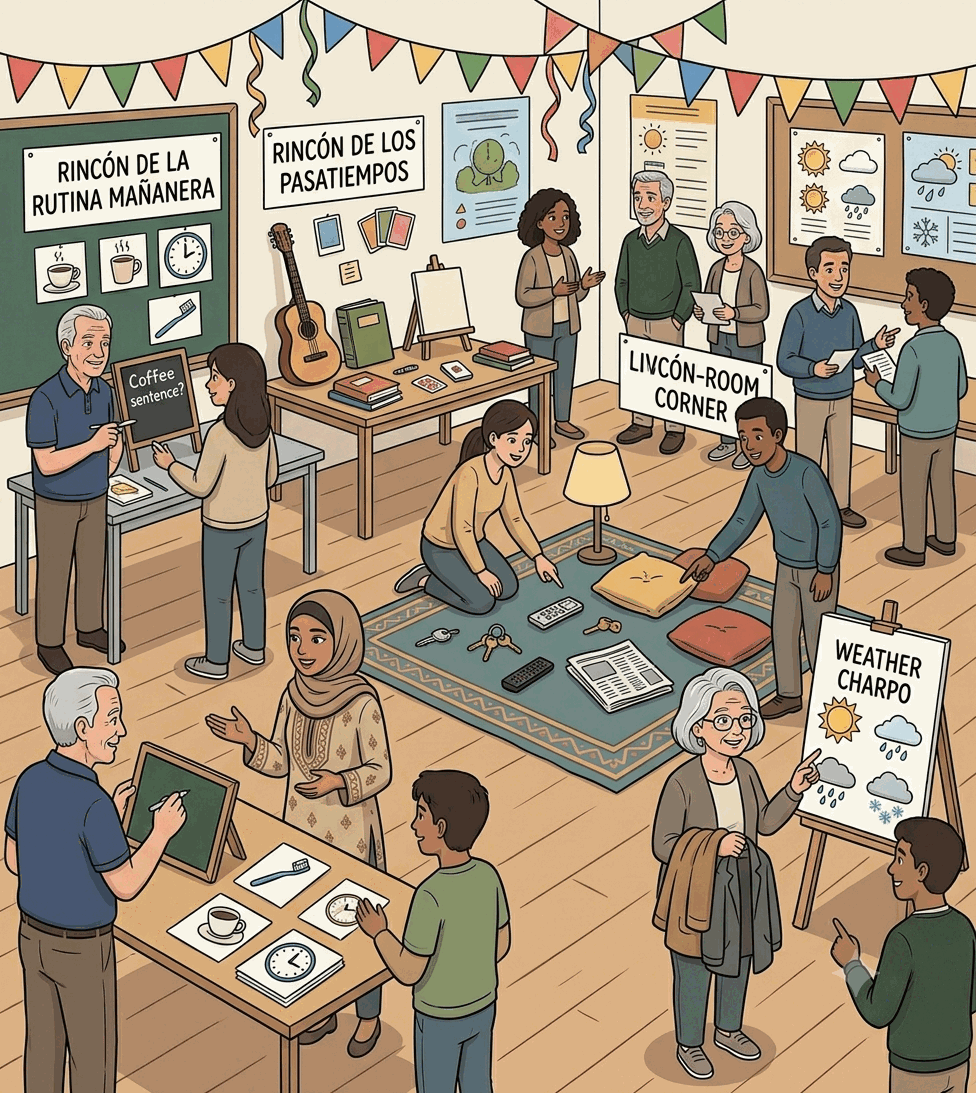
En grupos de cuatro, representad una escena en la que os organizáis para un fin de semana en La Cañada: habladis de vuestras rutinas, aficiones, el tiempo que hará, y de quién es cada objeto que lleváis. Debéis usar al menos: presente simple, un adverbio de frecuencia, una preposición de tiempo o lugar, un pronombre posesivo y un pronombre objeto.
Don McLean — "And I Love You So" (1970)
Cerramos la unidad: escucha la canción y comenta en grupo con qué gramática de esta SdA la relacionarías.