
SEP Alkayasí · CEPER 500 Viviendas
SdA 1 — Welcome to Alkayasí
←
SdA 2 →
SEP Alkayasí · CEPER 500 Viviendas
SdA 1 · Clase 1
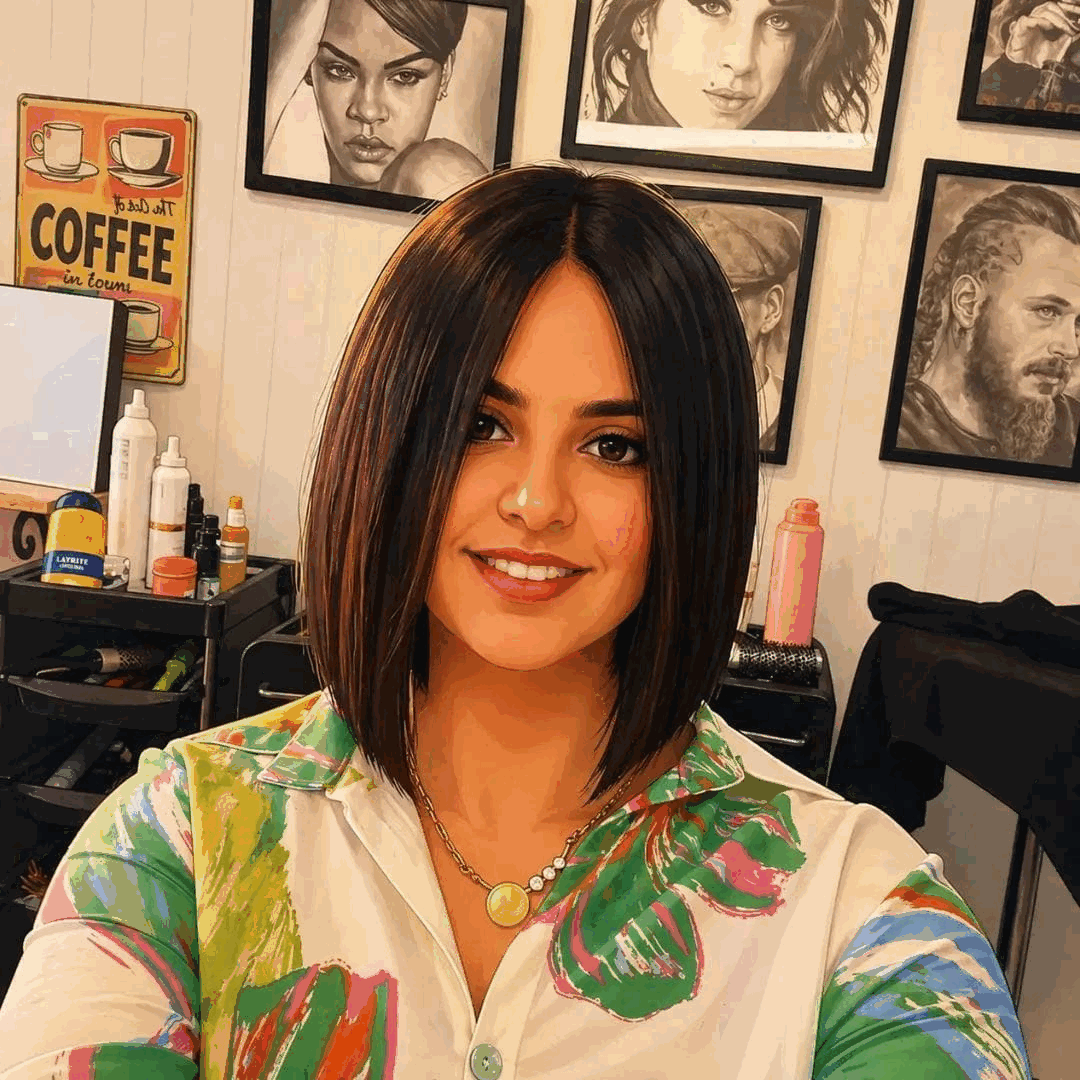
Septiembre 2020 · Itto llega al aula de Julio en La Cañada


| Bloque | Min | Contenido |
|---|---|---|
| 1. Listening | 10 | Escucha de la narración + comprensión global |
| 2. Reading | 15 | The Story + comprensión detallada |
| 3. Language Lab | 25 | Verbo To Be + El Alfabeto |
| 4. Vocabulary Lab | 15 | 10 palabras clave |
| 5. Production | 15 | Speaking + Writing guiados |
| 6. Mediation | 8 | Mediación lingüística |
| 7. Sing Along | 2 | ABBA — The Winner Takes It All |
Escucha el audio del diálogo (sin leer el texto) y marca Verdadero (V) o Falso (F).
🎧 Coloca el archivo audio/sda1_sesion1_story.mp3 junto a este HTML para que suene aquí.
1. Itto is a new teacher at Alkayasí. →
2. Itto is from Morocco. →
3. Francisco is a new student too. →
4. Julio welcomes Itto to the class. →
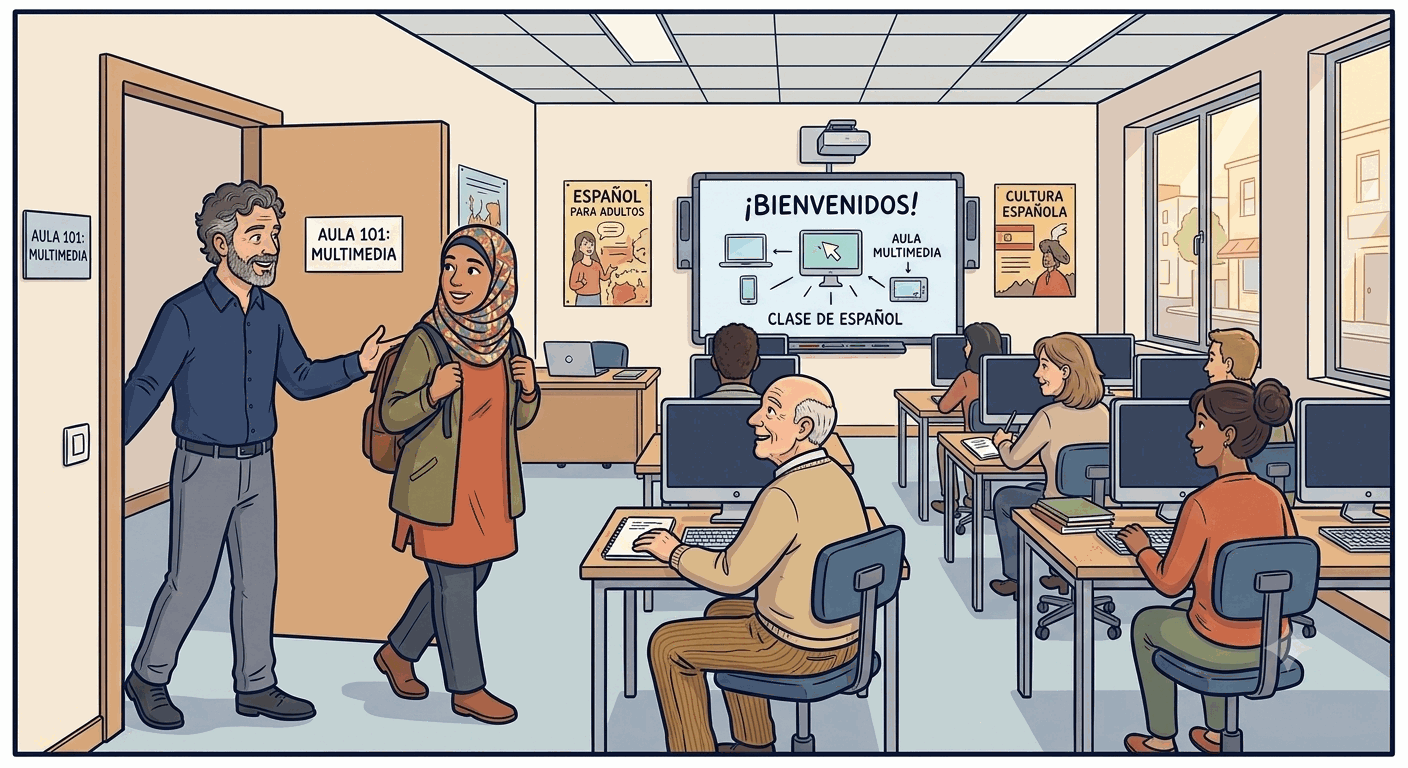
Es la primera clase del curso en el aula multimedia de La Cañada. Itto entra por primera vez buscando la clase de inglés para adultos.
🎧 Coloca el archivo audio/sda1_sesion1_story.mp3 junto a este HTML para que suene aquí.
It is September 2020, and it is Itto's first day at Alkayasí Adult School. She walks into Julio's classroom, a little nervous, and asks, "Good morning. Am I in the right classroom? I am looking for the English class for adults." Julio smiles and answers, "Yes, you are! Welcome! I am Julio, your English teacher." He asks her name, and Itto says, "My name is Itto. I am a new student in this school." Julio welcomes her and asks where she is from. Itto explains, "I am from Morocco, but now I live here, in La Cañada." Then Julio introduces Francisco, another student in the class. Francisco smiles and says, "Hello, Itto! Welcome to Alkayasí! I am seventy-six years old, and I am a student here since 2020, too — the same year as you!" Itto and Francisco greet each other warmly. Julio concludes, "We are a big, international family here: Spanish, Moroccan, Colombian, Romanian... Welcome to the group, Itto!"
| Forma | Significado | Ejemplo |
|---|---|---|
| I am | I'm (yo soy/estoy) | I'm Itto. |
| You are | You're (tú eres/estás) | You're a student. |
| He is | He's (él es/está) | He's Francisco. |
| She is | She's (ella es/está) | She's Itto. |
| It is | It's (ello es/está) | It's a modern school. |
| We are | We're (nosotros somos) | We're a big family. |
| They are | They're (ellos son) | They're from Spain. |
En inglés, deletrear (to spell) el nombre es una destreza básica: se usa en formularios, llamadas y para confirmar datos.
Ejemplo: "How do you spell your name?" → "I-T-T-O" (ai - ti - ti - ou)
1. Teacher /ˈtiːtʃə/ — Maestro/a.
2. Student /ˈstjuːdənt/ — Alumno/a.
3. Classmate /ˈklɑːsmeɪt/ — Compañero/a de clase.
4. Name /neɪm/ — Nombre de pila.
5. Surname /ˈsɜːneɪm/ — Apellido.
6. Country /ˈkʌntri/ — País.
7. Nationality /ˌnæʃəˈnæləti/ — Nacionalidad.
8. Welcome /ˈwelkəm/ — Bienvenido/a.
9. Adult /ˈædʌlt/ — Adulto/a.
10. Spell (v.) /spel/ — Deletrear.
Student A
1. "Good morning! Am I in the right classroom?"
2. "My name is _____."
3. "I am from _____."
4. "How do you spell your name?"
Student B
1. "Yes, you are! Welcome!"
2. "Nice to meet you! What is your name?"
3. "Where are you from?"
4. "Nice to meet you too. Welcome to Alkayasí!"
1. My name is
2. My surname is
3. I am from
4. I live in
5. I am a student at Alkayasí.
Cristóbal, alumno de informática e inglés (como su esposa Consuelo), es también nuevo este curso 2020, igual que Itto. Le enseña este cartel a un vecino suyo que aún no habla inglés y te pide que se lo expliques en español.
"Welcome to Alkayasí Adult School! Free English classes for adults. Monday to Thursday, 4:00 PM to 9:00 PM. All nationalities welcome!"
Tarea: Explícale a Cristóbal, en español y con tus propias palabras, qué dice el cartel.
ABBA — "The Winner Takes It All" (1980)
Busca la canción nº1 en tu libro Alkayasí Best English Songs Ever. Mientras escuchas, busca 3 ejemplos de contracciones del verbo to be (como it's, that's...) en la letra y anótalos.
SdA 1 · Clase 2
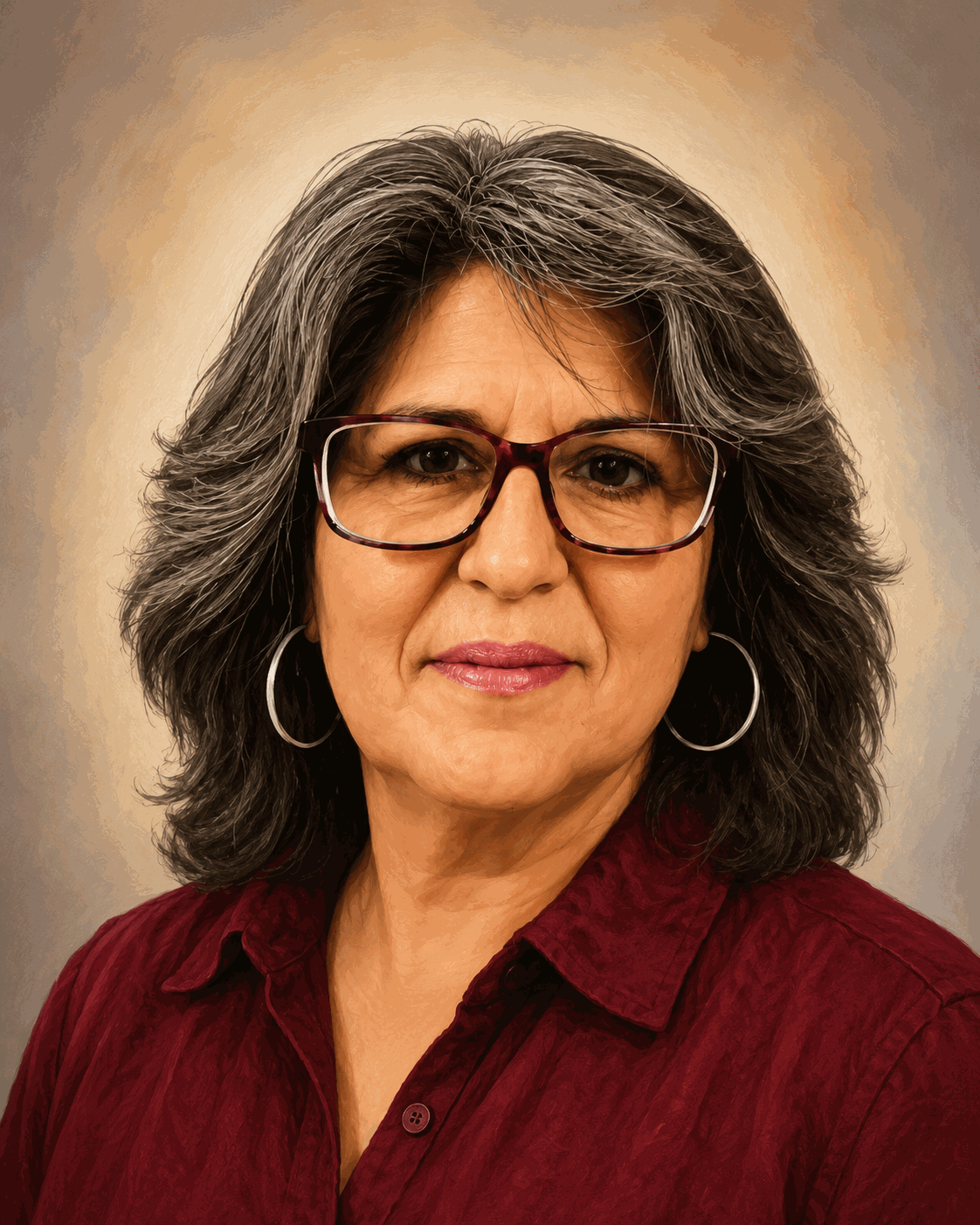
La Cañada · El aula multimedia de Alkayasí
| Bloque | Min | Contenido |
|---|---|---|
| 1. Listening | 10 | Escucha de la narración + comprensión global |
| 2. Reading | 15 | The Story + comprensión detallada |
| 3. Language Lab | 25 | Demonstratives: this/that/these/those |
| 4. Vocabulary Lab | 15 | 10 palabras clave |
| 5. Production | 15 | Speaking + Writing guiados |
| 6. Mediation | 8 | Mediación lingüística |
| 7. Sing Along | 2 | Adele — Someone Like You |
Escucha el audio del diálogo (sin leer el texto) y marca Verdadero (V) o Falso (F).
🎧 Coloca el archivo audio/sda1_sesion2_story.mp3 junto a este HTML para que suene aquí.
1. Itto has a new computer on her desk. →
2. There is no dictionary in the classroom. →
3. Carmen gives Itto a pen. →
4. The projector is not useful. →
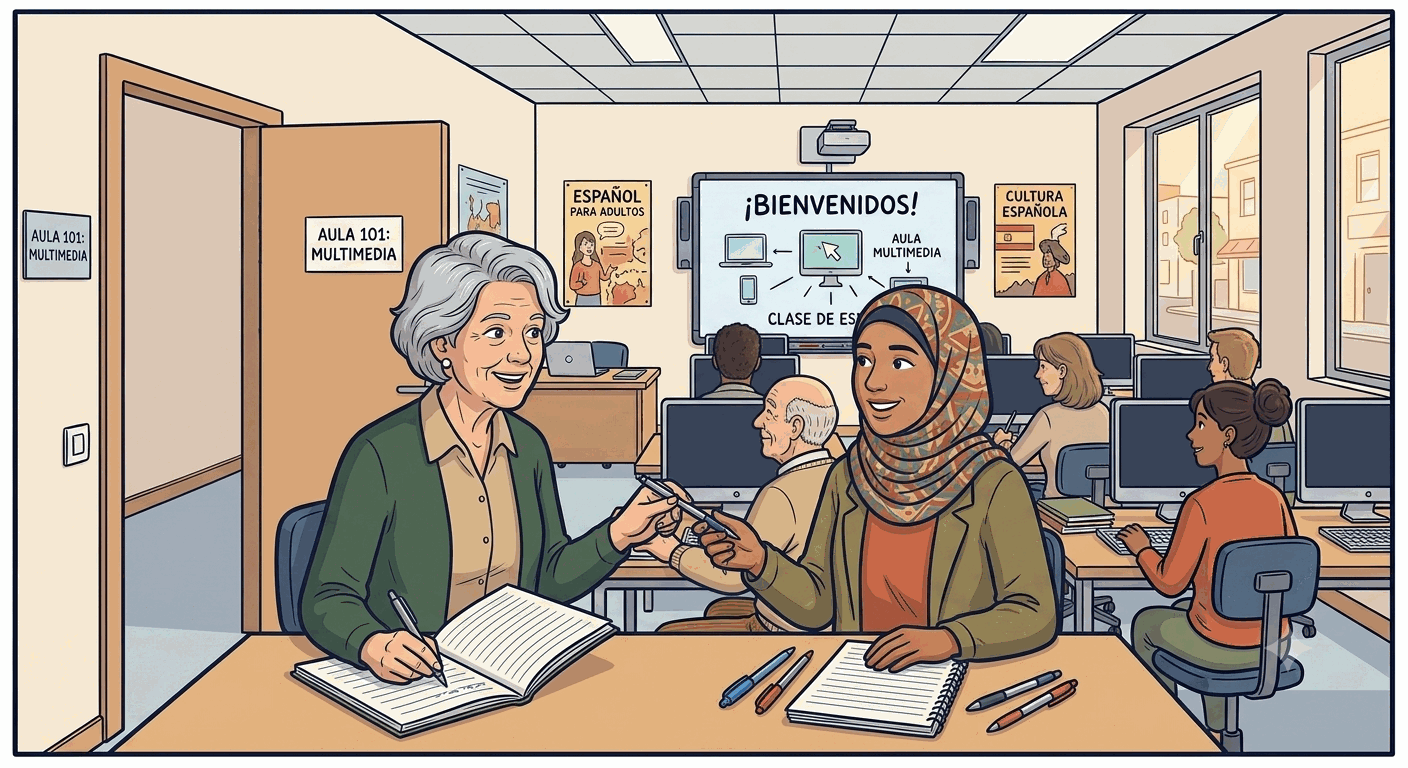
Itto conoce mejor el aula multimedia y a Carmen, otra compañera de clase.
🎧 Coloca el archivo audio/sda1_sesion2_story.mp3 junto a este HTML para que suene aquí.
In the multimedia classroom, Julio shows Itto around. He points and says, "This is your computer on the desk, and that is the smartboard at the front of the room." Itto looks at her chair and asks, "What are these objects on my chair?" Julio explains, "These are notebooks for writing, and those are the pens on Carmen's desk, over there." Carmen, another student, smiles and offers, "Hello, Itto! These pens are new. You can use one, if you like. I love English — it is a new hobby for me!" Itto thanks her and asks if there is an English dictionary in the classroom. Julio confirms, "Yes, there is! There is a big dictionary on your desk, next to the keyboard." Itto notices a machine on the wall and asks what it is. Julio answers, "That is the projector. It is very useful for our lessons." Carmen adds proudly, "And those are our twenty computers, Itto. Welcome to the best classroom in Alkayasí!"
| Forma | Significado | Ejemplo |
|---|---|---|
| This (cerca, singular) | Esto / este / esta | This computer is new. |
| These (cerca, plural) | Estos / estas | These notebooks are new. |
| That (lejos, singular) | Ese / esa / aquel | That smartboard is big. |
| Those (lejos, plural) | Esos / esas / aquellos | Those chairs are white. |
1. Notebook /ˈnəʊtbʊk/ — Cuaderno de apuntes.
2. Pen /pen/ — Bolígrafo.
3. Pencil /ˈpensl/ — Lápiz.
4. Computer /kəmˈpjuːtə/ — Ordenador.
5. Smartboard /ˈsmɑːtbɔːd/ — Pizarra digital (PDI).
6. Desk /desk/ — Pupitre o mesa.
7. Chair /tʃeə/ — Silla.
8. Keyboard /ˈkiːbɔːd/ — Teclado.
9. Mouse /maʊs/ — Ratón informático.
10. Dictionary /ˈdɪkʃənri/ — Diccionario.
Student A
1. "What is this?"
2. "What are those?"
3. "Is this your pen?"
4. "Are these your notebooks?"
Student B
1. "This is a keyboard."
2. "Those are windows."
3. "No, that is Carmen's pen."
4. "Yes, these are my notebooks."
1. This is my
2. These are my
3. That is the
4. Those are the
5. There is a dictionary on my desk.
Cristóbal, compañero de clase y también nuevo este curso, todavía confunde algunas etiquetas en inglés pegadas en los objetos del aula ("desk", "chair", "keyboard"...).
"Desk – Chair – Keyboard – Mouse – Dictionary – Smartboard"
Tarea: Ayuda a Cristóbal explicándole en español qué significa cada etiqueta y a qué objeto del aula corresponde.
Adele — "Someone Like You" (2011)
Busca la canción nº2 en tu libro de canciones. Localiza y anota 2 frases donde se use "this" o "that" (si aparecen) o, si no aparecen, anota 2 frases con el verbo "to be".
SdA 1 · Clase 3
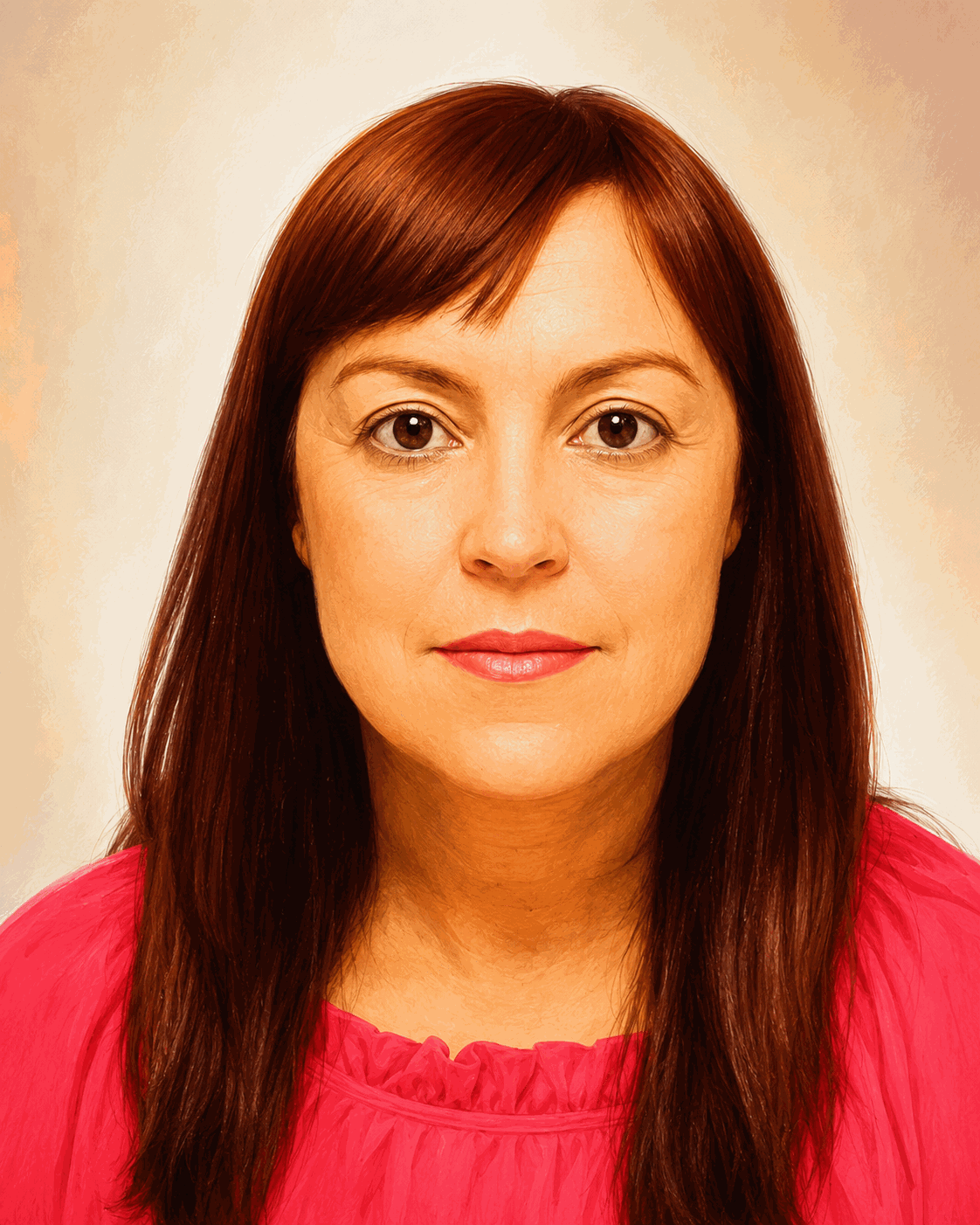
Un café en la plaza del barrio
| Bloque | Min | Contenido |
|---|---|---|
| 1. Listening | 10 | Escucha de la narración + comprensión global |
| 2. Reading | 15 | The Story + comprensión detallada |
| 3. Language Lab | 25 | There is / There are |
| 4. Vocabulary Lab | 15 | 10 palabras clave |
| 5. Production | 15 | Speaking + Writing guiados |
| 6. Mediation | 8 | Mediación lingüística |
| 7. Sing Along | 2 | Amy Winehouse — You Know I'm No Good |
Escucha el audio del diálogo (sin leer el texto) y marca Verdadero (V) o Falso (F).
🎧 Coloca el archivo audio/sda1_sesion3_story.mp3 junto a este HTML para que suene aquí.
1. There are three cafés near the church. →
2. There isn't a bus stop in La Cañada. →
3. Pilar recommends a café to Itto. →
4. There are no shops in the town. →
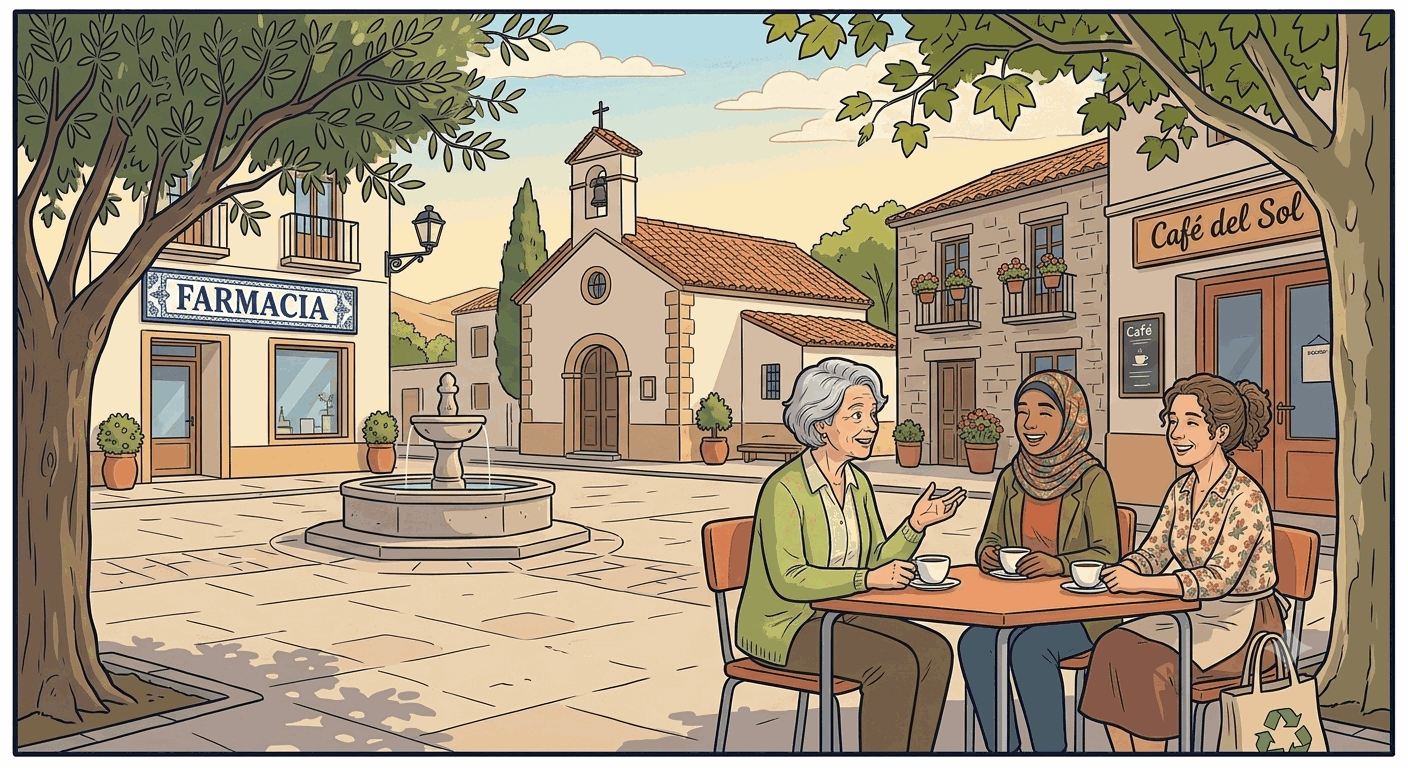
Itto y Julio pasean por La Cañada. Se encuentran con Pilar, otra compañera de clase, en la plaza.
🎧 Coloca el archivo audio/sda1_sesion3_story.mp3 junto a este HTML para que suene aquí.
Itto and Julio are walking around La Cañada. Itto says she likes the town very much, because there are many beautiful places. Julio points out a church square with big green trees, near the school. Suddenly, they meet Pilar, another student, in the square. She greets them and says, "There is a fantastic new café next to the pharmacy. Do you want to try it?" Itto asks if there is a good café for breakfast. Pilar answers, "Of course! There are three fantastic cafés, a pharmacy, and a municipal food market in front of the center. I am a student here too, in the Informática class!" Itto also asks about buses to the city center of Almería. Julio confirms, "Yes, there are! There is a convenient bus stop near the town hall." Pilar says goodbye: "Welcome to the neighborhood, Itto. See you in class!"
| Forma | Significado | Ejemplo |
|---|---|---|
| There is (singular) | Hay (uno) | There is a church. |
| There isn't | No hay (uno) | There isn't a station. |
| There are (plural) | Hay (varios) | There are three cafés. |
| There aren't | No hay (varios) | There aren't any cinemas. |
1. Church /tʃɜːtʃ/ — Iglesia.
2. Square /skweə/ — Plaza.
3. Café /ˈkæfeɪ/ — Cafetería.
4. Pharmacy /ˈfɑːməsi/ — Farmacia.
5. Market /ˈmɑːkɪt/ — Mercado municipal.
6. Bus stop /bʌs stɒp/ — Parada de autobús.
7. Supermarket /ˈsuːpəmɑːkɪt/ — Supermercado.
8. Town Hall /taʊn hɔːl/ — Ayuntamiento.
9. Park /pɑːk/ — Parque.
10. Street /striːt/ — Calle.
Student A
1. "Is there a pharmacy near here?"
2. "Are there any cafés in the square?"
3. "Is there a bus stop near the church?"
4. "How many markets are there?"
Student B
1. "Yes, there is. It is next to the market."
2. "Yes, there are. There are three."
3. "Yes, there is, near the town hall."
4. "There are two food markets."
1. There is a near my house.
2. There are two in my street.
3. There isn't a in La Cañada.
4. There are many in the square.
5. I like my neighborhood because...
Un turista despistado llega a las inmediaciones del centro y pregunta, angustiado, si hay alguna farmacia cerca.
"Excuse me, is there a pharmacy near here? I need to buy some medicine."
Tarea: Ayuda al turista traduciéndole la respuesta de Julio: "Yes, there is! There is a pharmacy near the church square."
Amy Winehouse — "You Know I'm No Good" (2006)
Busca la canción nº3 en tu libro de canciones y anota 2 palabras nuevas que reconozcas del vocabulario general de la unidad (no hace falta que estén en esta sesión).
SdA 1 · Clase 4
El formulario de matrícula oficial + los números

| Bloque | Min | Contenido |
|---|---|---|
| 1. Listening | 10 | Escucha de la narración + comprensión global |
| 2. Reading | 15 | The Story + comprensión detallada |
| 3. Language Lab | 25 | Negatives, Questions & Numbers 0-100 |
| 4. Vocabulary Lab | 15 | 10 palabras clave |
| 5. Production | 15 | Speaking + Writing guiados |
| 6. Mediation | 8 | Mediación lingüística |
| 7. Sing Along | 2 | Andy Williams — Love Story |
Escucha el audio del diálogo (sin leer el texto) y marca Verdadero (V) o Falso (F).
🎧 Coloca el archivo audio/sda1_sesion4_story.mp3 junto a este HTML para que suene aquí.
1. Itto is Spanish. →
2. Itto's phone number has six digits after the prefix. →
3. Tarik doesn't understand the form. →
4. Itto helps Tarik with the form. →
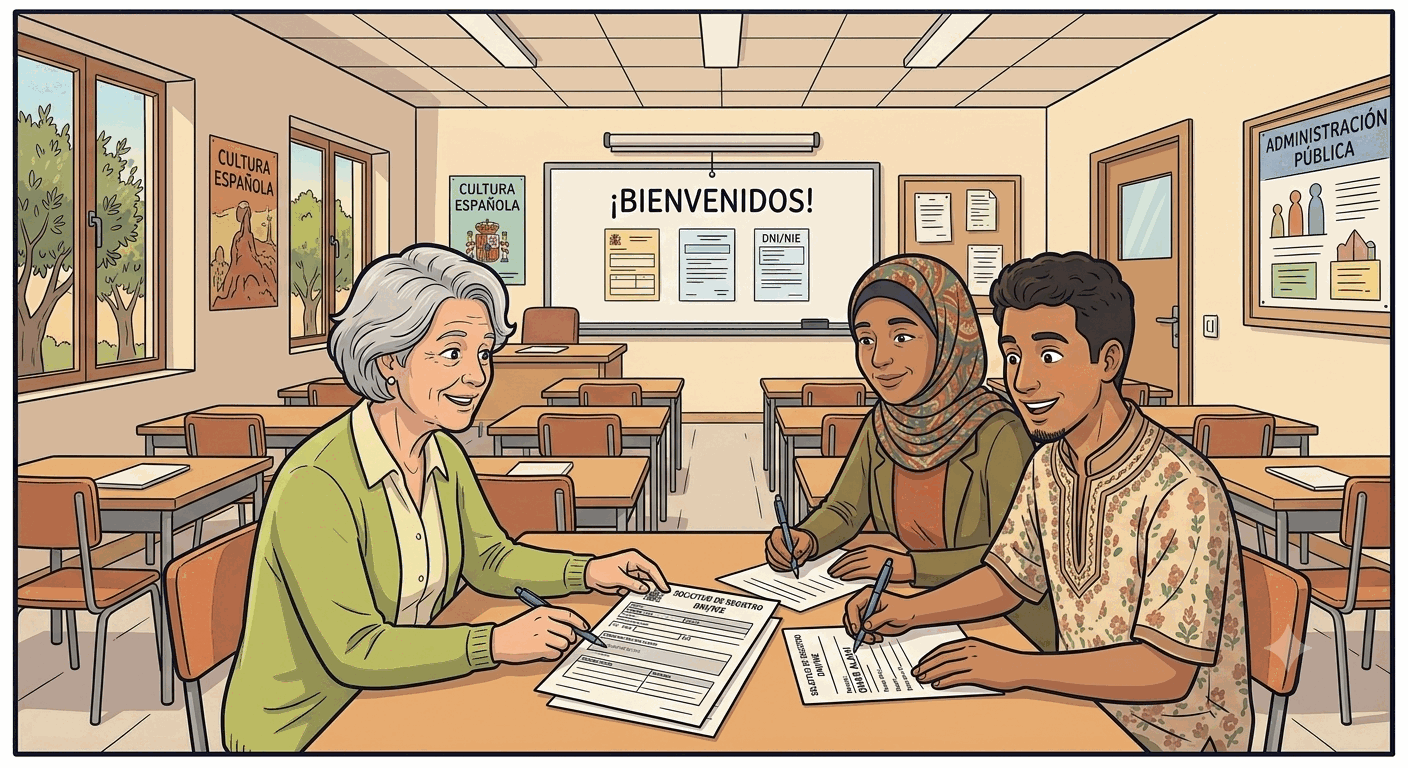
Itto rellena su ficha oficial de matrícula. Tarik, alumno también desde 2020 y camarero de profesión, se matricula el mismo día.
🎧 Coloca el archivo audio/sda1_sesion4_story.mp3 junto a este HTML para que suene aquí.
It is registration day, and Itto is filling in the official form for the adult course. Julio asks for her contact email address. Itto answers, "It is itto.canada@correo.com. And my phone number is six hundred, one two three, four five six." Julio then asks about her nationality, and if she is Spanish. Itto explains, "No, I am not. I am Moroccan, but my current postal address is in Almería." Nearby, Tarik, who works as a waiter and is also registering for the course, looks a little confused. He says, "I don't understand this form very well. Is it difficult?" Itto reassures him: "No, Tarik, it isn't difficult! Look: first name, surname, nationality, phone number... I can help you." Julio welcomes Tarik to Alkayasí and asks if he is over eighteen years old. Tarik laughs and answers, "Yes, of course! I am twenty-seven years old, and I have got a good job as a waiter in Almería."
| Forma | Significado | Ejemplo |
|---|---|---|
| I am not (I'm not) | Yo no soy/estoy | I'm not from Spain. |
| You are not (aren't) | Tú no eres/estás | You aren't Moroccan. |
| She is not (isn't) | Ella no es/está | She isn't a teacher. |
| Are you...? → Yes, I am. / No, I'm not. | ¿Eres...? Sí/No | Are you Spanish? No, I'm not. |
| Is he...? → Yes, he is. / No, he isn't. | ¿Es él...? Sí/No | Is he a teacher? Yes, he is. |
Para números compuestos: 23 = twenty-three; 45 = forty-five. Para deletrear un teléfono, se suele decir cada cifra por separado: 600-123-456 → "six, zero, zero... one, two, three... four, five, six".
1. First name /fɜːst neɪm/ — Nombre de pila.
2. Nationality /ˌnæʃəˈnæləti/ — Nacionalidad (en contexto de formulario).
3. Email address /ˈiːmeɪl əˈdres/ — Correo electrónico.
4. Phone number /fəʊn ˈnʌmbə/ — Número de teléfono.
5. Postal address /ˈpəʊstl əˈdres/ — Dirección postal.
6. Age /eɪdʒ/ — Edad.
7. Signature /ˈsɪɡnətʃə/ — Firma.
8. Postcode /ˈpəʊstkəʊd/ — Código postal.
9. Marital status /ˈmærɪtl ˈsteɪtəs/ — Estado civil.
10. Occupation /ˌɒkjuˈpeɪʃn/ — Ocupación / profesión.
Student A
1. "What is your phone number?"
2. "Are you married?"
3. "How old are you?"
4. "What is your postcode?"
Student B
1. "It is six... zero... zero..."
2. "No, I am not. I am single."
3. "I am twenty years old."
4. "It is zero four one two zero."
1. First Name:
2. Surname:
3. Nationality:
4. Phone Number:
5. Postal Address:
Tarik, alumno desde 2020, todavía no entiende bien el formulario oficial de matrícula del centro.
"First Name – Surname – Nationality – Phone Number – Email Address – Postal Address – Age – Marital Status"
Tarea: Ayuda a Tarik explicándole en español, campo por campo, qué información debe escribir en cada casilla del formulario.
Andy Williams — "Love Story" (1970)
Busca la canción nº4 en tu libro de canciones. Anota cualquier número (año, cantidad...) que aparezca mencionado en las notas del libro sobre la canción, si las hay.
SdA 1 · Clase 5
Las profesiones de la familia y los compañeros
| Bloque | Min | Contenido |
|---|---|---|
| 1. Listening | 10 | Escucha de la narración + comprensión global |
| 2. Reading | 15 | The Story + comprensión detallada |
| 3. Language Lab | 25 | Indefinite Articles & Possessive Adjectives |
| 4. Vocabulary Lab | 15 | 10 palabras clave |
| 5. Production | 15 | Speaking + Writing guiados |
| 6. Mediation | 8 | Mediación lingüística |
| 7. Sing Along | 2 | Barbra Streisand — Woman In Love |
Escucha el audio del diálogo (sin leer el texto) y marca Verdadero (V) o Falso (F).
🎧 Coloca el archivo audio/sda1_sesion5_story.mp3 junto a este HTML para que suene aquí.
1. Itto's brother is a journalist. →
2. Julio's father was a doctor. →
3. Tarik is twenty-seven years old. →
4. Julio's mother is still alive. →
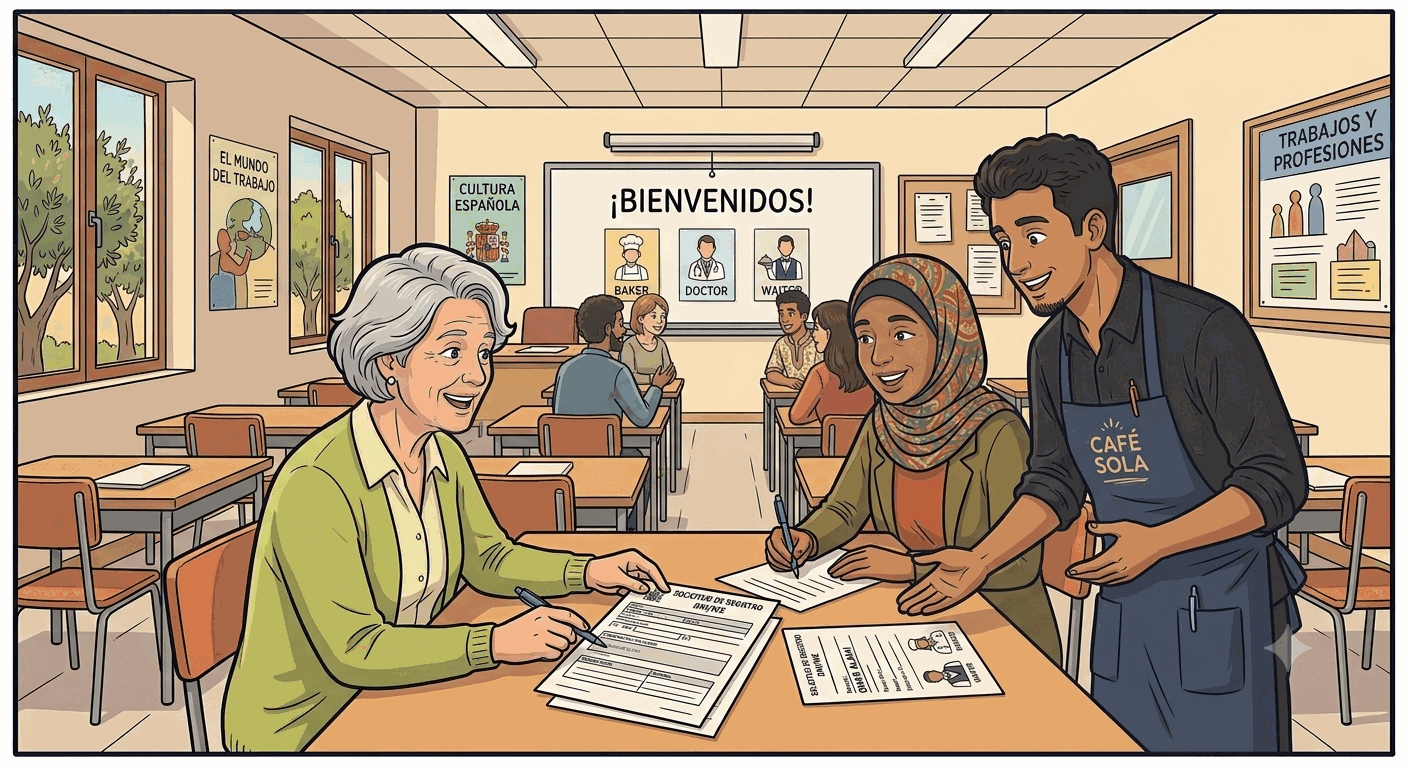
Itto habla con Julio sobre las profesiones de su familia. Tarik, compañero de clase, se une a la conversación.
🎧 Coloca el archivo audio/sda1_sesion5_story.mp3 junto a este HTML para que suene aquí.
Itto tells Julio about her family's jobs. "My brother Mustapha is a journalist in Morocco," she says. "He writes for a newspaper in Tadla, and he reports local news for his town." Julio nods and talks about his own parents, who are not alive now. "My father was a miner," he explains, "and he was already retired when he passed away, in 1997. My mother was a housewife, and she passed away in 2005." Itto listens carefully. "I am sorry, Julio," she says. "It is good to remember our family." Just then, Tarik arrives and greets them warmly. Itto explains that they are talking about jobs, and Tarik smiles. "My job is hard, but I like it," he says. "I am twenty-seven years old, and I am a waiter in a restaurant in Almería. I work many hours, but I meet interesting tourists every day." Julio replies, "That is a great job for practicing English!"
| Forma | Significado | Ejemplo |
|---|---|---|
| a + consonante | un/una | a journalist, a waiter |
| an + vocal | un/una | an assistant, an occupation |
| My / Your | Mi(s) / Tu(s) | My father / Your sister |
| His / Her | Su (de él) / Su (de ella) | His job / Her family |
1. Journalist /ˈdʒɜːnəlɪst/ — Periodista.
2. Waiter /ˈweɪtə/ — Camarero.
3. Retired /rɪˈtaɪəd/ — Jubilado/a.
4. Housewife /ˈhaʊswaɪf/ — Ama de casa.
5. Doctor /ˈdɒktə/ — Médico/a.
6. Nurse /nɜːs/ — Enfermero/a.
7. Driver /ˈdraɪvə/ — Conductor/a.
8. Restaurant /ˈrestrɒnt/ — Restaurante.
9. Family /ˈfæməli/ — Familia.
10. Parents /ˈpeərənts/ — Los padres.
Student A
1. "Are you a doctor?"
2. "Is your father retired?"
3. "What is Tarik's job?"
4. "Are you a waiter?"
Student B
1. "No, I'm not. I am a nurse."
2. "Yes, he is."
3. "He is a waiter."
4. "No, I'm not. I am a driver."
1. My father is a
2. My mother is a
3. My brother/sister is a
4. His/Her job is
5. I am a
Francisco ha visto un cartel de ofertas de empleo en inglés en el tablón del centro social y no entiende bien qué profesiones se piden.
"Wanted: Shop Assistant, Driver, Waiter, Nurse. Apply at the Town Hall."
Tarea: Explícale a Francisco en español qué profesiones se piden en el cartel y dónde debe presentar su solicitud.
Barbra Streisand — "Woman In Love" (1980)
Busca la canción nº5 en tu libro de canciones y anota si aparece alguna profesión o palabra de esta sesión relacionada con el trabajo.
SdA 1 · Clase 6
The Journey Starts — Gran repaso final de la unidad

| Bloque | Min | Contenido |
|---|---|---|
| 1. Review | 20 | Repaso de gramática consolidada |
| 2. Vocabulary Review | 15 | 10 palabras de repaso |
| 3. Final Quiz | 25 | Cuestionario final de 10 preguntas |
| 4. Roleplay | 20 | La Feria Internacional de Alkayasí |
| 5. Sing Along | 10 | Ben E. King — Stand By Me |
| Forma | Significado | Ejemplo |
|---|---|---|
| To Be (afirmativa/negativa/pregunta) | I'm a student. / She isn't Moroccan. / Is he a teacher? | |
| Demostrativos | This computer here. / That smartboard there. | |
| There is / There are | There is a square. / There are three cafés. | |
| Posesivos y artículos | My classmate is a waiter. / He is a waiter. |
1. Classmates /ˈklɑːsmeɪts/ — Compañeros de clase.
2. Greetings /ˈɡriːtɪŋz/ — Saludos.
3. Classroom /ˈklɑːsruːm/ — Aula.
4. Neighborhood /ˈneɪbəhʊd/ — Barrio.
5. Occupation /ˌɒkjuˈpeɪʃn/ — Profesión.
6. Review /rɪˈvjuː/ — Repaso.
7. Town /taʊn/ — Pueblo.
8. Origin /ˈɒrɪdʒɪn/ — Procedencia.
9. Level /ˈlevl/ — Nivel.
10. Journey /ˈdʒɜːni/ — Viaje/trayectoria.
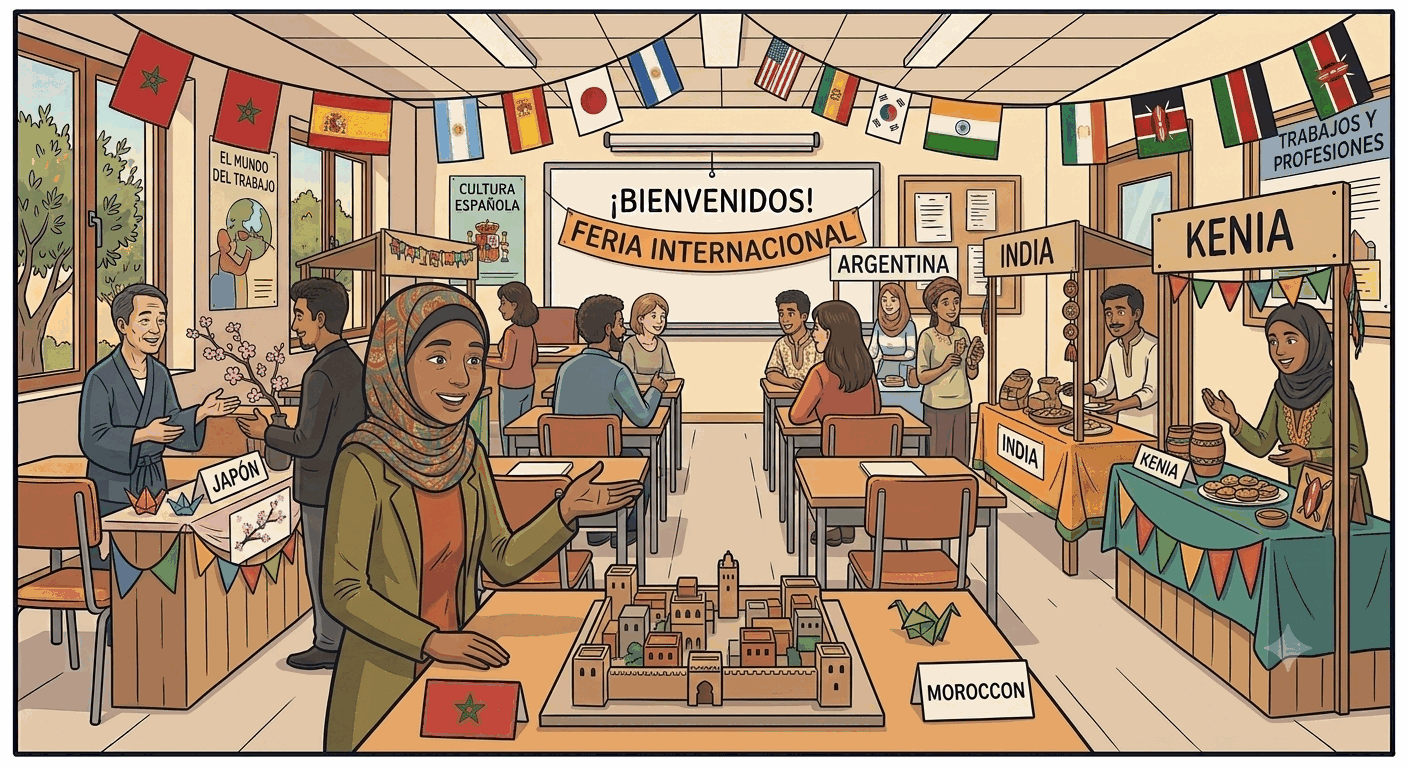
Simulamos ser miembros de la comunidad multicultural del SEP Alkayasí en 2020: Francisco, Carmen, Consuelo, Cristóbal, Pilar, Rogelio y Tarik forman los distintos "stands" de la Feria. En parejas, preséntate, indica tu origen, deletrea tu email e indica tu profesión (actual o jubilación) usando estructuras completas de la SdA 1.
Ben E. King — "Stand By Me" (1968)
Cerramos esta primera Situación de Aprendizaje celebrando la cohesión y el apoyo mutuo del grupo. Escucha la canción nº6 de tu libro y comenta en clase qué sentimiento transmite.