
SEP Alkayasí · CEPER 500 Viviendas
SEP Alkayasí · CEPER 500 Viviendas
SdA A2·6 · Clase 1
Un papel que falta en octubre, una respuesta que llega en diciembre, y un plazo que empieza a correr en Rabat



| Bloque | Min | Contenido |
|---|---|---|
| Warm-up + Listening | 15 | Audio + T/F |
| Reading & comprensión | 20 | Lectura + preguntas |
| Language Lab | 20 | Present Perfect (ever/never) + 15 drills |
| Vocabulary Lab | 10 | 15 palabras nuevas |
| Production | 15 | Speaking + Writing |
| Mediation | 5 | Tarea de mediación |
| Sing Along + Roleplay | 5 | Canción + cierre |
Escucha el audio de la narración (sin leer el texto) y marca True (T) o False (F).
🎧 Coloca el archivo audio/sda6_sesion1_listening.mp3 junto a este HTML para que suene aquí.
1. The letter from Almería in October said everything was approved. →
2. The lawyer thought the request for more documents was a bad sign. →
3. Itto sent the missing document the next day. →
4. The family waited about six weeks for an answer. →
5. The final resolution arrived in October. →
El calvario administrativo de Mustapha en Rabat
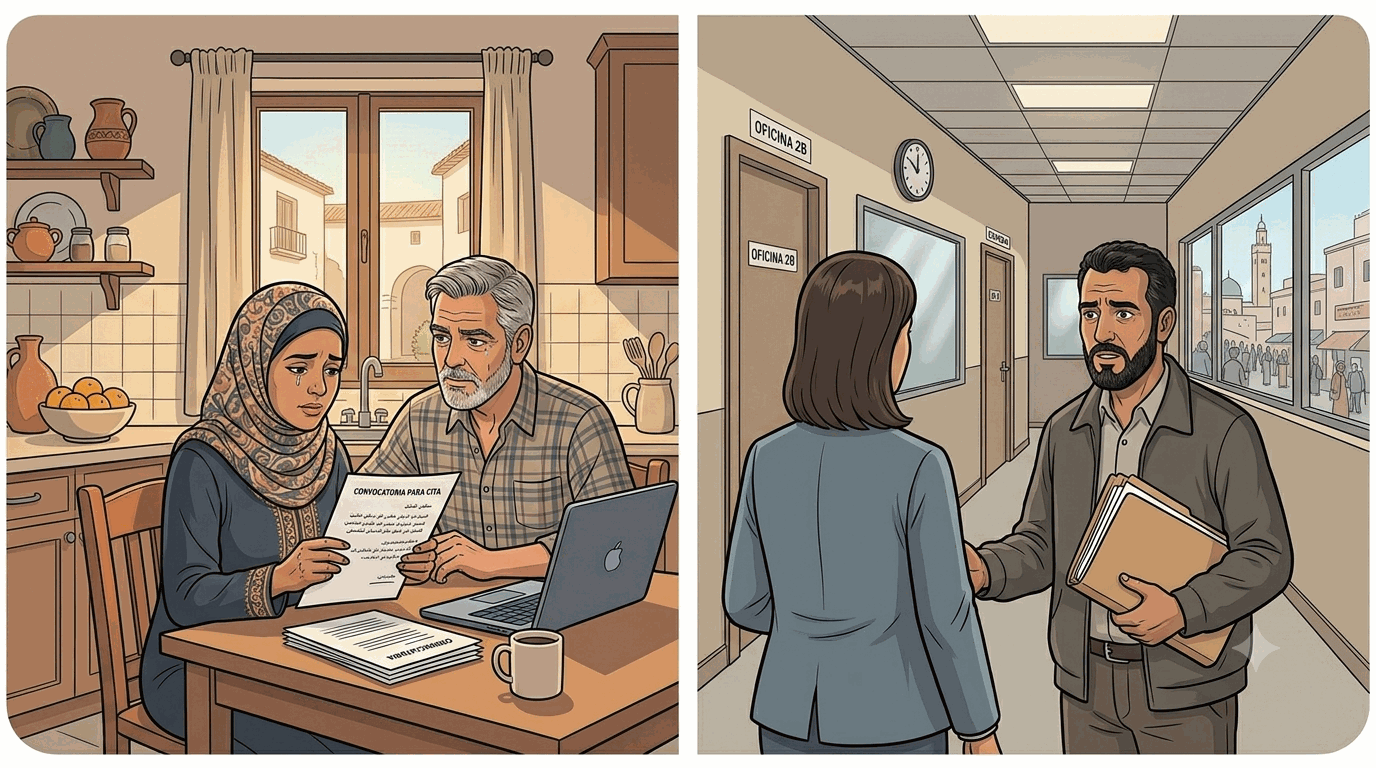
Imagen generada con Google Gemini Flash-Lite
🎧 Coloca el archivo audio/sda6_sesion1_story.mp3 junto a este HTML para que suene aquí.
The good news reached Mustapha within minutes: his sister had sent a single voice
message, her voice breaking with relief. "They said yes, Mustapha. Mum and Dad can go to
Spain." He allowed himself thirty seconds of pure happiness before his journalist's brain
took over completely: the resolution came with a clock attached. Thirty days. If his parents
didn't enter Spain within a month, the whole process would be cancelled, and they would have
to start again from zero.
He had covered enough news stories about the Spanish Embassy in Rabat to know exactly what he
was facing. Nobody simply walked in. Appointments for a visa interview were being given for
six months ahead, sometimes more — an absurd number when set against his thirty-day deadline.
For two days, he tried every official channel he could think of: the embassy's phone line,
its website, a formal letter through a colleague at the radio station. Nothing moved.
On the third day, an older colleague pulled him aside quietly. "There are people who know how
to get things done faster," he said, "if you're desperate enough." Mustapha was desperate
enough. He got a phone number for a man who, for a fee, arranged appointments that seemed
impossible to arrange through the official channels alone — a small, unofficial world that
existed, as far as Mustapha could tell, in the shadow of every embassy in the country.
The agent's first request was simple: a folder of documents proving that Ali Boukrim and
Fátima Aachouch had no one else in Morocco who could support them. It sounded easy. It
wasn't. Mustapha spent the following two weeks travelling between towns, government offices
and relatives he barely remembered, chasing papers that seemed to multiply every time he
thought he was finished.
By the time the folder was complete, barely a week of the thirty days remained. Mustapha
handed everything over and waited, exhausted, wondering whether it had all been worth it — or
whether, after everything, his parents would spend Christmas still waiting in Ouaoumana.
Retomamos el Present Perfect visto en la SdA A2·5, y añadimos su uso más característico: hablar de experiencias de vida, sin importar cuándo ocurrieron exactamente (Have you ever...? / I've never...). Usamos ever en preguntas (Have you ever waited six months for an appointment?) y never en frases negativas (Mustapha has never dealt with paperwork like this before). Seguimos usando el Present Perfect también para resultados presentes de acciones pasadas y para situaciones que empiezan en el pasado y continúan.
Pulsa cada palabra para consultarla en WordReference.
1. embassy (n.) /ˈembəsi/ — embajada.
2. appointment (n.) /əˈpɔɪntmənt/ — cita.
3. paperwork (n.) /ˈpeɪpəwɜːk/ — papeleo.
4. agent (n.) /ˈeɪdʒənt/ — gestor, intermediario.
5. visa (n.) /ˈviːzə/ — visado.
6. grant (v.) /ɡrɑːnt/ — conceder.
7. reject (v.) /rɪˈdʒekt/ — rechazar.
8. missing (adj.) /ˈmɪsɪŋ/ — que falta.
9. delay (n./v.) /dɪˈleɪ/ — retraso / retrasar.
10. unofficial (adj.) /ˌʌnəˈfɪʃl/ — extraoficial.
11. family reunification /ˈfæməli ˌriːjuːnɪfɪˈkeɪʃn/ — reagrupación familiar.
12. time limit /ˈtaɪm ˌlɪmɪt/ — plazo.
13. comfort (v./n.) /ˈkʌmfət/ — consolar / consuelo.
14. postpone (v.) /pəˈspəʊn/ — posponer.
15. against the clock (idiom) /əˈɡenst ðə klɒk/ — contrarreloj.
Cuenta una vez en que tuviste que esperar mucho tiempo por un trámite importante (una cita médica, un papel oficial, una respuesta de una administración). ¿Cómo te sentiste mientras esperabas?
1. Escribe 2 frases con Present Perfect + "ever", en forma de pregunta, sobre experiencias de trámites o esperas.
2. Escribe 2 frases con Present Perfect + "never", sobre algo que Mustapha nunca ha hecho.
3. Escribe una frase en pasado simple sobre un momento concreto de la historia (con fecha o momento claro).
Un amigo tuyo, que no habla inglés, no entiende bien esta frase de la historia.
"There are people who know how to get things done faster, if you're desperate enough."
Tarea: Explícale en español, de forma clara y natural, qué implica esta frase sobre cómo funcionaba en realidad el proceso en la Embajada, sin traducir palabra por palabra.
Paul Anka – Papa (1974)
Escuchad la canción y localizad las palabras relacionadas con el paso del tiempo y el esfuerzo de un padre por su familia — comentad en clase el paralelismo con el esfuerzo de Mustapha por sus propios padres.
Trabajo opcional para casa — Libro 4: 50 Selected AI Songs for A2
Morgan Luna – Infinite Love
Escucha esta canción en casa y anota qué palabras usa para hablar del amor incondicional entre generaciones.
Imagen generada con Google Gemini Flash-Lite
En parejas, representad la llamada telefónica entre Mustapha y el "agente" en la que este le pide el primer documento. Usad al menos 2 frases con Present Perfect (have you ever / I've never).
SdA A2·6 · Clase 2
Catorce horas de viaje y una primera noche llena de comparaciones
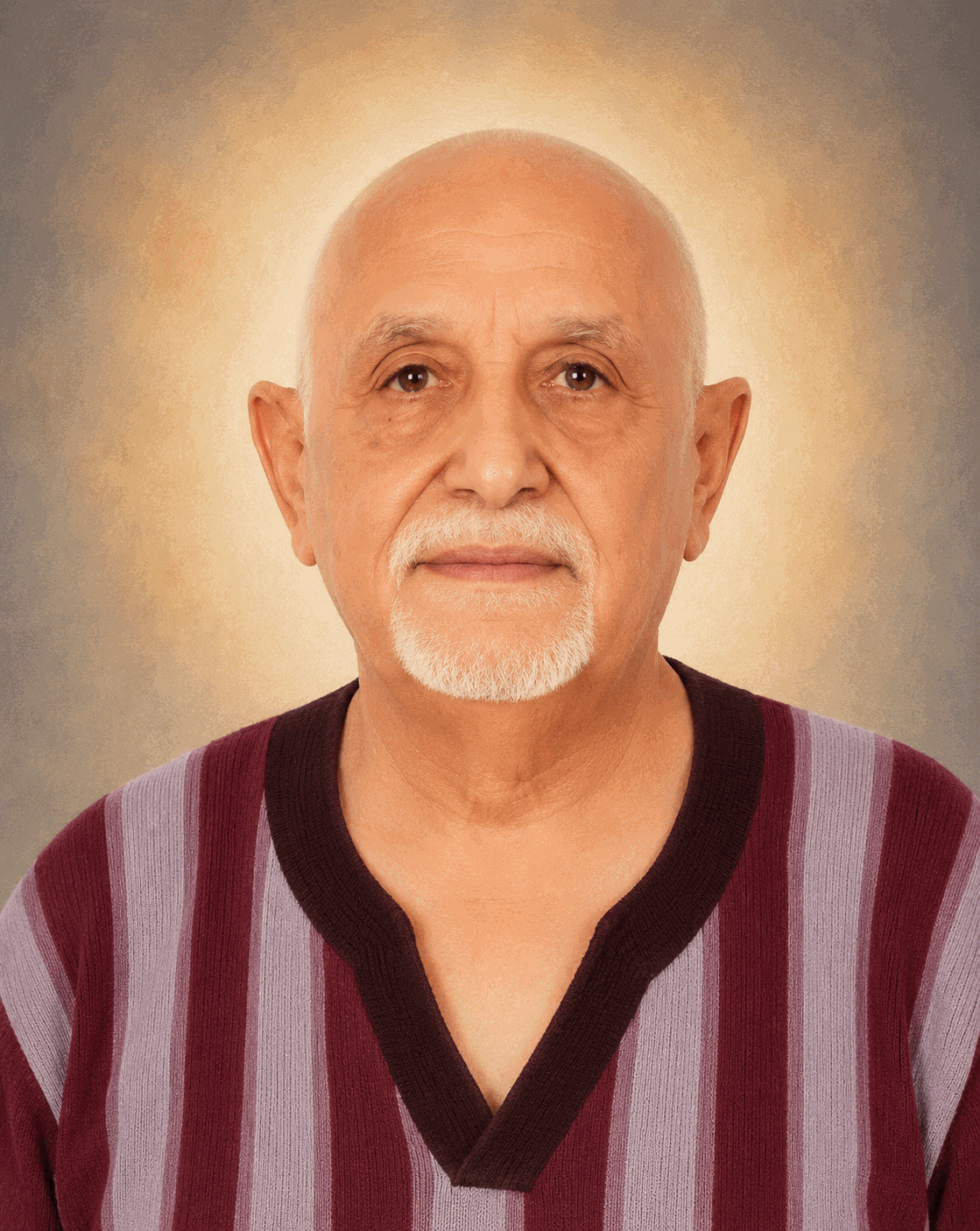
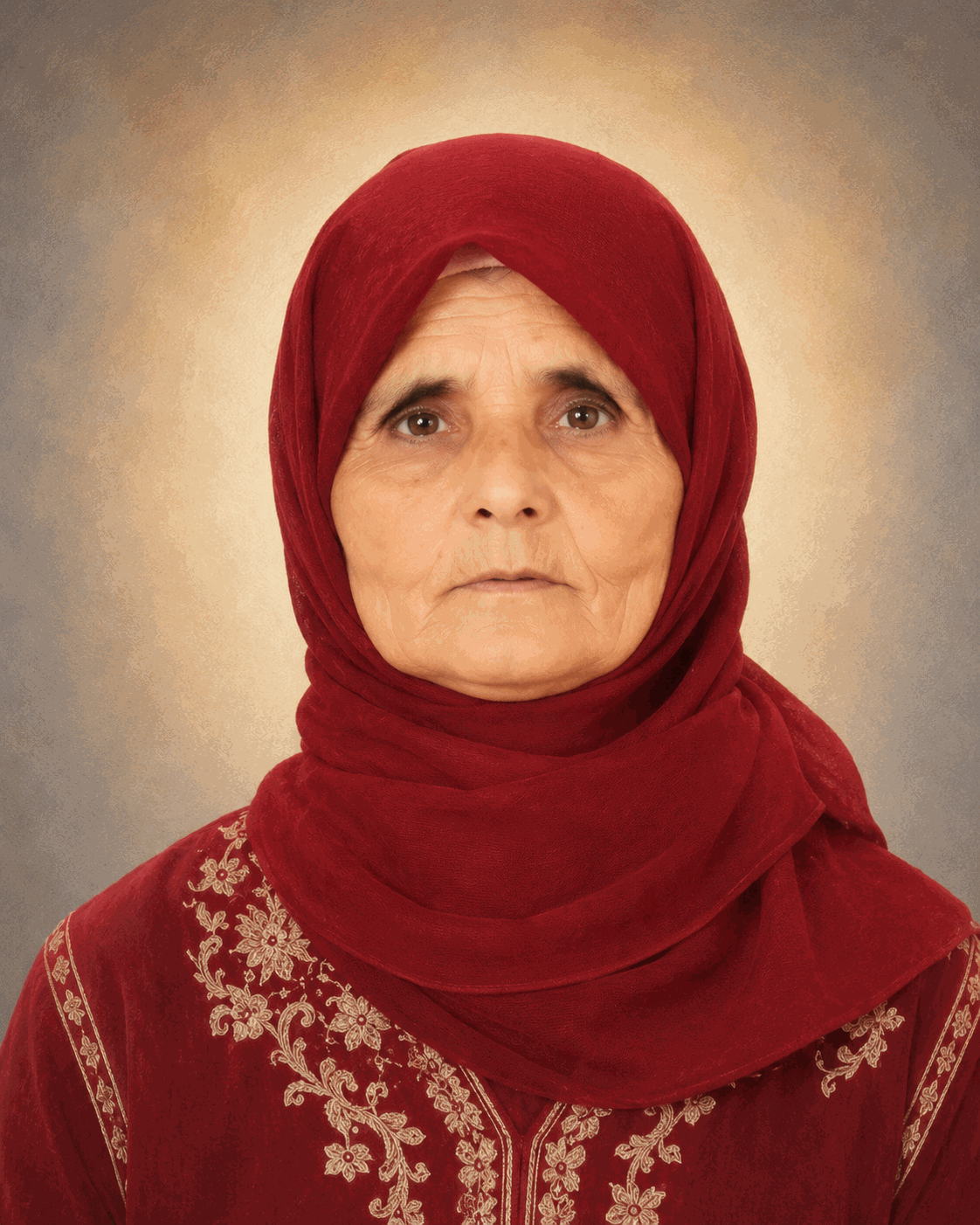
| Bloque | Min | Contenido |
|---|---|---|
| Warm-up + Listening | 15 | Audio + T/F |
| Reading & comprensión | 20 | Lectura + preguntas |
| Language Lab | 20 | Comparativos (intro) + 15 drills |
| Vocabulary Lab | 10 | 15 palabras nuevas |
| Production | 15 | Speaking + Writing |
| Mediation | 5 | Tarea de mediación |
| Sing Along + Roleplay | 5 | Canción + cierre |
Escucha el audio de la narración (sin leer el texto) y marca True (T) o False (F).
🎧 Coloca el archivo audio/sda6_sesion2_listening.mp3 junto a este HTML para que suene aquí.
1. The van left Morocco in the evening. →
2. Ali Boukrim slept for most of the journey. →
3. Fátima wore two blankets even though the van had heating. →
4. The journey included a ferry crossing. →
5. Nobody was waiting for them when they arrived. →
Primeras comparaciones, la primera noche en la nueva casa
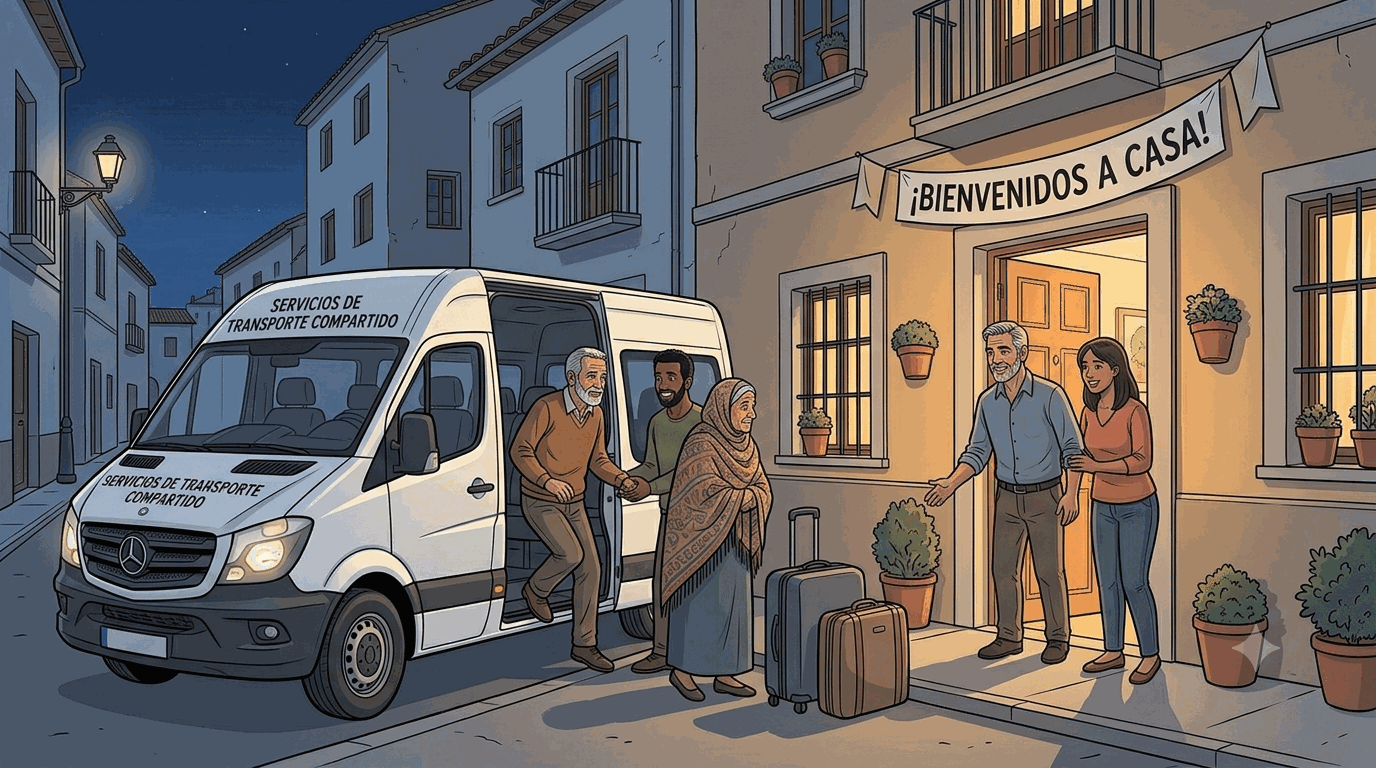
Imagen generada con Google Gemini Flash-Lite
🎧 Coloca el archivo audio/sda6_sesion2_story.mp3 junto a este HTML para que suene aquí.
By the time the van finally stopped outside the house, it was almost eight in the
evening, and the January air felt sharper than either grandparent had expected. Ali Boukrim
climbed down slowly, gripping Tarik's arm, and looked up at the three floors of the house
with something between admiration and disbelief. "Bigger than I imagined," he said quietly to
Itto, in Tamazight.
Inside, the differences kept coming. The heating was gentler than the wood stoves they were
used to, but somehow the house still felt colder — Fátima blamed the tall ceilings and the
tiled floors, so unlike the packed earth of her own kitchen back home. The roads on the way
from the port had been smoother than anything in the Middle Atlas: no potholes, no dust, just
long stretches of grey tarmac lit by orange streetlights. "Roads like these," Ali Boukrim
said, half-joking, "and yet somehow slower drivers than ours."
Julio had prepared what he thought was a simple welcome dinner — soup, bread, grilled chicken
— but Fátima eyed the plates with polite suspicion before finally trying everything, one
small bite at a time. She found the bread softer than hers, less filling somehow, and said so
without any hesitation, in a tone that made Itto laugh despite her exhaustion.
Later that night, once the suitcases were finally unpacked and the house had gone quiet,
Julio found Ali Boukrim standing at the living-room window, looking out at the streetlights
of La Cañada. "It's a lot brighter here than back home," the old man said, almost to himself.
"The sky at night was darker in Ouaoumana — you could see more stars." Julio didn't quite
know how to answer that, so he simply stood beside him for a while, saying nothing, letting
the first strange night of their new life settle quietly around all four of them.
Empezamos los comparativos: para adjetivos cortos añadimos -er + than (colder than, softer than, smoother than); para adjetivos largos usamos more + adjetivo + than. Recordamos también las formas irregulares: better than, worse than. Practicamos comparando el viaje, el clima y las costumbres de Ouaoumana y Almería.
Pulsa cada palabra para consultarla en WordReference.
1. van (n.) /væn/ — furgoneta.
2. driver (n.) /ˈdraɪvə/ — conductor/a.
3. overnight (adj./adv.) /ˌəʊvəˈnaɪt/ — de un día para otro.
4. shattered (adj.) /ˈʃætəd/ — agotadísimo/a.
5. unfamiliar (adj.) /ˌʌnfəˈmɪliə/ — desconocido/a.
6. climate (n.) /ˈklaɪmət/ — clima.
7. humidity (n.) /hjuːˈmɪdəti/ — humedad.
8. mild (adj.) /maɪld/ — suave (clima).
9. paved (adj.) /peɪvd/ — asfaltado/a.
10. similar (adj.) /ˈsɪmələ/ — parecido/a.
11. overwhelmed (adj.) /ˌəʊvəˈwelmd/ — abrumado/a.
12. reunite (v.) /ˌriːjuːˈnaɪt/ — reunir(se).
13. get used to (phrasal v.) /ɡet ˈjuːst tə/ — acostumbrarse a.
14. routine (n.) /ruːˈtiːn/ — rutina.
15. warmly (adv.) /ˈwɔːmli/ — calurosamente.
En parejas, comparad dos lugares que conozcáis bien (dos ciudades, dos casas, dos países). Usad al menos 3 comparativos.
1. Escribe 3 frases comparando el viaje en furgoneta con un viaje que hayas hecho tú.
2. Escribe 2 frases sobre las diferencias de clima entre Ouaoumana y Almería.
3. Escribe una frase con Present Perfect sobre algo que los abuelos han hecho por primera vez esa noche (repaso).
Un amigo español no entiende bien por qué Ali Boukrim diría esto sobre los conductores españoles.
"Roads like these, and yet somehow slower drivers than ours."
Tarea: Explícale en español la broma/observación, capturando el humor, sin traducir palabra por palabra.
Phil Collins – Against All Odds (1981)
Toda la familia ha superado obstáculos para llegar hasta este momento; comentad qué versos de la canción podrían aplicarse al esfuerzo de Mustapha en la Sesión 1.
Trabajo opcional para casa — Libro 4: 50 Selected AI Songs for A2
Raselhits – In Loving Memory
Escucha esta canción en casa: ¿qué momentos del pasado creéis que echan de menos los abuelos en su primera noche en España?
Imagen generada con Google Gemini Flash-Lite
En grupos de 3, representad la primera cena de bienvenida: uno interpreta a Julio, sirviendo la comida; otro a Fátima, comparando en voz alta cada plato con la comida de casa; otro a Ali Boukrim, mirando la casa y comparándola con Ouaoumana. Usad al menos 3 comparativos.
SdA A2·6 · Clase 3
Dormitorios, trámites y un chequeo médico con sorpresa
| Bloque | Min | Contenido |
|---|---|---|
| Warm-up + Listening | 15 | Audio + T/F |
| Reading & comprensión | 20 | Lectura + preguntas |
| Language Lab | 20 | Comparativos (as...as) + intro superlativos + 15 drills |
| Vocabulary Lab | 10 | 15 palabras nuevas |
| Production | 15 | Speaking + Writing |
| Mediation | 5 | Tarea de mediación |
| Sing Along + Roleplay | 5 | Canción + cierre |
Escucha el audio de la narración (sin leer el texto) y marca True (T) o False (F).
🎧 Coloca el archivo audio/sda6_sesion3_listening.mp3 junto a este HTML para que suene aquí.
1. Registering at the town hall took several hours. →
2. The NIE process at the Immigration Office was quicker than the town hall visit. →
3. Itto had to visit the Immigration Office more than once. →
4. Mustapha made a joke about the paperwork feeling familiar. →
5. Everyone in the family laughed at Mustapha's joke. →
Dormitorios, trámites y un chequeo médico con sorpresa
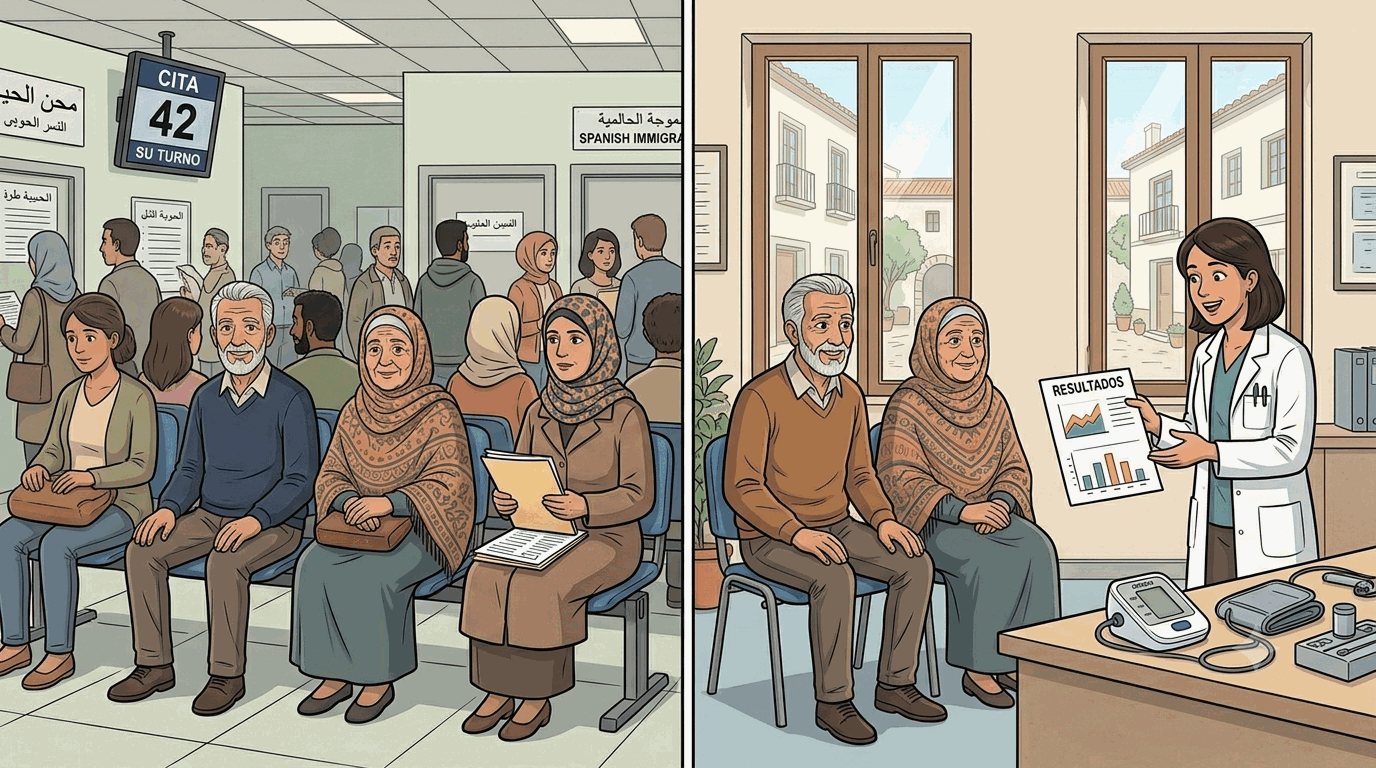
Imagen generada con Google Gemini Flash-Lite
🎧 Coloca el archivo audio/sda6_sesion3_story.mp3 junto a este HTML para que suene aquí.
Preparing the house had taken almost three weeks. The living room, once full of
bookshelves and Julio's old armchair, was now a bedroom for Ali Boukrim, with a low, firm bed
and a small bathroom converted from what used to be a store cupboard — close enough that he
never had to climb a single step at night. Upstairs, the second guest bedroom, separated from
Julio and Itto's own room by the main bathroom, became Fátima's space, at least officially.
Within three days, though, she had pushed the mattress of her comfortable double bed against
the wall and was sleeping, as she always had, on a folded blanket on the floor. Julio's old
study migrated to what had been the smallest bedroom, now barely big enough for a desk and a
single bookshelf, but private enough for him not to complain.
Food turned out to be less of a battle than clothing. Fátima accepted most Spanish dishes
with only mild suspicion, but she flatly refused to wear anything without long sleeves,
regardless of how mild the Almería winter actually was; Ali Boukrim, for his part, kept his
usual djellaba for the house and only agreed, after some gentle negotiation from Itto, to a
warmer jacket for outings.
The bureaucracy, meanwhile, refused to slow down. After the town hall came the Immigration
Office and the long wait for the grandparents' NIE, and after the NIE came MUFACE: Julio's
health insurance, adapted with some effort to now cover two more people. A full medical
check-up followed almost immediately — blood tests, blood pressure, the works — and the
results surprised everyone except, perhaps, Fátima herself. Both grandparents, the doctor
explained with visible amusement, were in noticeably better shape than most of his Spanish
patients half their age. Ali Boukrim's blood pressure needed a little watching, nothing more;
Fátima's numbers, across the board, looked almost enviable. "At this rate," Itto told Julio
that evening, only half-joking, "my mother is going to outlive both of us."
Seguimos con los comparativos, y añadimos la estructura as + adjetivo + as (para decir que dos cosas son iguales) y not as + adjetivo + as (para decir que una es menos... que otra). También empezamos a fijarnos en los superlativos, que desarrollaremos en la Sesión 4.
Pulsa cada palabra para consultarla en WordReference.
1. register (v.) /ˈredʒɪstə/ — empadronar(se).
2. town hall (n.) /taʊn hɔːl/ — ayuntamiento.
3. residence permit (n.) /ˈrezɪdəns ˌpɜːmɪt/ — permiso de residencia.
4. form (n.) /fɔːm/ — impreso, formulario.
5. proof (n.) /pruːf/ — justificante, prueba.
6. coverage (n.) /ˈkʌvərɪdʒ/ — cobertura.
7. check-up (n.) /ˈtʃek ʌp/ — revisión médica.
8. blood pressure /blʌd ˈpreʃə/ — tensión arterial.
9. dependant (n.) /dɪˈpendənt/ — persona dependiente / a cargo.
10. generation (n.) /ˌdʒenəˈreɪʃn/ — generación.
11. habit (n.) /ˈhæbɪt/ — hábito.
12. custom (n.) /ˈkʌstəm/ — costumbre.
13. flexible (adj.) /ˈfleksəbl/ — flexible.
14. adapt (v.) /əˈdæpt/ — adaptarse.
15. inflexible (adj.) /ɪnˈfleksəbl/ — inflexible.
¿Qué costumbre tuya sería más difícil de cambiar si te mudaras a vivir a otro país? Compara con tu compañero/a usando comparativos.
1. Escribe 2 frases con "as...as" o "not as...as" sobre las diferencias entre la casa de Ouaoumana y la casa de Almería.
2. Escribe 2 frases comparando la comida o la ropa de los abuelos con las costumbres españolas.
3. Escribe una frase con superlativo sobre algo de la historia (p. ej. el trámite más difícil).
Un amigo te pregunta qué quiso decir Itto exactamente con esta frase.
"At this rate, my mother is going to outlive both of us."
Tarea: Explícaselo en español, con el mismo tono medio en broma medio en serio.
Pink Floyd – Comfortably Numb (1979)
El título juega con la idea de sentirse "cómodamente insensible" — comentad en clase si creéis que, después de tantos trámites, la familia empieza por fin a sentirse simplemente "cómoda", sin más sobresaltos.
Trabajo opcional para casa — Libro 4: 50 Selected AI Songs for A2
Bleeding Strings – No More Fear, No More Silence
Escucha esta canción en casa: ¿creéis que el título podría describir cómo se siente ahora la familia, después de superar tantos trámites?
Imagen generada con Google Gemini Flash-Lite
En parejas, representad la consulta médica del chequeo: uno interpreta al médico de familia, dando los resultados con sorpresa; el otro a Itto, traduciendo para sus padres. Usad al menos 2 comparativos y 1 superlativo.
SdA A2·6 · Clase 4
Alí se muda con Zahra, y una visita a Serón antes de la fiesta

| Bloque | Min | Contenido |
|---|---|---|
| Warm-up + Listening | 15 | Audio + T/F |
| Reading & comprensión | 20 | Lectura + preguntas |
| Language Lab | 20 | Superlativos + 15 drills |
| Vocabulary Lab | 10 | 15 palabras nuevas |
| Production | 15 | Speaking + Writing |
| Mediation | 5 | Tarea de mediación |
| Sing Along + Roleplay | 5 | Canción + cierre |
Escucha el audio de la narración (sin leer el texto) y marca True (T) o False (F).
🎧 Coloca el archivo audio/sda6_sesion4_listening.mp3 junto a este HTML para que suene aquí.
1. Ali Boukrim felt completely comfortable at Julio and Itto's house from the start. →
2. Zahra's flat is bigger than Julio and Itto's house. →
3. Ali Boukrim moved to Zahra's flat within a week of the suggestion. →
4. Mohamed is Ali Boukrim's great-grandson. →
5. Ali Boukrim missed the quiet at Julio and Itto's house. →
Ali Boukrim se instala con Zahra, y una visita a Serón antes de la fiesta
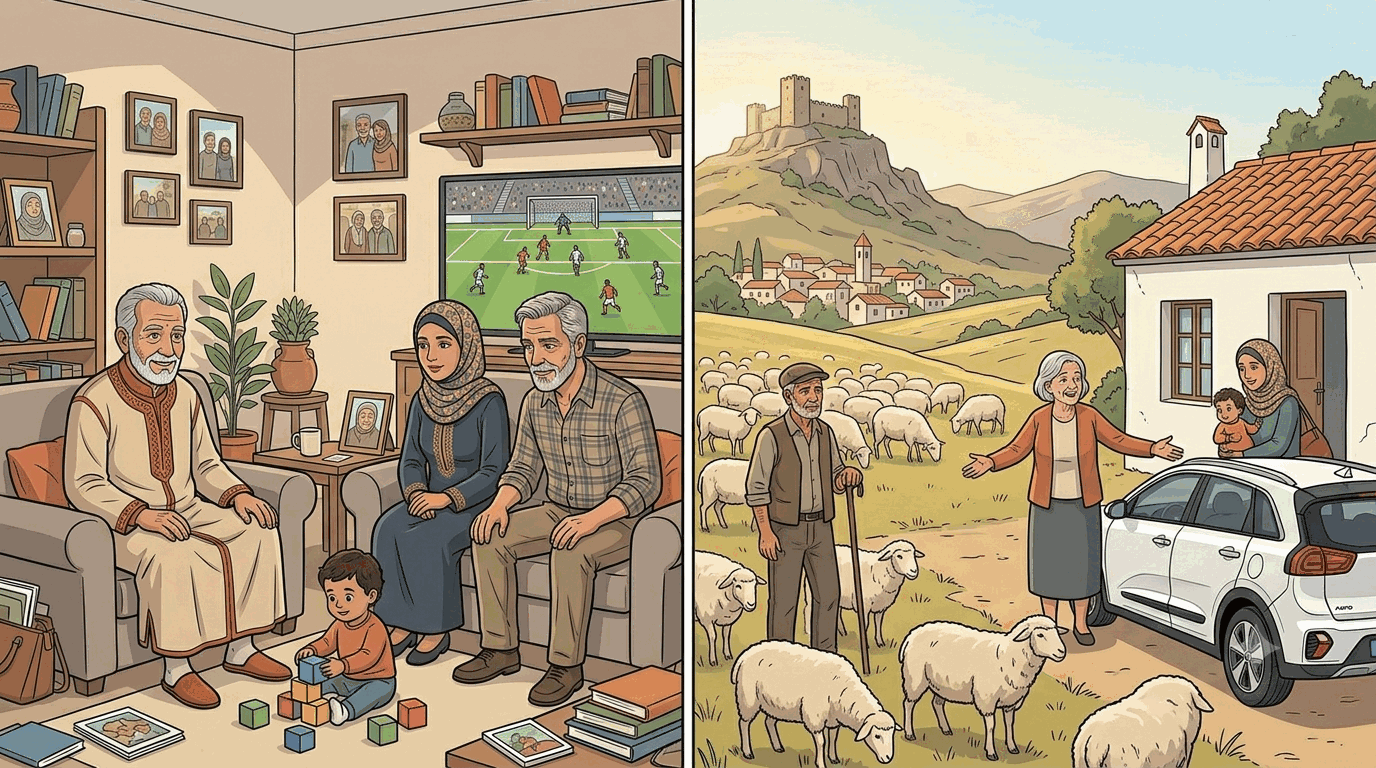
Imagen generada con Google Gemini Flash-Lite
🎧 Coloca el archivo audio/sda6_sesion4_story.mp3 junto a este HTML para que suene aquí.
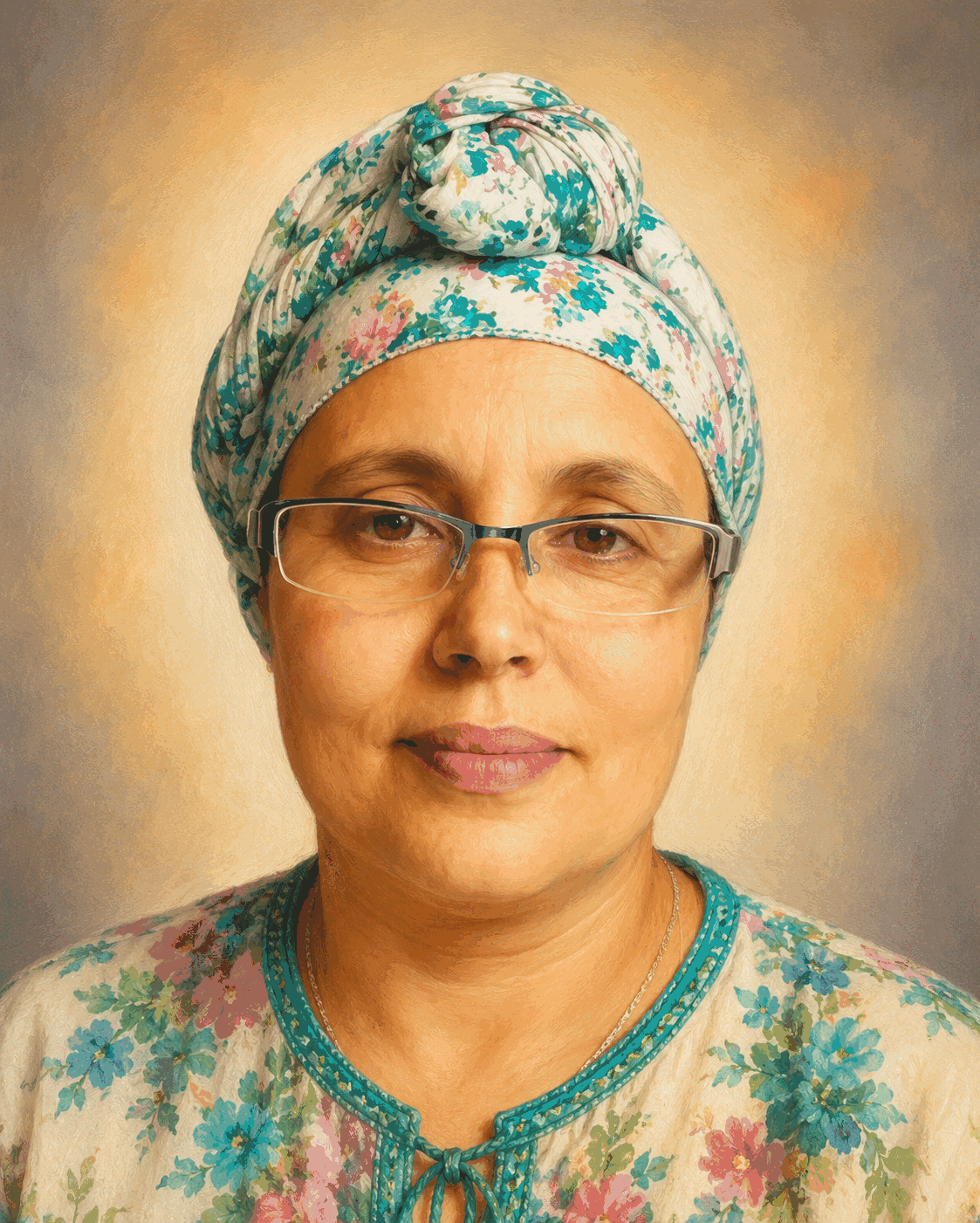
At Zahra's flat, Ali Boukrim quickly became the calmest presence in the loudest room.
Sebastián, who ran his own workshop in La Cañada and came home most evenings smelling
faintly of engine oil, had claimed the sofa's best corner as his own for years — until,
without any real discussion, it simply became Ali Boukrim's spot instead. Tarik still lived
there too, along with Sana and their son Mohamed, now the undisputed centre of the
household's attention. For Sana, who had once looked after Ali Boukrim and Fátima back in
Morocco before her marriage, having him nearby again felt less like an obligation and more
like something close to relief.
Of the whole extended family, everyone agreed, this was easily the liveliest house: the
noisiest television, the messiest kitchen table, the most chaotic mealtimes — and, according
to Ali Boukrim himself, the most fun. Mohamed had claimed his great-grandfather as a personal
audience for every new word he learned, and Ali Boukrim, who had once seemed content to
spend his days lying quietly on a mat in Ouaoumana, now found himself following a toddler
around a Spanish living room with something suspiciously close to energy.
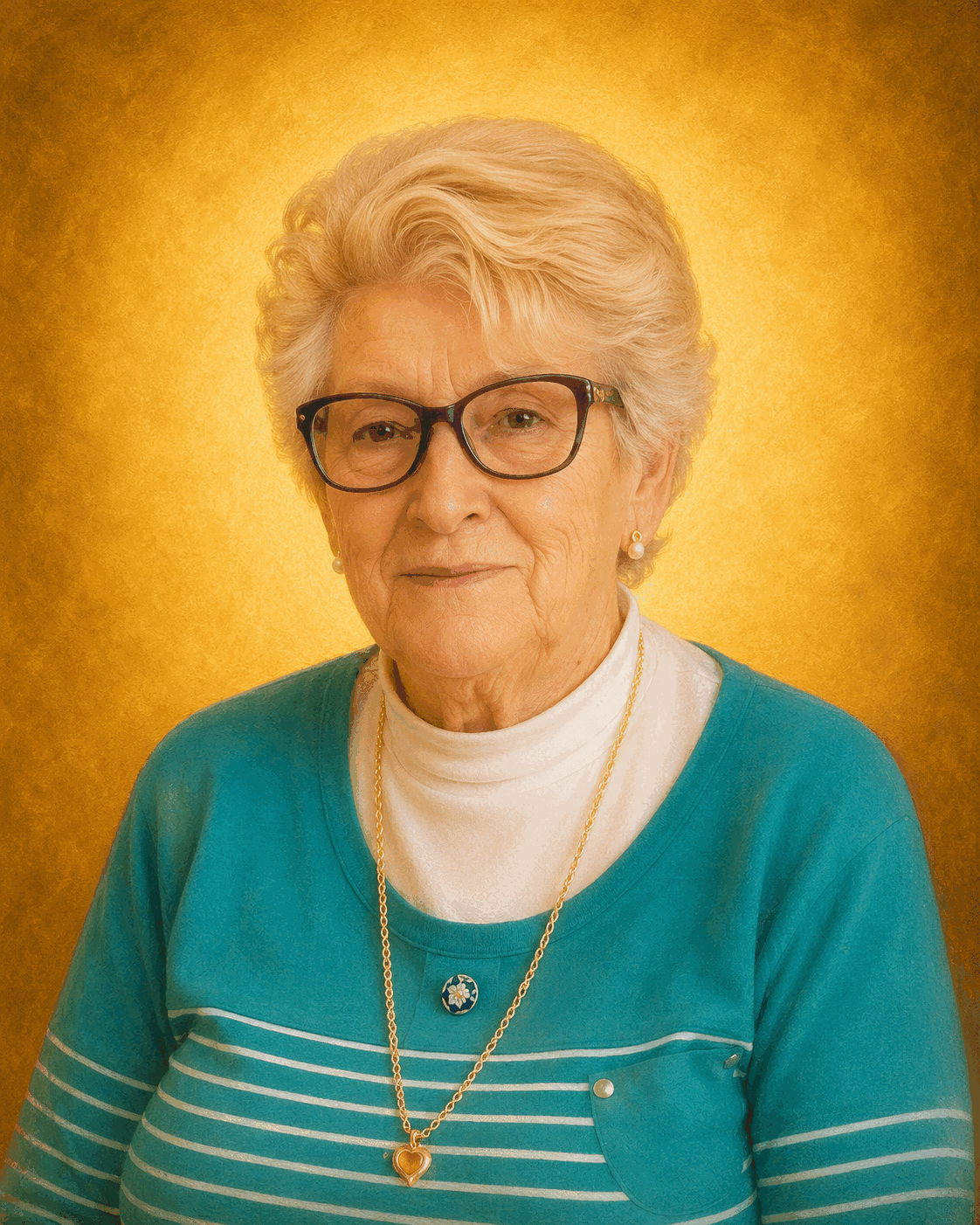
Towards the end of April, Julio suggested a family outing: a drive up to Serón, to the old
family house, and lunch with his cousin Mariquita, the friendliest — and, at seventy-five,
the youngest — of his older relatives on that side of the family. Mariquita welcomed Ali
Boukrim and Fátima at her door as though she had known them for years, and after lunch, Julio
walked his in-laws slowly around the castle above the village, the oldest building either of
them had seen since leaving Morocco.
Before heading home, they made one more stop: a small farm on the outskirts of the village,
where a local shepherd Julio and Itto had known for years still raised his sheep the
old-fashioned way, out on open pasture rather than penned indoors. With the lamb festival
only a month away, Julio and Tarik each reserved an animal, shaking the shepherd's hand on a
deal that, in this family at least, was worth considerably more than any piece of paper.
Los superlativos comparan tres o más elementos y usan the + adjetivo-est (para adjetivos cortos) o the most + adjetivo (para adjetivos largos). Recordamos también las formas irregulares: the best, the worst. Practicamos usando la familia extensa y sus casas como ejemplo.
Pulsa cada palabra para consultarla en WordReference.
1. shepherd (n.) /ˈʃepəd/ — pastor.
2. flock (n.) /flɒk/ — rebaño.
3. natural (adj.) /ˈnætʃrəl/ — natural.
4. reserve (v.) /rɪˈzɜːv/ — reservar, encargar.
5. garage (n.) /ˈɡærɑːʒ/ — taller, garaje.
6. move in (phrasal v.) /muːv ɪn/ — mudarse, instalarse.
7. close-knit (adj.) /kləʊs nɪt/ — muy unido/a (familia).
8. lively (adj.) /ˈlaɪvli/ — animado/a, bullicioso/a.
9. great-grandchild (n.) /ɡreɪt ˈɡræntʃaɪld/ — bisnieto/a.
10. village (n.) /ˈvɪlɪdʒ/ — pueblo.
11. mountain (n.) /ˈmaʊntɪn/ — montaña.
12. old-fashioned (adj.) /ˌəʊld ˈfæʃnd/ — a la antigua, tradicional.
13. trust (v./n.) /trʌst/ — confiar / confianza.
14. honest (adj.) /ˈɒnɪst/ — honrado/a.
15. castle (n.) /ˈkɑːsl/ — castillo.
¿Cuál es la casa "más animada" de tu propia familia? ¿Por qué? Usad al menos 2 superlativos.
1. Escribe 3 frases con superlativos sobre los personajes o lugares de la historia.
2. Escribe 2 frases comparando (con comparativos) la vida de Ali Boukrim en casa de Julio e Itto con su vida en casa de Zahra.
3. Escribe una frase sobre qué harías tú si tuvieras que "encargar" algo a un artesano o productor local.
Un amigo extranjero, acostumbrado a que todo se firme por escrito, te pregunta por qué en esta familia un apretón de manos vale tanto.
"...a deal that, in this family at least, was worth considerably more than any piece of paper."
Tarea: Explícaselo en español.
Queen – I Want to Break Free (1985)
Comentad en clase la ironía: Ali Boukrim, que llevaba una vida tranquila y sedentaria en Ouaoumana, ahora persigue a su bisnieto por el salón. ¿En qué sentido se ha "liberado" esta primavera?
Trabajo opcional para casa — Libro 4: 50 Selected AI Songs for A2
Caelis – The Last Promise
Escucha esta canción en casa: ¿qué tipo de promesa creéis que representa el apretón de manos entre Julio, Tarik y el pastor?
Imagen generada con Google Gemini Flash-Lite
En grupos de 4, representad la visita a la granja del pastor: uno hace de pastor, mostrando el rebaño y explicando cómo cría a los animales; los otros regatean amablemente y encargan los corderos para la fiesta. Usad al menos 2 superlativos.
SdA A2·6 · Clase 5
Doble comilona, una despedida cariñosa, y un balance de toda la unidad

| Bloque | Min | Contenido |
|---|---|---|
| Warm-up + Listening | 15 | Audio + T/F |
| Reading & comprensión | 20 | Lectura + preguntas |
| Language Lab | 20 | Repaso comparativos/superlativos + Present Perfect + 15 drills |
| Vocabulary Lab | 10 | 15 palabras nuevas |
| Production | 15 | Speaking + Writing |
| Mediation | 5 | Tarea de mediación |
| Sing Along + Roleplay | 5 | Canción + cierre |
Escucha el audio de la narración (sin leer el texto) y marca True (T) o False (F).
🎧 Coloca el archivo audio/sda6_sesion5_listening.mp3 junto a este HTML para que suene aquí.
1. The two lambs came from a shepherd near Almería city. →
2. Ali Boukrim and Fátima wanted the meat already prepared from a shop. →
3. Saadia travelled from Éibar for the festival. →
4. The barbecue took place at Julio's backyard on the first day. →
5. The neighbours complained about the smell. →
Un ritual respetado, una comilona doble, y una despedida cariñosa
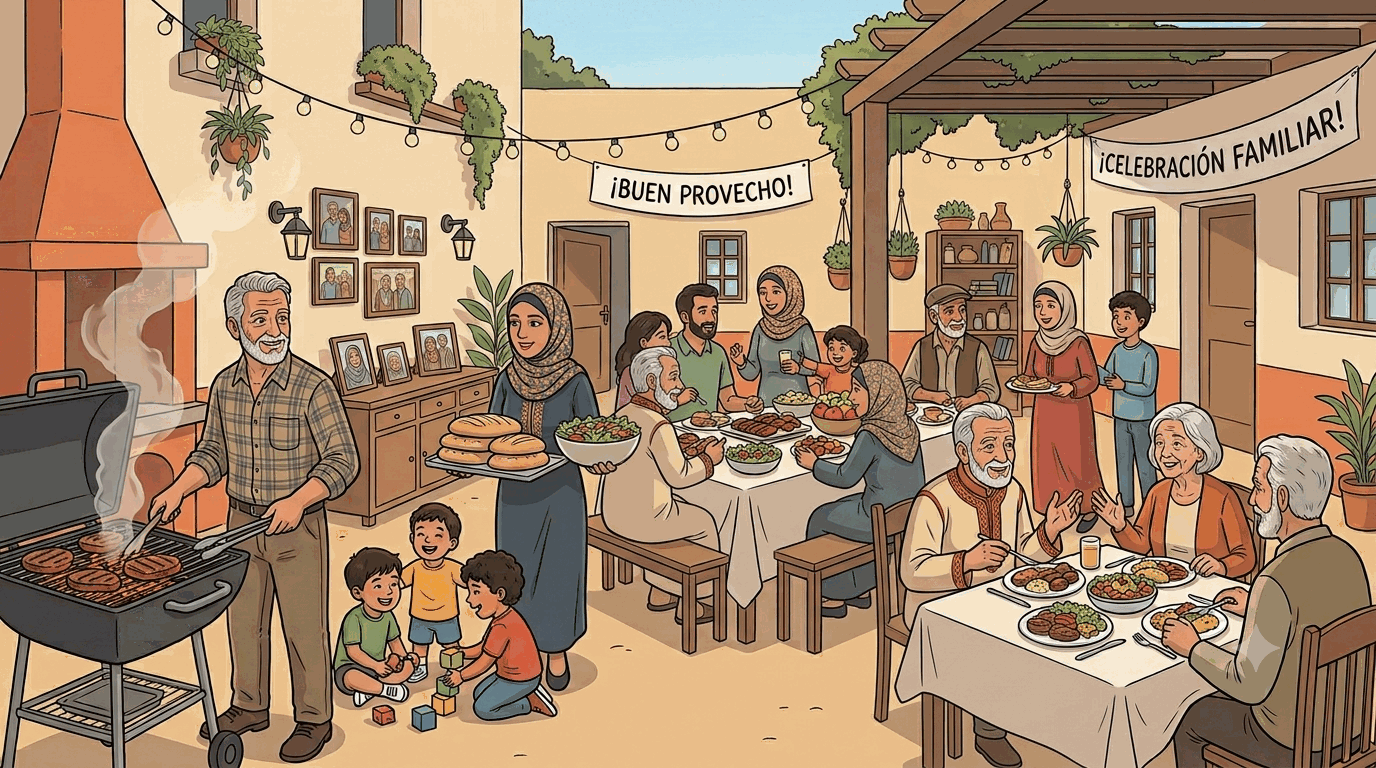
Imagen generada con Google Gemini Flash-Lite
🎧 Coloca el archivo audio/sda6_sesion5_story.mp3 junto a este HTML para que suene aquí.
The religious side of the celebration mattered more to Ali Boukrim than anyone in the
family had perhaps realised until that morning: this was a ritual, not simply a meal, and it
needed to be done properly, with the animals alive and healthy right up until the moment
itself. Julio and Itto had arranged everything with Sebastián weeks in advance, and by
mid-morning it was already over, handled quietly and respectfully in a back corner of the
workshop, away from the children and the general noise of the party. Nobody made a fuss about
it, and nobody needed to; by the time most of the family arrived, the focus had already
shifted entirely to the fire, the smoke, and the smell of roasting meat.
What followed was, by general agreement, the biggest feast the family had organised all year.
Sebastián, more comfortable with a barbecue than with almost anything else, took charge of
the coals with visible pride, while Saadia moved between groups with trays of bread and
salads, catching up with relatives she hadn't seen properly since the trip to France the
previous summer. Fátima, seated in the shade with a plate she insisted was "too generous,"
ended up eating more than anyone expected, and later admitted, laughing, that this was the
best lamb she had tasted since leaving Morocco.
There were more leftovers than the family knew what to do with, so the celebration simply
continued the next day, this time in Julio's own backyard — smaller, quieter, but arguably
even warmer, with just the closest relatives gathered around a second, more relaxed
barbecue. Ali Boukrim called it the most restful afternoon he'd had since arriving in
Spain.
By Sunday evening, though, a different mood had settled over the garden. Saadia was leaving
for Éibar the next morning, and Fátima, after four months in Almería, had decided to go with
her for a couple of months — company for her daughter, a change of scenery, and perhaps, Itto
suspected, simply a small break from being, as her mother put it with a wink, "everybody's
favourite grandmother." The goodbyes at the door the next morning were warm rather than sad,
full of promises to video-call every week, and Ali Boukrim, staying behind with his usual
calm, told his wife to enjoy herself — he, after all, still had a great-grandson to keep him
entertained.
Cerramos la unidad combinando lo aprendido: comparativos, superlativos, y un repaso del Present Perfect de la Sesión 1, esta vez para hacer balance de toda la unidad.
Pulsa cada palabra para consultarla en WordReference.
1. festival (n.) /ˈfestɪvl/ — fiesta, festival.
2. religious (adj.) /rɪˈlɪdʒəs/ — religioso/a.
3. ritual (n.) /ˈrɪtʃuəl/ — ritual.
4. barbecue (n./v.) /ˈbɑːbɪkjuː/ — barbacoa.
5. backyard (n.) /ˌbækˈjɑːd/ — patio trasero.
6. gather (v.) /ˈɡæðə/ — reunirse.
7. feast (n.) /fiːst/ — banquete.
8. leftovers (n.) /ˈleftəʊvəz/ — sobras.
9. portion (n.) /ˈpɔːʃn/ — ración.
10. invite (v.) /ɪnˈvaɪt/ — invitar.
11. farewell (n.) /feəˈwel/ — despedida.
12. miss (v.) /mɪs/ — echar de menos.
13. stay on (phrasal v.) /steɪ ɒn/ — quedarse más tiempo.
14. company (n.) /ˈkʌmpəni/ — compañía.
15. specialty (n.) /ˈspeʃəlti/ — especialidad (culinaria).
Describe la celebración familiar más grande que hayas vivido. ¿Qué la hizo especial? Usa comparativos y superlativos.
1. Escribe 3 frases con superlativos sobre la fiesta del cordero.
2. Escribe 2 frases con Present Perfect haciendo balance de lo que ha vivido la familia en esta unidad.
3. Escribe una frase de despedida como si fueras Fátima, dirigida a Julio e Itto.
Un compañero de clase no entiende bien el humor de esta frase.
"...a small break from being, as her mother put it with a wink, 'everybody's favourite grandmother.'"
Tarea: Explícasela en español, transmitiendo el tono cariñoso y de broma.
Ray Charles – Hit the Road Jack (1962)
La letra habla literalmente de una despedida — comentad en clase si el tono de la canción (más brusco) encaja o contrasta con la despedida cariñosa de Fátima en la historia.
Trabajo opcional para casa — Libro 4: 50 Selected AI Songs for A2
Let Babylon Burn – The Apology Mi Carry Forever
Escucha esta canción en casa: ¿creéis que el título podría aplicarse a alguna despedida familiar que hayáis vivido vosotros?
Imagen generada con Google Gemini Flash-Lite
En grupos de 4-5, representad la despedida en la puerta de casa: Fátima, Saadia, Julio, Itto y Ali Boukrim se despiden por la mañana. Usad al menos 1 superlativo y 1 frase con Present Perfect.
SdA A2·6 · Clase 6
Repaso general de la SdA A2·6
| Bloque | Min | Contenido |
|---|---|---|
| Warm-up | 5 | Recordatorio de la unidad |
| Review Fair (5 estaciones) | 45 | Roleplay por estaciones, repaso de las 5 sesiones |
| Review Language Lab | 25 | Quiz mixto de repaso (10 ítems) |
| Sing Along de cierre | 10 | Canción + resumen de la unidad |
| Despedida | 5 | Cierre y enlace con la SdA A2·7 |
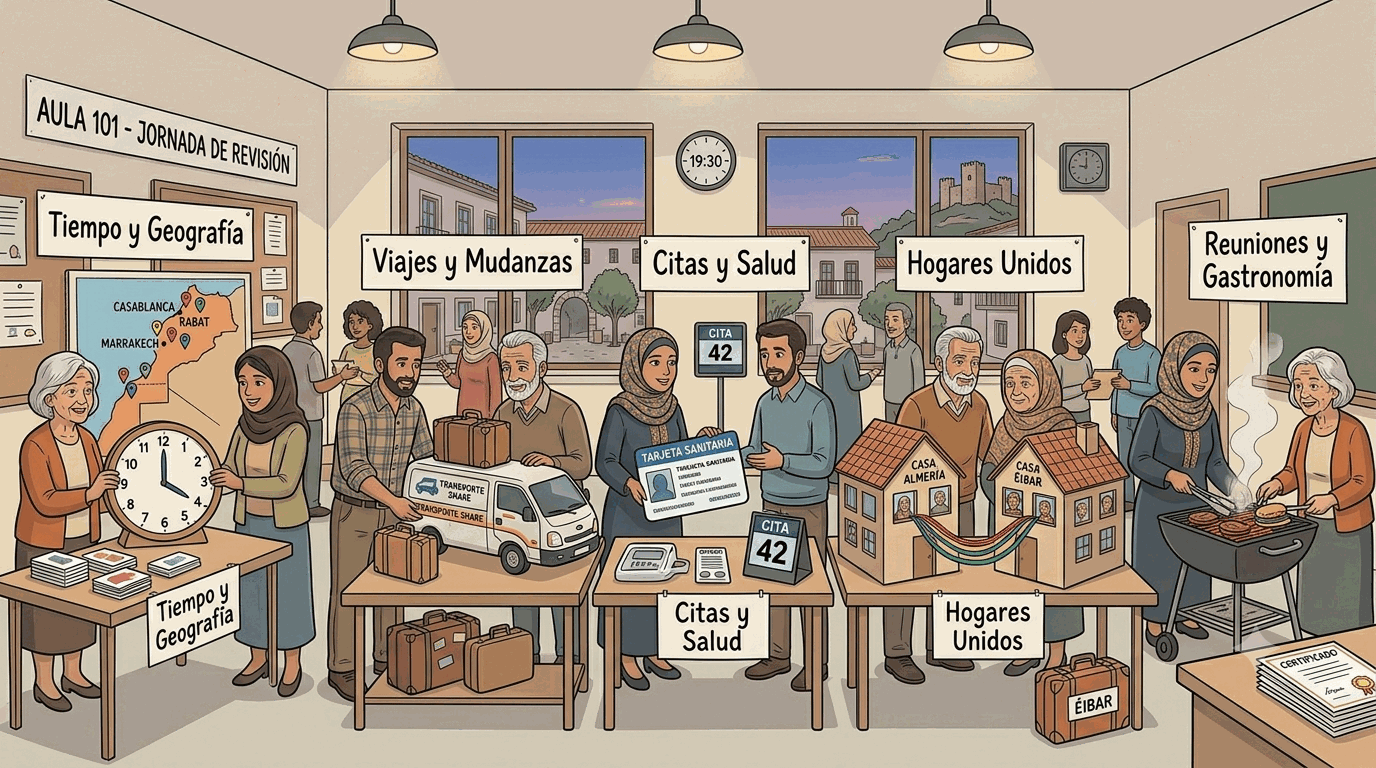
Imagen generada con Google Gemini Flash-Lite
La clase se organiza como una pequeña feria de repaso, con cinco estaciones montadas en
distintos puntos del aula:
Estación 1 — "Thirty Days": un sobre con un mapa de Marruecos y un reloj de
cartulina, para repasar la Sesión 1.
Estación 2 — "The Van from Ouaoumana": una furgoneta de juguete junto a dos
maletas en miniatura, para repasar la Sesión 2.
Estación 3 — "Settling In": una llave y una tarjeta sanitaria de cartulina, para
repasar la Sesión 3.
Estación 4 — "Two Houses, One Family": dos casas de cartón unidas por un hilo,
para repasar la Sesión 4.
Estación 5 — "The Lamb Festival": una parrilla de juguete junto a una maleta
pequeña con una etiqueta de "Éibar", para repasar la Sesión 5.
Los alumnos rotan en grupos pequeños por las cinco estaciones, improvisando una breve escena
de 2-3 minutos en cada una.
Repaso de comparativos, superlativos y Present Perfect, en los contextos de trámites, viaje, vida doméstica y celebración familiar.
Robbie Williams – Feel (2002)
Como cierre de la unidad, comentad en gran grupo: de las cinco sesiones, ¿cuál os ha
parecido más significativa? "Feel" habla de querer sentir algo de verdad — ¿creéis que
resume el año que ha vivido esta familia bajo un mismo techo?
Un año después de la primera solicitud fallida, Ali Boukrim y Fátima Aachouch llevaban ya varios meses viviendo bajo el mismo techo que su hija — dos techos, en realidad, repartidos entre dos casas que ya empezaban a sentir como una sola familia extendida. Quedaban, por supuesto, costumbres que ninguno de los dos estaba dispuesto a cambiar, y noches en las que el suelo seguía pareciéndole a Fátima más cómodo que cualquier colchón del mundo. Pero también quedaba, cada domingo, una mesa cada vez más llena: la pequeña María, en Marruecos, crecía entre fotos y videollamadas con el nombre de la madre de Julio, fallecida años atrás, cuyo recuerdo la familia seguía sintiendo, de una forma pequeña pero real, cada vez que alguien pronunciaba ese nombre. Y en algún documento antiguo, guardado entre los papeles del consulado marroquí, seguía figurando otro nombre — Julio Alí — elegido hacía años en honor al propio padre de Itto, el mismo hombre que ahora, cada tarde, dormía en el salón de su casa. Bajo el mismo techo, al final, cabían más nombres, más historias y más familia de la que nadie hubiera imaginado al principio del curso.
Trabajo opcional para casa — Libro 4: 50 Selected AI Songs for A2
Morgan Luna – You Are My Heaven
Escucha esta canción en casa como cierre de la unidad, y guárdala en tu lista de canciones favoritas.