
SEP Alkayasí · CEPER 500 Viviendas
SEP Alkayasí · CEPER 500 Viviendas
SdA 7 · Clase 1
Una noche tranquila en casa · Verbos irregulares (bloque 1)



| Bloque | Min | Contenido |
|---|---|---|
| 1. Listening | 10 | Escucha de la narración + comprensión global |
| 2. Reading | 15 | The Story + comprensión detallada |
| 3. Language Lab | 25 | Pasado simple irregular (bloque 1: go, come, see, leave, take, meet) |
| 4. Vocabulary Lab | 15 | 10 palabras clave |
| 5. Production | 15 | Speaking + Writing guiados |
| 6. Mediation | 8 | Mediación lingüística |
| 7. Sing Along | 2 | R.E.M. — "Everybody Hurts" (1992) |
Escucha el audio de la narración (sin leer el texto) y marca Verdadero (V) o Falso (F).
🎧 Coloca el archivo audio/sda7_sesion1_story.mp3 junto a este HTML para que suene aquí.
1. Majda has lived with Julio and Itto for a year and a half. →
2. Majda has a full-time job this summer. →
3. Majda usually looks at her phone during dinner. →
4. Itto decides to tell Majda about her own past. →
5. Majda leaves the table angry and refuses to listen. →
Verano de 2024 · Itto decide contarle a Majda su propia historia
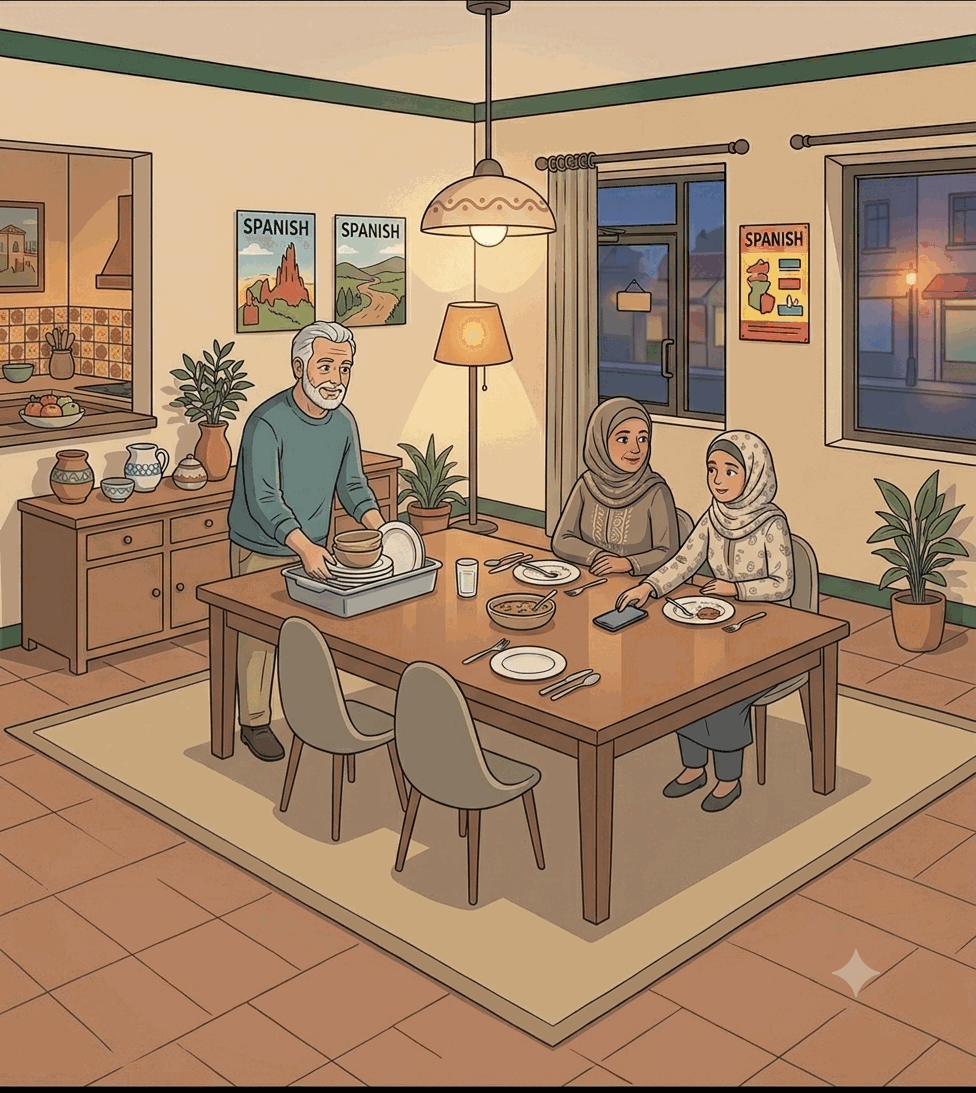
Imagen generada con Google Gemini Flash-Lite
🎧 Coloca el archivo audio/sda7_sesion1_story.mp3 junto a este HTML para que suene aquí.
It is the summer of 2024. Majda has lived with Julio and Itto for a year and a half now, ever since she left Zahra's flat and moved into the spare room upstairs. Every evening is almost the same: she comes home from a short walk, sits at the table, and looks at her phone for hours. She hasn't found a job yet, and she left her English classes after only two lessons. Tonight, during dinner, Itto watches her niece scroll through her phone without eating much. "Majda," she says gently, "can I tell you something tonight? Something about my own life, before I met Julio?" Majda looks up, surprised. She puts the phone down on the table, just for a moment. Julio smiles quietly and clears the plates. Itto takes a deep breath. "It's not an easy story," she says, "but maybe it can help you understand a few things." Majda nods slowly, and for the first time in weeks, her phone stays on the table, screen down, for almost an hour.
Los verbos irregulares no añaden -ed en pasado; hay que memorizar su forma. Bloque 1: go→went, come→came, see→saw, leave→left, take→took, meet→met.
Afirmativa: She left the flat last year. They went for a walk.
Negativa: didn't + infinitivo → She didn't go to class today.
Interrogativa: Did + sujeto + infinitivo...? → Did she meet Julio in 2020?
1. screen time /skriːn taɪm/ — tiempo de pantalla.
2. to scroll /tə skrəʊl/ — desplazarse (por una pantalla).
3. notification /ˌnəʊtɪfɪˈkeɪʃn/ — notificación.
4. device /dɪˈvaɪs/ — dispositivo.
5. to unplug /tə ʌnˈplʌg/ — desconectar.
6. offline /ˌɒfˈlaɪn/ — desconectado, sin conexión.
7. addicted /əˈdɪktɪd/ — enganchado, adicto.
8. habit /ˈhæbɪt/ — hábito, costumbre.
9. to charge (a phone) /tə tʃɑːdʒ/ — cargar (un móvil).
10. distracted /dɪˈstræktɪd/ — distraído.
En parejas, comentad vuestros propios hábitos con el móvil: cuánto tiempo lo usáis, para qué, y si alguna vez os gustaría desconectar más.
1. Escribe 5 frases sobre tu propia rutina diaria con el móvil, usando el vocabulario de esta sesión.
Carmen, que está preocupada porque su nieto también pasa mucho tiempo con el móvil, pregunta a Julio cómo ve esta situación desde su experiencia familiar.
Tarea: El alumnado media la conversación, explicando en español, con sobriedad y sin juzgar a nadie, lo que Julio cuenta en inglés sobre los hábitos tecnológicos en casa.
R.E.M. — "Everybody Hurts" (1992)
Mientras escuchas, piensa en cómo a veces cuesta empezar a contar algo difícil, igual que le pasa a Itto esta noche; anota un verbo en pasado que reconozcas.
SdA 7 · Clase 2
El paseo de Costacabana · "Used to" y verbos irregulares (bloque 2)
| Bloque | Min | Contenido |
|---|---|---|
| 1. Listening | 10 | Escucha de la narración + comprensión global |
| 2. Reading | 15 | The Story + comprensión detallada |
| 3. Language Lab | 25 | "Used to" (hábitos pasados) + irregulares (bloque 2) |
| 4. Vocabulary Lab | 15 | 10 palabras clave |
| 5. Production | 15 | Speaking + Writing guiados |
| 6. Mediation | 8 | Mediación lingüística |
| 7. Sing Along | 2 | Roy Orbison — "Pretty Woman" (1964) |
Escucha el audio de la narración (sin leer el texto) y marca Verdadero (V) o Falso (F).
🎧 Coloca el archivo audio/sda7_sesion2_story.mp3 junto a este HTML para que suene aquí.
1. Before coming to Spain, Itto used to teach at a driving school. →
2. Itto's sister Saadia arrived in Spain in 2007. →
3. Itto paid money for an arrangement that turned out to be a fraud. →
4. Itto knew the man she "married" very well. →
5. Itto got divorced in 2015. →
El paseo marítimo de Costacabana · el falso matrimonio

Imagen generada con Google Gemini Flash-Lite
🎧 Coloca el archivo audio/sda7_sesion2_story.mp3 junto a este HTML para que suene aquí.
The next evening, Julio and Itto walk along the promenade of Costacabana, close to the airport and the sea. The sky is orange, and the beach is almost empty. Itto starts talking quietly. "Before I met you, I used to live a very different life," she says. "I used to teach at a driving school in my town, and later I taught adult classes for a women's association too." Julio listens carefully. Itto continues: her sister Saadia arrived in Spain in 2004, and later Zahra in 2007. For years, Itto thought about coming too, but nothing worked. In the end, she paid a large amount of money — money her sister Saadia lent her — for an arrangement: a marriage with a Moroccan man living in Spain, so she could get a family visa. "I never even knew him," she says softly. "It was a fraud. I lost the money, and I lost several years of my life." She finally got divorced, alone, in 2015. Julio takes her hand without saying a word. The sea is calm, and for a while, they just keep walking.
"Used to" + infinitivo se usa para hablar de hábitos o situaciones pasadas que ya no son ciertas.
Afirmativa: She used to teach at a driving school.
Negativa: She didn't use to live in Spain.
Contraste con el presente: Now she lives in Almería, but she used to live in Morocco.
Verbos irregulares bloque 2: know→knew, think→thought, get→got, pay→paid, lose→lost, teach→taught.
1. fraud /frɔːd/ — fraude, estafa.
2. to scam /tə skæm/ — estafar.
3. arrangement /əˈreɪndʒmənt/ — arreglo, acuerdo.
4. driving instructor /ˈdraɪvɪŋ ɪnˈstrʌktə/ — profesor/a de autoescuela.
5. association /əˌsəʊsiˈeɪʃn/ — asociación.
6. to trust /tə trʌst/ — confiar.
7. promise /ˈprɒmɪs/ — promesa.
8. determined /dɪˈtɜːmɪnd/ — decidido/a, con determinación.
9. independent /ˌɪndɪˈpendənt/ — independiente.
10. disappointed /ˌdɪsəˈpɔɪntɪd/ — decepcionado/a.
En parejas, hablad de un cambio de vida importante (real o de algún personaje del elenco) que requirió mucha determinación, usando "used to".
1. Escribe 5 frases usando "used to" sobre cómo era la vida de alguien antes de un cambio importante.
Pilar, que tiene amigas marroquíes y está aprendiendo sobre extranjería, pregunta a Julio qué significa exactamente "conseguir los papeles" y por qué es tan importante para la comunidad marroquí en Almería.
Tarea: El alumnado media, explicando en español, con respeto y sin prejuicios, lo que Julio cuenta en inglés sobre las dificultades para conseguir la residencia legal.
Roy Orbison — "Pretty Woman" (1964)
Mientras escuchas, piensa en el contraste entre la vida que Itto tenía antes y la que decidió construir después; anota un verbo irregular que reconozcas.
SdA 7 · Clase 3
Caminata cerca de casa · Verbos irregulares (bloque 3)
| Bloque | Min | Contenido |
|---|---|---|
| 1. Listening | 10 | Escucha de la narración + comprensión global |
| 2. Reading | 15 | The Story + comprensión detallada |
| 3. Language Lab | 25 | Pasado simple irregular (bloque 3: say, tell, find, buy, bring, drive) |
| 4. Vocabulary Lab | 15 | 10 palabras clave |
| 5. Production | 15 | Speaking + Writing guiados |
| 6. Mediation | 8 | Mediación lingüística |
| 7. Sing Along | 2 | Scorpions — "Still Loving You" (1984) |
Escucha el audio de la narración (sin leer el texto) y marca Verdadero (V) o Falso (F).
🎧 Coloca el archivo audio/sda7_sesion3_story.mp3 junto a este HTML para que suene aquí.
1. Saadia paid money for a tourist visa for Itto. →
2. Itto travelled directly to Éibar without going through France. →
3. Itto lived in Éibar for almost a year, cleaning houses. →
4. It was easy to get legal papers in the Basque Country without a contract. →
5. Itto decided to travel to Almería to look for legal work. →
Caminata cerca de casa · el visado de turista y la vida en Éibar
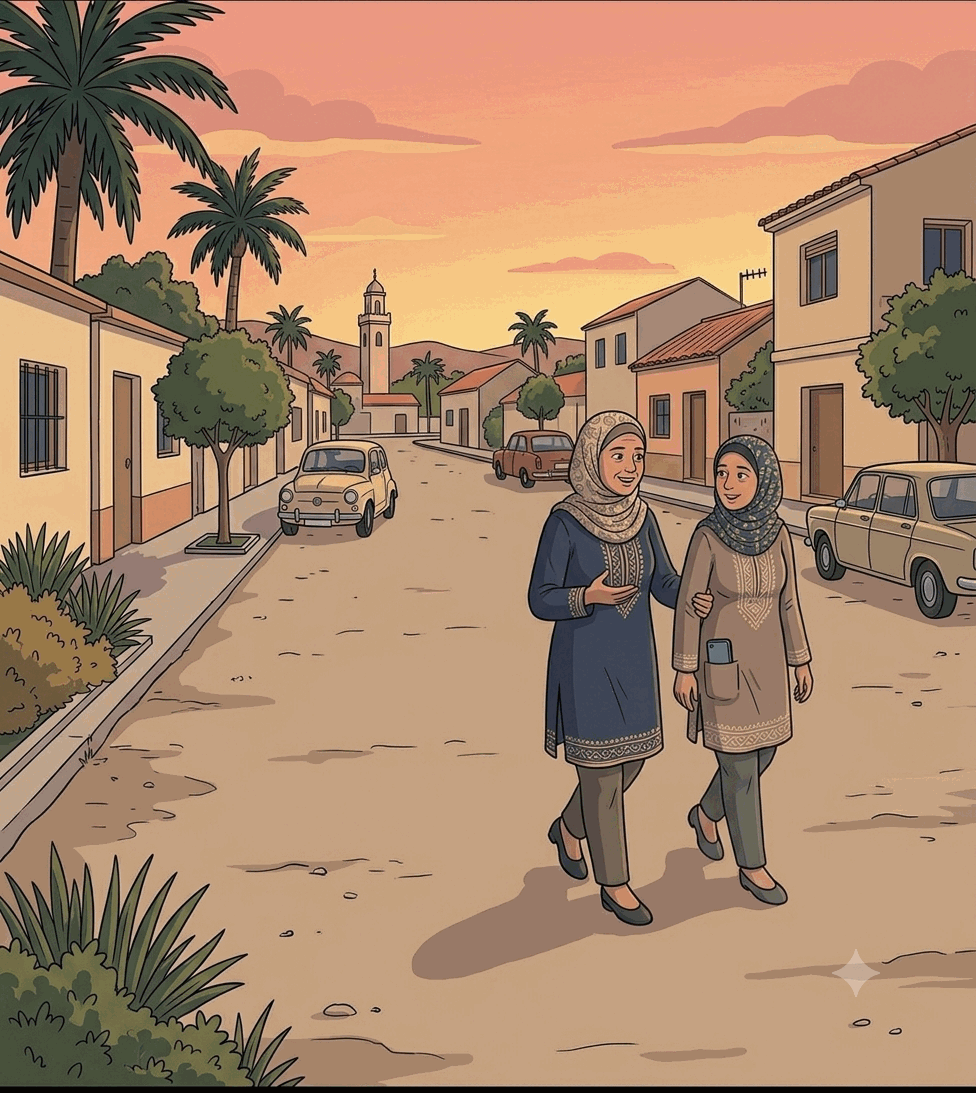
Imagen generada con Google Gemini Flash-Lite
🎧 Coloca el archivo audio/sda7_sesion3_story.mp3 junto a este HTML para que suene aquí.
A few days later, during a walk near home, Itto tells Majda the next part of her story. In 2017, her sister Saadia found a way to help her: she paid another large sum of money to people who promised a tourist visa. Early in 2018, Itto finally travelled to France. "I didn't know exactly what to expect," she tells Majda. "I just brought one small suitcase." At the airport, Saadia was waiting, and she drove Itto straight to Éibar, in the Basque Country. Itto lived there for almost a year, cleaning houses for several families. She said very little Spanish then, but she learnt quickly. "The weather was always grey," Itto laughs, "so different from Almería!" Majda listens closely, forgetting her phone completely. "Why didn't you stay in Éibar with Saadia?" she asks. Itto explains: without a proper contract, it was almost impossible to get legal papers there. So, after almost a year, she made a difficult decision: to travel south, to Almería, where her other sister Zahra could help her find real work.
Verbos irregulares bloque 3: say→said, tell→told, find→found, buy→bought, bring→brought, drive→drove.
Uso de because / so para explicar causa y consecuencia: She didn't have a contract, so it was difficult to get papers.
1. tourist visa /ˈtʊərɪst ˈviːzə/ — visado de turista.
2. suitcase /ˈsuːtkeɪs/ — maleta.
3. to promise /tə ˈprɒmɪs/ — prometer.
4. to clean (houses) /tə kliːn/ — limpiar (casas).
5. employer /ɪmˈplɔɪə/ — empleador/a.
6. weather /ˈweðə/ — tiempo (meteorológico).
7. grey /greɪ/ — gris.
8. contract /ˈkɒntrækt/ — contrato.
9. legal /ˈliːgl/ — legal.
10. decision /dɪˈsɪʒn/ — decisión.
En parejas, contad (usando el bloque 3) una decisión difícil que alguien tomó en su vida, real o de algún personaje del elenco.
1. Escribe 5 frases sobre el viaje de Itto usando said, told, found, bought, brought y drove.
Rogelio, muy interesado en los detalles, pregunta a Julio por qué es tan difícil conseguir papeles legales sin un contrato de trabajo en algunas regiones de España.
Tarea: El alumnado media, explicando en español, de forma objetiva y sin juicios de valor, la relación entre el contrato legal y la regularización.
Scorpions — "Still Loving You" (1984)
Mientras escuchas, piensa en la persistencia de Itto en su empeño de conseguir papeles; anota un verbo irregular que reconozcas.
SdA 7 · Clase 4
Cocina de casa · Verbos irregulares (bloque 4)
| Bloque | Min | Contenido |
|---|---|---|
| 1. Listening | 10 | Escucha de la narración + comprensión global |
| 2. Reading | 15 | The Story + comprensión detallada |
| 3. Language Lab | 25 | Pasado simple irregular (bloque 4: make, become, feel, sell, keep, spend) |
| 4. Vocabulary Lab | 15 | 10 palabras clave |
| 5. Production | 15 | Speaking + Writing guiados |
| 6. Mediation | 8 | Mediación lingüística |
| 7. Sing Along | 2 | Sting — "Englishman In New York" (1987) |
Escucha el audio de la narración (sin leer el texto) y marca Verdadero (V) o Falso (F).
🎧 Coloca el archivo audio/sda7_sesion4_story.mp3 junto a este HTML para que suene aquí.
1. Zahra helped Itto find work in a greenhouse in La Cañada. →
2. Itto got the legal contract completely free of charge. →
3. Itto worked without a salary for several months to pay off her debt. →
4. Itto gave up and stopped working when she felt tired. →
5. Majda says she already knew this part of Itto's story. →
Cocina de casa · el invernadero y el año trabajando gratis

Imagen generada con Google Gemini Flash-Lite
🎧 Coloca el archivo audio/sda7_sesion4_story.mp3 junto a este HTML para que suene aquí.
The following week, in the kitchen after breakfast, Itto continues her story for Majda. In Almería, her sister Zahra helped her find work in a greenhouse in La Cañada. It wasn't easy: to get a legal contract, Itto had to pay another six thousand euros, this time to the greenhouse owner's contact. "It felt unfair," Itto admits, "but for many people without papers, this was the only real chance in Europe." During the last months of 2019 and the first months of 2020, Itto worked without any salary at all, to finish paying off the debt. She spent almost every day among the tomato plants, from early morning until the evening. She kept working, even when she felt exhausted. "I never sold anything I didn't have," she tells Majda firmly, "I paid with my own effort, every single day." Slowly, she became known in the neighbourhood as a serious, hard-working woman. Majda looks at her aunt with new respect. "I didn't know any of this," she whispers.
Verbos irregulares bloque 4: make→made, become→became, feel→felt, sell→sold, keep→kept, spend→spent.
Repaso de expresiones de tiempo: during the last months of 2019, from early morning until the evening, every single day.
1. greenhouse /ˈgriːnhaʊs/ — invernadero.
2. debt /det/ — deuda.
3. to pay off /tə peɪ ɒf/ — saldar, terminar de pagar.
4. salary /ˈsæləri/ — salario.
5. hard-working /ˌhɑːdˈwɜːkɪŋ/ — trabajador/a.
6. unfair /ʌnˈfeə/ — injusto/a.
7. effort /ˈefət/ — esfuerzo.
8. contact (person) /ˈkɒntækt/ — contacto, intermediario.
9. owner /ˈəʊnə/ — propietario/a.
10. neighbourhood /ˈneɪbəhʊd/ — barrio.
En parejas, describid un trabajo duro que conocéis bien (propio, familiar o de un personaje del elenco), usando el bloque 4.
1. Escribe 5 frases sobre cómo Itto pagó su deuda, usando made, became, felt, sold, kept y spent.
Consuelo y Cristóbal, que conocen bien la zona de invernaderos de La Cañada, comentan con Julio la situación de muchos trabajadores extranjeros en Almería.
Tarea: El alumnado media, explicando en español, con respeto y sin estereotipos, lo que Julio cuenta en inglés, centrándose en el esfuerzo personal de Itto.
Sting — "Englishman In New York" (1987)
Mientras escuchas, piensa en la idea de ser extranjero/a en un lugar nuevo; anota un verbo irregular que reconozcas.
SdA 7 · Clase 5
Sobremesa en casa · Verbos irregulares (bloque 5) y cierre del relato
| Bloque | Min | Contenido |
|---|---|---|
| 1. Listening | 10 | Escucha de la narración + comprensión global |
| 2. Reading | 15 | The Story + comprensión detallada |
| 3. Language Lab | 25 | Pasado simple irregular (bloque 5) + repaso de "used to" |
| 4. Vocabulary Lab | 15 | 10 palabras clave |
| 5. Production | 15 | Speaking + Writing guiados |
| 6. Mediation | 8 | Mediación lingüística — cierre del relato con Majda |
| 7. Sing Along | 2 | Supertramp — "School" (1974) |
Escucha el audio de la narración (sin leer el texto) y marca Verdadero (V) o Falso (F).
🎧 Coloca el archivo audio/sda7_sesion5_story.mp3 junto a este HTML para que suene aquí.
1. Itto received the Social Worker's report in July 2020. →
2. Itto got her NIE by marrying a Spanish citizen. →
3. Itto enrolled at Alkayasí before getting her NIE. →
4. Itto met Julio at the greenhouse where she worked. →
5. At the end of the conversation, Majda says she might try an English class. →
Sobremesa en casa · el NIE, Alkayasí, y el cierre del relato con Majda

Imagen generada con Google Gemini Flash-Lite
🎧 Coloca el archivo audio/sda7_sesion5_story.mp3 junto a este HTML para que suene aquí.
On a quiet Sunday, after lunch, Itto finishes her story. In July 2020, after three long years of legal residence in Spain, a social worker finally understood her situation and wrote the report Itto needed. A few months later, in October 2020, Itto got her NIE — her own resident permit, won through her own effort, without depending on any husband. "I never chose the easy way," she tells Majda, "but I chose my own way." That same September, before even having her NIE, Zahra had already enrolled her at the Alkayasí adult school, with just her passport. There, in a small classroom, Itto met an English and Computing teacher called Julio. Majda listens until the end, and for a moment nobody speaks. Then Itto adds gently: "Everybody's story breaks at some point, Majda. Mine broke many times. But it didn't stay broken." Majda finally puts her phone in another room, without being asked. "Maybe I could try one English class," she says quietly. Itto smiles and squeezes her hand.
Verbos irregulares bloque 5: understand→understood, catch→caught, hear→heard, win→won, choose→chose, break→broke.
Repaso de "used to": Itto used to live a very different life, but she never used to give up.
1. social worker /ˈsəʊʃl ˈwɜːkə/ — trabajador/a social.
2. report /rɪˈpɔːt/ — informe.
3. resident permit /ˈrezɪdənt ˈpɜːmɪt/ — permiso de residencia (NIE).
4. achievement /əˈtʃiːvmənt/ — logro.
5. proud /praʊd/ — orgulloso/a.
6. milestone /ˈmaɪlstəʊn/ — hito, momento clave.
7. to enrol /tə ɪnˈrəʊl/ — matricularse.
8. application /ˌæplɪˈkeɪʃn/ — solicitud.
9. independent /ˌɪndɪˈpendənt/ — independiente.
10. determined /dɪˈtɜːmɪnd/ — decidido/a.
En parejas, reflexionad sobre un logro personal conseguido "por cuenta propia", sin depender de nadie más, usando el bloque 5.
1. Escribe 5 frases que resuman el recorrido completo de Itto (desde 2015 hasta 2020), usando al menos 3 verbos irregulares distintos.
Julio e Itto hablan con Majda sobre su uso del móvil, usando la propia historia de superación de Itto como argumento para animarla, sin presionarla.
"Maybe you could try one class, Majda... it's never too late to start something new."
Tarea: En parejas, el alumnado media entre lo que dice Itto en inglés sobre su propia historia y una posible respuesta de Majda en español, practicando cómo animar a alguien sin presionarlo.
Supertramp — "School" (1974)
Mientras escuchas, piensa en la decisión final de Majda de "probar una clase"; anota un verbo irregular que reconozcas y repasa mentalmente los 5 bloques de esta SdA.
SdA 7 · Clase 6
Repaso final de la SdA 7
| Bloque | Min | Contenido |
|---|---|---|
| 1. Review | 10 | Repaso de gramática consolidada |
| 2. Vocabulary Review | 15 | Repaso de vocabulario |
| 3. Final Quiz | 25 | Cuestionario final de 10 preguntas |
| 4. Roleplay | 30 | Roleplay grupal de repaso |
| 5. Sing Along | 10 | Repaso musical de la unidad |
Pasado simple irregular: los 30 verbos irregulares más frecuentes, repartidos en 5 bloques · "Used to" para hábitos pasados en contraste con la vida actual · Vocabulario de trámites migratorios y de hábitos tecnológicos.
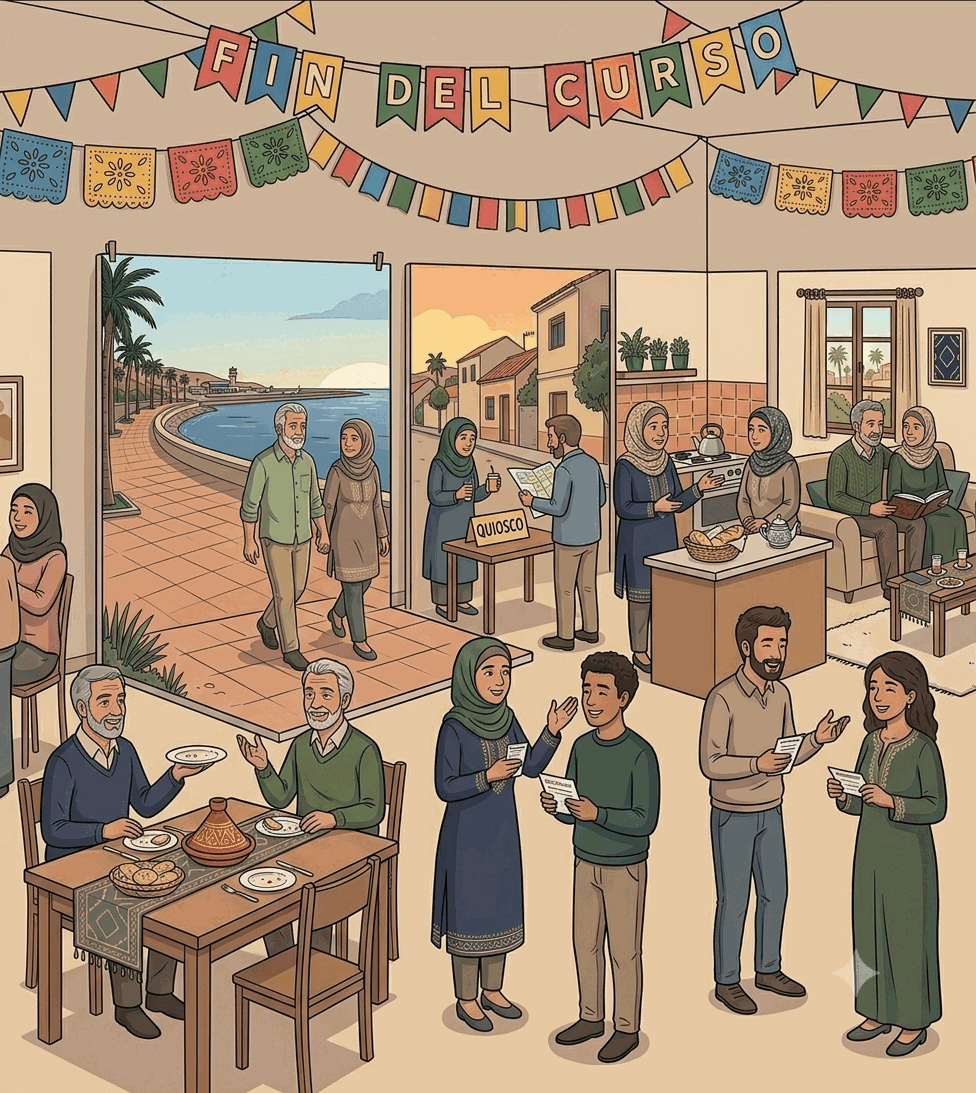
"Her Own Way": en grupos de 4-5 personas, recread los principales momentos del relato de Itto (el falso matrimonio, el visado y Éibar, el invernadero, la obtención del NIE, la conversación final con Majda), usando el vocabulario y los verbos irregulares de la unidad. Cerrad la escena con una frase de ánimo de Julio o Itto dirigida a Majda.
The Animals — "House Of The Rising Sun" (1964)
Escucha de cierre de la unidad, mientras la familia comparte una sobremesa tranquila tras la conversación con Majda.
Repasamos las seis canciones de esta SdA: R.E.M. — "Everybody Hurts" (1992), Roy Orbison — "Pretty Woman" (1964), Scorpions — "Still Loving You" (1984), Sting — "Englishman In New York" (1987), Supertramp — "School" (1974), The Animals — "House Of The Rising Sun" (1964).