
SEP Alkayasí · CEPER 500 Viviendas
SEP Alkayasí · CEPER 500 Viviendas
SdA A2·5 · Clase 1
Finales de agosto de 2025, el nacimiento de María, contado casi en directo


Tiempo lectivo orientativo: 90 minutos · planificación base: 85 min + margen flexible.
| Bloque | Min. | Qué haremos | Propósito |
|---|---|---|---|
| 1. Where were we? | 8 | Recordamos la noche difícil en el centro y los hechos recientes. | Reactivar |
| 2. Story / Listening | 12 | Escuchamos una noche de llamadas, mensajes y problemas que conectan pasado y presente. | Comprender |
| 3. Understanding | 8 | Comprobamos información concreta de la historia y la escucha. | Comprobar comprensión |
| 4. Language in Action | 15 | Repasamos tiempos conocidos e introducimos Present Perfect para resultados presentes. | Construir precisión |
| 5. Words We Need | 10 | Activamos vocabulario del centro, llamadas y situaciones problemáticas. | Ampliar vocabulario útil |
| 6. Sound Lab | 10 | Revisamos schwa en sílabas átonas dentro del relato. | Escuchar y producir |
| 7. Let’s Use English | 12 | Explicamos qué ha ocurrido y cuál es el resultado ahora. | Comunicar |
| 8. Mediation / Real Life | 5 | Transmitimos a otra persona los hechos esenciales y su consecuencia presente. | Mediar |
| 9. Self-assessment | 5 | Comprobamos qué podemos hacer ya. | Reflexionar |
| 10. Aula sin Muros | Casa | Elegimos una práctica optativa de refuerzo o ampliación. | Continuar en casa |
Los tiempos son aproximados. Podemos dedicar más o menos tiempo a cada parte según las necesidades del grupo.
Recupera una idea y dos palabras de la sesión anterior.
Lee o escucha el episodio anterior y pide un resumen breve.
The Night the Phone Wouldn't Stop
Escucha el audio de la narración (sin leer el texto) y marca True (T) o False (F).
🎧 Coloca el archivo audio/sda5_sesion1_listening.mp3 junto a este HTML para que suene aquí.
1. The WhatsApp group was unusually quiet that week. →
2. Zahra was the first to send news about Souad. →
3. Abderrahim sent a video, not a photo, from the hospital. →
4. Julio was also physically present in Morocco at that time. →
5. Mustapha started looking for a way to move Souad somewhere else. →
De la habitación de un hospital español a otro, en Marruecos
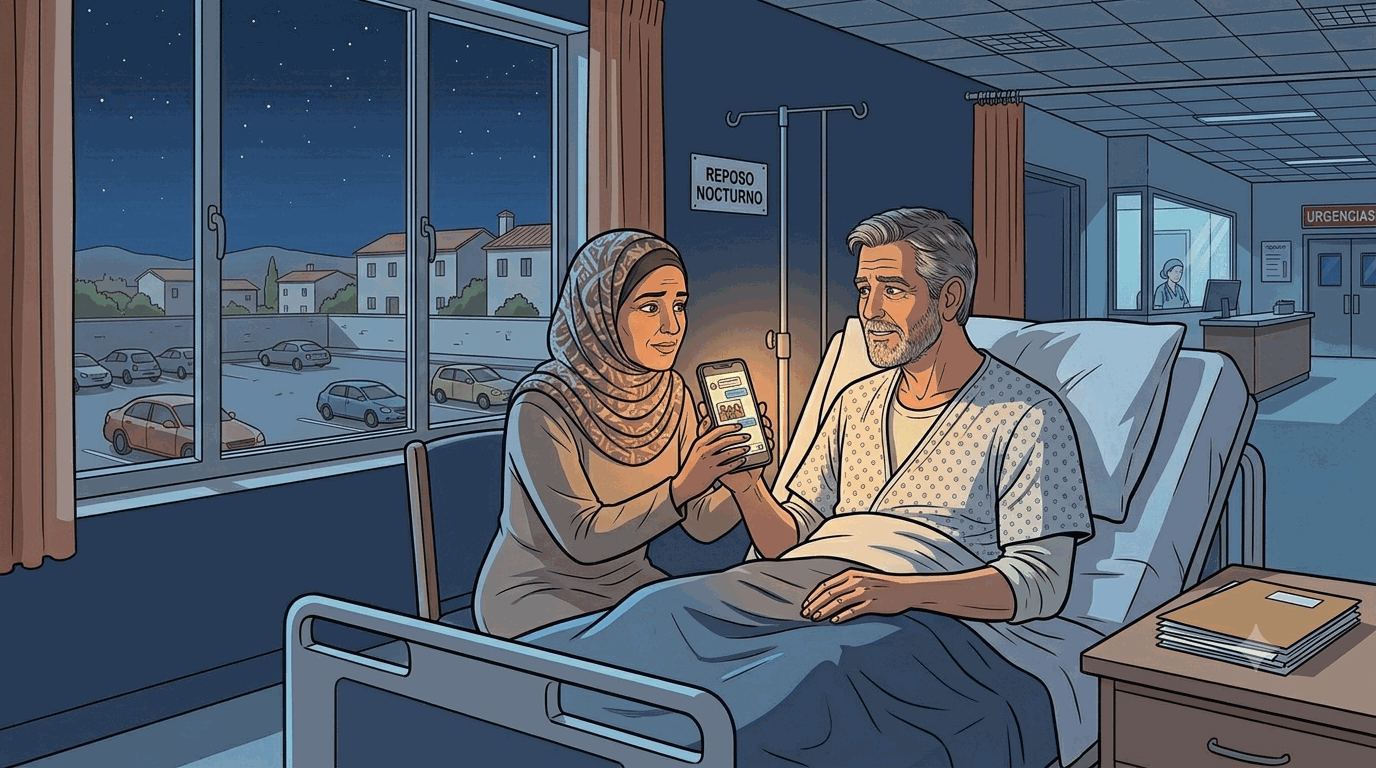
Imagen generada con Google Gemini Flash-Lite
🎧 Coloca el archivo audio/sda5_sesion1_story.mp3 junto a este HTML para que suene aquí.
By the time Mustapha reached the public hospital, he understood the situation was
serious: doctors were overwhelmed, and neither Souad nor the baby were getting the attention
they urgently needed. Without waiting for an official transfer, he found a private clinic
nearby and arranged, on the spot, for Souad to be moved there instead.
Itto translated every message for Julio, sentence by sentence, sitting close to his hospital
bed. The ambulance took almost an hour to arrive — an agonising wait for everyone on the
group chat — but Souad finally reached the clinic, and within minutes she was in the hands
of a proper medical team.
A little after midnight, a new voice message arrived: this time, it was Abderrahim's. His
voice broke halfway through the sentence. "She's here. Souad is fine. The baby is fine. It's
a girl." They named her María.
The relief lasted only a few seconds before a new problem appeared: the clinic's bill came
to 1,500 euros, an enormous sum for a family like Abderrahim's — almost a full year's income
from the farm. Mustapha didn't hesitate. He told Julio the number that same night, not as a
request, simply as information.
Julio didn't need to think twice either. He transferred half the amount before breakfast the
next morning. Saadia, from Éibar, sent what she could without being asked. Mustapha covered
the rest himself, quietly, the way he always did.
Three days later, Souad and María left the clinic together, with Abderrahim carrying a bag
far too small for how important it felt. The whole family, from three different countries,
had somehow managed to be there for the birth of one very small girl.
Repasamos el presente simple/continuo (lo que ocurre en paralelo esa noche: Zahra sends a message, Julio is watching the screen) y el pasado simple (la secuencia de hechos: Mustapha found a clinic). Además, introducimos el Present Perfect para hablar de resultados que siguen siendo relevantes justo ahora (A new message has arrived, Nobody has slept much) — sin entrar todavía en su explicación completa, que llega en la Sesión 2.
Pulsa cada palabra para consultarla en WordReference.
1. labour (n.) /ˈleɪbə/ — parto.
2. contraction /kənˈtrækʃn/ — contracción.
3. midwife /ˈmɪdwaɪf/ — comadrona.
4. incubator /ˈɪŋkjʊbeɪtə/ — incubadora.
5. premature (adj.) /ˈpremətʃə/ — prematuro/a.
6. newborn (n./adj.) /ˈnjuːbɔːn/ — recién nacido/a.
7. transfer (v.) /trænsˈfɜː/ — trasladar.
8. donate (v.) /dəʊˈneɪt/ — donar.
9. contribute (v.) /kənˈtrɪbjuːt/ — contribuir.
10. reassured (adj.) /ˌriːəˈʃʊəd/ — tranquilizado/a.
11. fragile (adj.) /ˈfrædʒaɪl/ — frágil.
12. cradle (n.) /ˈkreɪdl/ — cuna.
13. overjoyed (adj.) /ˌəʊvəˈdʒɔɪd/ — eufórico/a de alegría.
14. video call /ˈvɪdiəʊ kɔːl/ — videollamada.
15. update (n./v.) /ˈʌpdeɪt/ — actualización / poner al día.
Escucha las sílabas átonas de palabras conocidas y localiza el sonido débil /ə/.
Repite las palabras dentro del relato sin acentuar en exceso las sílabas débiles.
Escucha la historia; localiza las sílabas débiles y después repite las cinco palabras modelo.
Escucha el modelo. Repite y busca una producción clara e inteligible. Foco fijado por M4l A2-25.
Primero escucha sin leer. Después, si lo necesitas, muestra el script y vuelve a escuchar.
It was another difficult evening at the centre. The telephone rang again and again. A teacher answered, but the caller wanted to speak to the director. Listen to the unstressed sounds in `another`, `telephone`, `teacher`, `answer` and `director`. Repeat the words, then repeat the short story naturally.
English Pronunciation in Use Elementary · Unit 37.0 · p. 83 · exercise 37.0.2
Úsalo como modelo profesional complementario. El trabajo principal de este Sound Lab se mantiene sin cambios.
Cuenta una vez en que una familia (la tuya o una que conozcas) se uniera para resolver un problema urgente. ¿Quién ayudó, y cómo?
1. Escribe 3 frases en pasado simple sobre lo que estaba pasando en el hospital marroquí.
2. Escribe 2 frases en presente continuo sobre lo que Itto o Julio estaban haciendo mientras llegaban los mensajes.
3. Escribe una frase con Present Perfect sobre algo que "acaba de pasar" en la historia (p. ej., "A new voice message has arrived").
EXTENDED · Canción de la sesión original
Marc Anthony – I Need To Know (2000)
Escucha la canción y localiza las preguntas directas que hace. Esa noche, en el grupo de WhatsApp, todo el mundo también "necesitaba saber" qué estaba pasando — comentad en clase el paralelismo.
Imagen generada con Google Gemini Flash-Lite
En grupos de 3-4, representad el grupo de WhatsApp de esa noche: cada persona interpreta a un miembro de la familia (Zahra, Abderrahim, Mustapha, Saadia) mandando mensajes de voz breves, uno detrás de otro. Usad al menos 2 frases en Present Perfect (p. ej., "Something has happened...", "The baby has arrived...").
Abrir canción y actividades (BestSongs_A2_Interactivo.html · song-25)
Una amiga te pregunta cómo se pudo pagar tan rápido una factura tan alta en una situación de emergencia.
"Mustapha didn't hesitate. He told Julio the number that same night, not as a request, simply as information."
Tarea: Explícaselo en español a tu amiga, de forma clara y natural, sin traducir palabra por palabra.
Si necesitas apoyo, elige Reinforce o Catch up. Si ya puedes hacerlo, prueba More practice cuando te apetezca.
Elige una ruta que te ayude. No necesitas hacerlas todas.
Selecciona solo la práctica relacionada con la sesión. Consulta el ejemplar del docente o el tuyo.
Recurso optativo: no forma parte de las tareas obligatorias.
SdA A2·5 · Clase 2
El alta hospitalaria, la baja médica, y una nueva forma de cuidarse

Tiempo lectivo orientativo: 90 minutos · planificación base: 85 min + margen flexible.
| Bloque | Min. | Qué haremos | Propósito |
|---|---|---|---|
| 1. Where were we? | 8 | Recordamos experiencias recientes y resultados presentes. | Reactivar |
| 2. Story / Listening | 12 | Escuchamos cómo continúa el curso durante otros quince días. | Comprender |
| 3. Understanding | 8 | Comprobamos información concreta de la historia y la escucha. | Comprobar comprensión |
| 4. Language in Action | 15 | Usamos Present Perfect para experiencias y resultados conectados con el presente. | Construir precisión |
| 5. Words We Need | 10 | Activamos vocabulario de continuidad, curso y cambios. | Ampliar vocabulario útil |
| 6. Sound Lab | 10 | Escuchamos el acento de phrasal verbs dentro del relato. | Escuchar y producir |
| 7. Let’s Use English | 12 | Contamos experiencias recientes y sus resultados. | Comunicar |
| 8. Mediation / Real Life | 5 | Resumimos para otra persona qué ha cambiado y qué continúa. | Mediar |
| 9. Self-assessment | 5 | Comprobamos qué podemos hacer ya. | Reflexionar |
| 10. Aula sin Muros | Casa | Elegimos una práctica optativa de refuerzo o ampliación. | Continuar en casa |
Los tiempos son aproximados. Podemos dedicar más o menos tiempo a cada parte según las necesidades del grupo.
Recupera una idea y dos palabras de la sesión anterior.
Lee o escucha el episodio anterior y pide un resumen breve.
Fifteen Days, Then Fifteen More
Escucha el audio de la narración (sin leer el texto) y marca True (T) o False (F).
🎧 Coloca el archivo audio/sda5_sesion2_listening.mp3 junto a este HTML para que suene aquí.
1. Julio spent three days in intensive care before moving to a normal ward. →
2. He felt strong and ready to go straight back to work. →
3. The new school year began the day after he left intensive care. →
4. Julio managed to attend the opening staff meeting from his hospital bed. →
5. His sick leave was approved for an unlimited period from the start. →
Prórroga tras prórroga, y una alimentación que empieza a cambiar
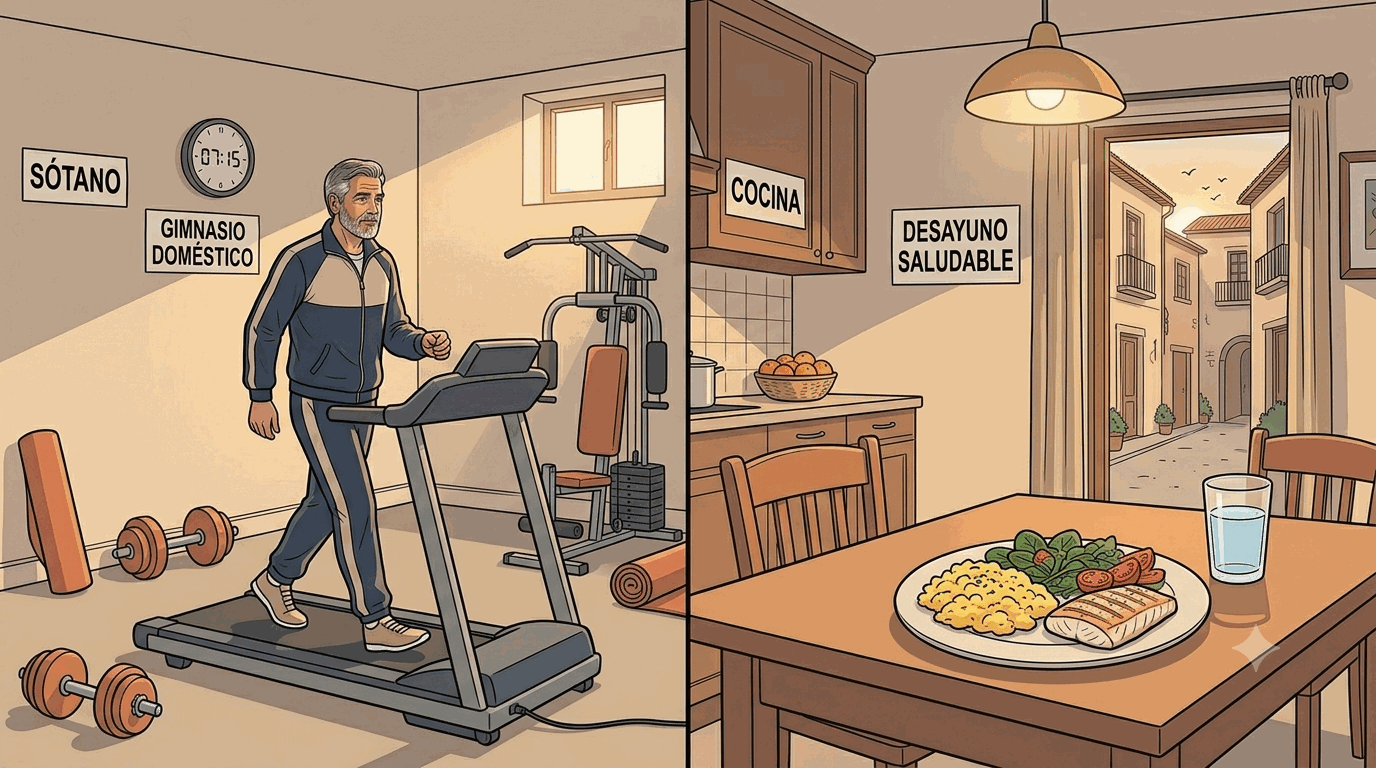
Imagen generada con Google Gemini Flash-Lite
🎧 Coloca el archivo audio/sda5_sesion2_story.mp3 junto a este HTML para que suene aquí.
The first fifteen days of sick leave passed slowly. Julio's body had lost almost ten
kilos — weight he admits he needed to lose, but also a worrying amount of muscle. He was
weak, and simple things, like climbing the stairs at home, left him out of breath. The
consultant renewed his leave for another fifteen days, and then, a little later, for fifteen
more.
Around the second week of September, a piece of news reached him privately: the head teacher
had also gone on sick leave, on the eighth of September, and — from what people were saying —
it wouldn't be a short one. Julio didn't know what to feel about that. Relief, mostly. Maybe
something else, too, that he preferred not to look at too closely.
With so much unplanned time at home, Julio finally did something he had been putting off for
years: he took his health seriously. He almost completely cut out bread, pasta and sugar, and
started eating more meat, fish and eggs instead. He read about hydration and mineral salts,
and realised he had probably been drinking too much plain water for years, without knowing
it. He also opened the door to the small home gym in the basement — dusty from years of
disuse — and began walking on the treadmill for thirty minutes every day, along with some
simple exercises for his arms, legs and abdomen. For a while, at least, he followed this new
routine without missing a single day.
In mid-October, just before returning to work, he visited the Education Delegation once more.
Three months had passed since his complaint, and still nothing. The person in charge of
Personnel listened politely, promised to look into it personally, and that was all. Julio
understood there was nothing more to gain from waiting there, so he requested voluntary
discharge from his sick leave and went back to school.
Usamos el Present Perfect para hablar de acciones pasadas con un resultado o una conexión directa con el presente (Julio has lost weight — todavía se nota ahora), y también para situaciones que empezaron en el pasado y continúan (He has been on sick leave since 1st September). Repasamos for (duración) y since (punto de inicio).
Pulsa cada palabra para consultarla en WordReference.
1. extend (v.) /ɪkˈstend/ — prorrogar.
2. fortnightly (adj./adv.) /ˈfɔːtnaɪtli/ — quincenal(mente).
3. consultant (n.) /kənˈsʌltənt/ — médico/a especialista.
4. discharge (n./v.) /ˈdɪstʃɑːdʒ/ — alta (médica).
5. carbohydrate /ˌkɑːbəʊˈhaɪdreɪt/ — hidrato de carbono.
6. protein /ˈprəʊtiːn/ — proteína.
7. processed food /ˈprəʊsest fuːd/ — alimento procesado.
8. treadmill /ˈtredmɪl/ — cinta de correr.
9. sedentary (adj.) /ˈsedntri/ — sedentario/a.
10. willpower /ˈwɪlpaʊə/ — fuerza de voluntad.
11. balanced diet /ˈbælənst ˈdaɪət/ — dieta equilibrada.
12. hydration /haɪˈdreɪʃn/ — hidratación.
13. mineral salts /ˈmɪnərəl sɔːlts/ — sales minerales.
14. regain (v.) /rɪˈɡeɪn/ — recuperar (fuerza).
15. unanswered (adj.) /ʌnˈɑːnsəd/ — sin respuesta.
Escucha cómo se distribuye el acento en phrasal verbs integrados en el relato.
Repite cada phrasal verb dentro de su grupo manteniendo un ritmo natural.
Escucha el relato, localiza los cinco phrasal verbs y repite cada expresión en contexto.
Escucha el modelo. Repite y busca una producción clara e inteligible. Foco fijado por M4l A2-26.
Primero escucha sin leer. Después, si lo necesitas, muestra el script y vuelve a escuchar.
The class carried on for fifteen days. Then the students came back for fifteen more. We wrote down the new dates, found out what had changed and looked after one another. Listen for the stress in `carried on`, `came back`, `wrote down`, `found out` and `looked after`. Repeat each phrase in context.
English Pronunciation in Use Elementary · Unit 38.0 · p. 85 · exercise 38.0.1
Úsalo como modelo profesional complementario. El trabajo principal de este Sound Lab se mantiene sin cambios.
¿Has cambiado alguna vez un hábito de vida importante (alimentación, ejercicio, sueño...) después de un susto de salud, propio o de alguien cercano? Cuéntalo usando Present Perfect.
1. Escribe 3 frases con Present Perfect sobre los cambios de Julio.
2. Escribe 2 frases con "since" y "for" sobre la duración de su baja.
3. Escribe una frase negativa en Present Perfect sobre algo que la Delegación todavía no ha hecho.
EXTENDED · Canción de la sesión original
Mary Hopkin – Those Were The Days (1968)
La canción habla de mirar atrás con nostalgia. Buscad en el texto de la sesión ejemplos que podrían expresarse con Present Perfect ("he ha cambiado", "he ha aprendido") y comentad si Julio mira hacia atrás con nostalgia o con alivio.
Imagen generada con Google Gemini Flash-Lite
En parejas: una persona es Julio, explicando a un amigo/a los cambios que ha hecho en su vida desde la baja; la otra pregunta y reacciona. Usad al menos 3 frases en Present Perfect.
Abrir canción y actividades (BestSongs_A2_Interactivo.html · song-26)
Un familiar te pregunta si Julio ha recibido ya alguna respuesta oficial a su denuncia.
"Three months had passed since his complaint, and still nothing."
Tarea: Explícaselo en español de forma clara y natural, sin traducir palabra por palabra.
Si necesitas apoyo, elige Reinforce o Catch up. Si ya puedes hacerlo, prueba More practice cuando te apetezca.
Elige una ruta que te ayude. No necesitas hacerlas todas.
Selecciona solo la práctica relacionada con la sesión. Consulta el ejemplar del docente o el tuyo.
Recurso optativo: no forma parte de las tareas obligatorias.
SdA A2·5 · Clase 3
Octubre de 2025 en adelante — la vuelta a Alkayasí
Tiempo lectivo orientativo: 90 minutos · planificación base: 85 min + margen flexible.
| Bloque | Min. | Qué haremos | Propósito |
|---|---|---|---|
| 1. Where were we? | 8 | Recordamos Present Perfect y marcadores frecuentes. | Reactivar |
| 2. Story / Listening | 12 | Escuchamos los problemas causados por la ausencia de una figura directiva. | Comprender |
| 3. Understanding | 8 | Comprobamos información concreta de la historia y la escucha. | Comprobar comprensión |
| 4. Language in Action | 15 | Usamos already, yet, just y never con Present Perfect en situaciones cercanas. | Construir precisión |
| 5. Words We Need | 10 | Activamos vocabulario escolar, organización y ayuda. | Ampliar vocabulario útil |
| 6. Sound Lab | 10 | Producimos grupos consonánticos sin añadir vocales de apoyo. | Escuchar y producir |
| 7. Let’s Use English | 12 | Preguntamos y respondemos sobre cosas ya hechas o todavía pendientes. | Comunicar |
| 8. Mediation / Real Life | 5 | Transmitimos a otra persona qué se ha hecho y qué queda por hacer. | Mediar |
| 9. Self-assessment | 5 | Comprobamos qué podemos hacer ya. | Reflexionar |
| 10. Aula sin Muros | Casa | Elegimos una práctica optativa de refuerzo o ampliación. | Continuar en casa |
Los tiempos son aproximados. Podemos dedicar más o menos tiempo a cada parte según las necesidades del grupo.
Recupera una idea y dos palabras de la sesión anterior.
Lee o escucha el episodio anterior y pide un resumen breve.
The Head Teacher We Never Had
Escucha el audio de la narración (sin leer el texto) y marca True (T) o False (F).
🎧 Coloca el archivo audio/sda5_sesion3_listening.mp3 junto a este HTML para que suene aquí.
1. Julio had been away from school for several months. →
2. The acting head teacher greeted Julio warmly. →
3. Nobody asked Julio about his health when he returned. →
4. A colleague had just been appointed as the new Head of Studies. →
5. Julio immediately felt exactly the same tension as before. →
Un equipo distinto, por primera vez en años
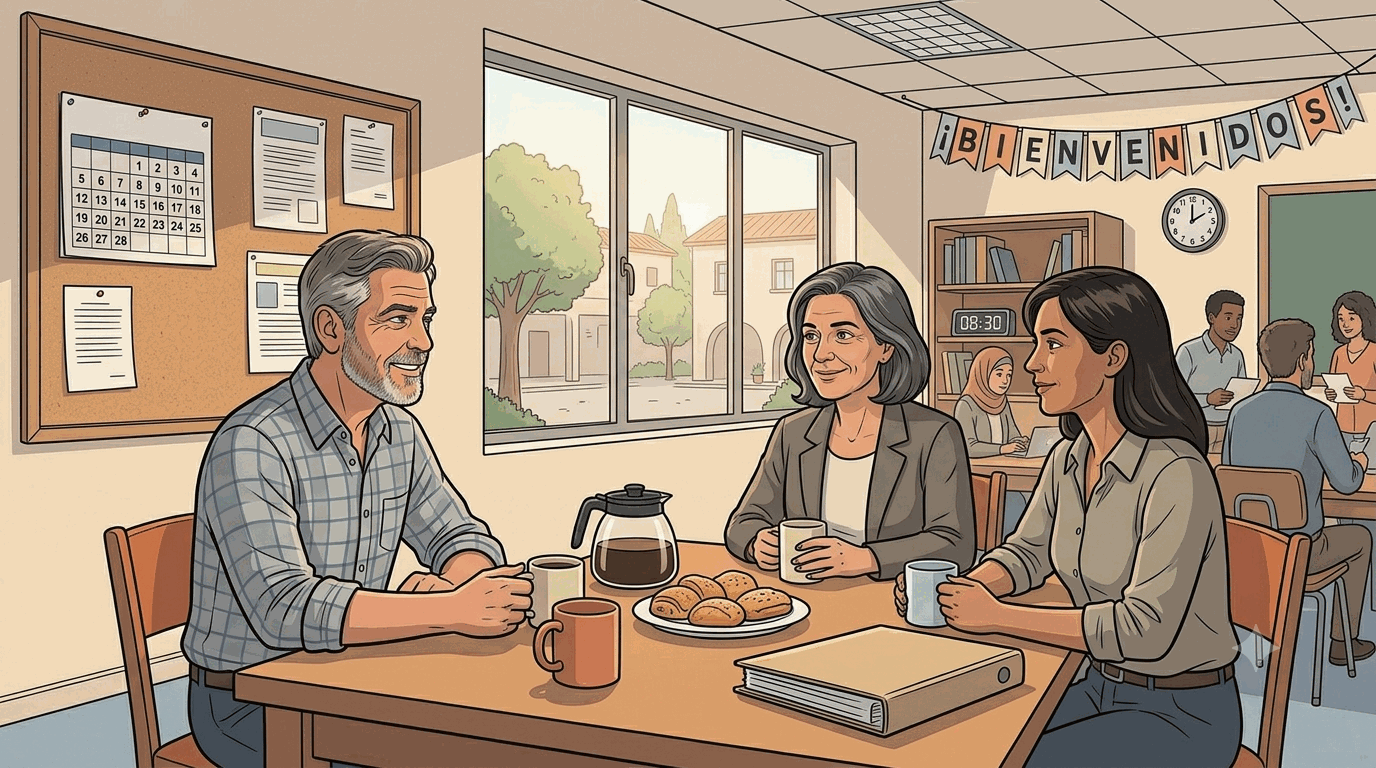
Imagen generada con Google Gemini Flash-Lite
🎧 Coloca el archivo audio/sda5_sesion3_story.mp3 junto a este HTML para que suene aquí.
Word around the school was that the acting head teacher had taken on the role almost by
accident — the head teacher had wanted someone else in the Head of Studies position, but the
regional Inspectorate hadn't approved his choice. So the role had gone, instead, to a
colleague who had already been working at the centre for years, someone open, communicative,
and genuinely interested in how things were going for the rest of the team.
For Julio, the change was hard to put into words. He had spent five years feeling like an
outsider in his own workplace, careful about what he said and who he said it to. Now, for the
first time since he had arrived, colleagues actually asked him for help — with a broken
projector, with a tricky lesson plan, with anything, really — and it felt completely normal,
the way it probably should have felt from the very beginning.
The new Head of Studies, appointed for the year at the head teacher's own request — despite
Julio, by both seniority and experience, being the obvious choice for the role — turned out
to do the job well, fairly and efficiently. Julio noticed the irony without dwelling on it
too much. He had learned, over the years, not to expect gratitude or recognition for doing
things properly; it was enough, for now, that the section finally felt like somewhere he
wanted to be.
Nobody at Alkayasí talked much about what would happen when the head teacher eventually came
back. It wasn't a comfortable subject, and there wasn't much point in guessing. For the
moment, the team simply worked well together, and Julio had decided to enjoy that for as
long as it lasted.
Seguimos con el Present Perfect, ahora centrados en sus marcadores más típicos: already (ya, en frases afirmativas), yet (todavía, en negativas e interrogativas), just (acabar de) y never... before (nunca antes).
Pulsa cada palabra para consultarla en WordReference.
1. acting (adj.) /ˈæktɪŋ/ — en funciones.
2. approachable (adj.) /əˈprəʊtʃəbl/ — accesible, cercano/a.
3. supportive (adj.) /səˈpɔːtɪv/ — que apoya.
4. atmosphere /ˈætməsfɪə/ — ambiente.
5. collaborative (adj.) /kəˈlæbərətɪv/ — colaborativo/a.
6. temporary (adj.) /ˈtemprəri/ — temporal.
7. appoint (v.) /əˈpɔɪnt/ — nombrar (para un cargo).
8. delegate (n./v.) /ˈdelɪɡət/ — delegado/a / delegar.
9. trustworthy (adj.) /ˈtrʌstwɜːði/ — de confianza.
10. workplace /ˈwɜːkpleɪs/ — lugar de trabajo.
11. morale /məˈrɑːl/ — moral (de equipo).
12. settle in (phr. v.) /ˈsetl ɪn/ — adaptarse, instalarse.
13. reliable (adj.) /rɪˈlaɪəbl/ — fiable.
14. considerate (adj.) /kənˈsɪdərət/ — considerado/a.
15. teammate /ˈtiːmmeɪt/ — compañero/a de equipo.
Escucha grupos consonánticos en palabras y enlaces frecuentes del contexto escolar.
Repite los modelos manteniendo las consonantes completas y sin introducir una vocal de apoyo.
Escucha los seis modelos, repítelos lentamente y vuelve a producirlos dentro del ritmo del relato.
Escucha el modelo. Repite y busca una producción clara e inteligible. Foco fijado por M4l A2-27.
Primero escucha sin leer. Después, si lo necesitas, muestra el script y vuelve a escuchar.
The students asked for help, but the head teacher never arrived. The next class started without a clear plan. We checked the lists, spoke to staff and worked together. Listen to the consonant groups in `students`, `asked`, `next class`, `lists`, `spoke` and `worked`. Repeat without adding an extra vowel.
English Pronunciation in Use Elementary · Unit 39.0 · p. 87 · exercise 39.0.1
Úsalo como modelo profesional complementario. El trabajo principal de este Sound Lab se mantiene sin cambios.
¿Has vuelto alguna vez a un lugar (trabajo, estudios, un grupo) después de una ausencia larga y lo has encontrado diferente? Cuéntalo.
1. Escribe 3 frases con Present Perfect + already/yet/just sobre la vuelta de Julio.
2. Escribe 2 frases sobre cómo ha cambiado el ambiente en el centro.
3. Escribe una frase con "for the first time" sobre algo que le ha pasado a Julio.
EXTENDED · Canción de la sesión original
Meat Loaf – You Took the Words Right Out of My Mouth (1977)
Comentad en clase el tono de sorpresa y ligereza de la canción — ¿os recuerda al alivio inesperado que siente Julio esta sesión?
Imagen generada con Google Gemini Flash-Lite
En grupos de 3: representad el primer café de la mañana en la sala de profesores el día de la vuelta de Julio — la directora en funciones, la nueva Jefa de Estudios Delegada y Julio, charlando. Usad al menos 3 frases en Present Perfect.
Abrir canción y actividades (BestSongs_A2_Interactivo.html · song-27)
Un amigo te pregunta por qué Julio no fue nombrado Jefe de Estudios, si tiene más antigüedad.
"The new Head of Studies, appointed for the year at the head teacher's own request — despite Julio, by both seniority and experience, being the obvious choice for the role."
Tarea: Explícaselo en español de forma clara y natural, sin traducir palabra por palabra.
Si necesitas apoyo, elige Reinforce o Catch up. Si ya puedes hacerlo, prueba More practice cuando te apetezca.
Elige una ruta que te ayude. No necesitas hacerlas todas.
Selecciona solo la práctica relacionada con la sesión. Consulta el ejemplar del docente o el tuyo.
Recurso optativo: no forma parte de las tareas obligatorias.
SdA A2·5 · Clase 4
El aula de Alquián, martes y jueves

Tiempo lectivo orientativo: 90 minutos · planificación base: 85 min + margen flexible.
| Bloque | Min. | Qué haremos | Propósito |
|---|---|---|---|
| 1. Where were we? | 8 | Recordamos pasado simple y resultados presentes. | Reactivar |
| 2. Story / Listening | 12 | Escuchamos cómo el grupo afronta un aula que nadie quería. | Comprender |
| 3. Understanding | 8 | Comprobamos información concreta de la historia y la escucha. | Comprobar comprensión |
| 4. Language in Action | 15 | Combinamos pasado simple para la secuencia y Present Perfect para el resultado actual. | Construir precisión |
| 5. Words We Need | 10 | Activamos vocabulario de aula, materiales y adaptación. | Ampliar vocabulario útil |
| 6. Sound Lab | 10 | Reconocemos y producimos contracciones frecuentes dentro de frases. | Escuchar y producir |
| 7. Let’s Use English | 12 | Explicamos qué ocurrió y cómo ha cambiado la situación. | Comunicar |
| 8. Mediation / Real Life | 5 | Resumimos una incidencia y su resultado para alguien que no estuvo presente. | Mediar |
| 9. Self-assessment | 5 | Comprobamos qué podemos hacer ya. | Reflexionar |
| 10. Aula sin Muros | Casa | Elegimos una práctica optativa de refuerzo o ampliación. | Continuar en casa |
Los tiempos son aproximados. Podemos dedicar más o menos tiempo a cada parte según las necesidades del grupo.
Recupera una idea y dos palabras de la sesión anterior.
Lee o escucha el episodio anterior y pide un resumen breve.
The Classroom Nobody Wanted
Escucha el audio de la narración (sin leer el texto) y marca True (T) o False (F).
🎧 Coloca el archivo audio/sda5_sesion4_listening.mp3 junto a este HTML para que suene aquí.
1. Julio's classes in Alquián take place every day of the week. →
2. The reassignment came from a straightforward timetable reorganisation. →
3. Julio has no background in either English or IT. →
4. The classroom had clearly been well looked after for years. →
5. Different temporary teachers had used the room before Julio. →
De trastero olvidado a aula multimedia
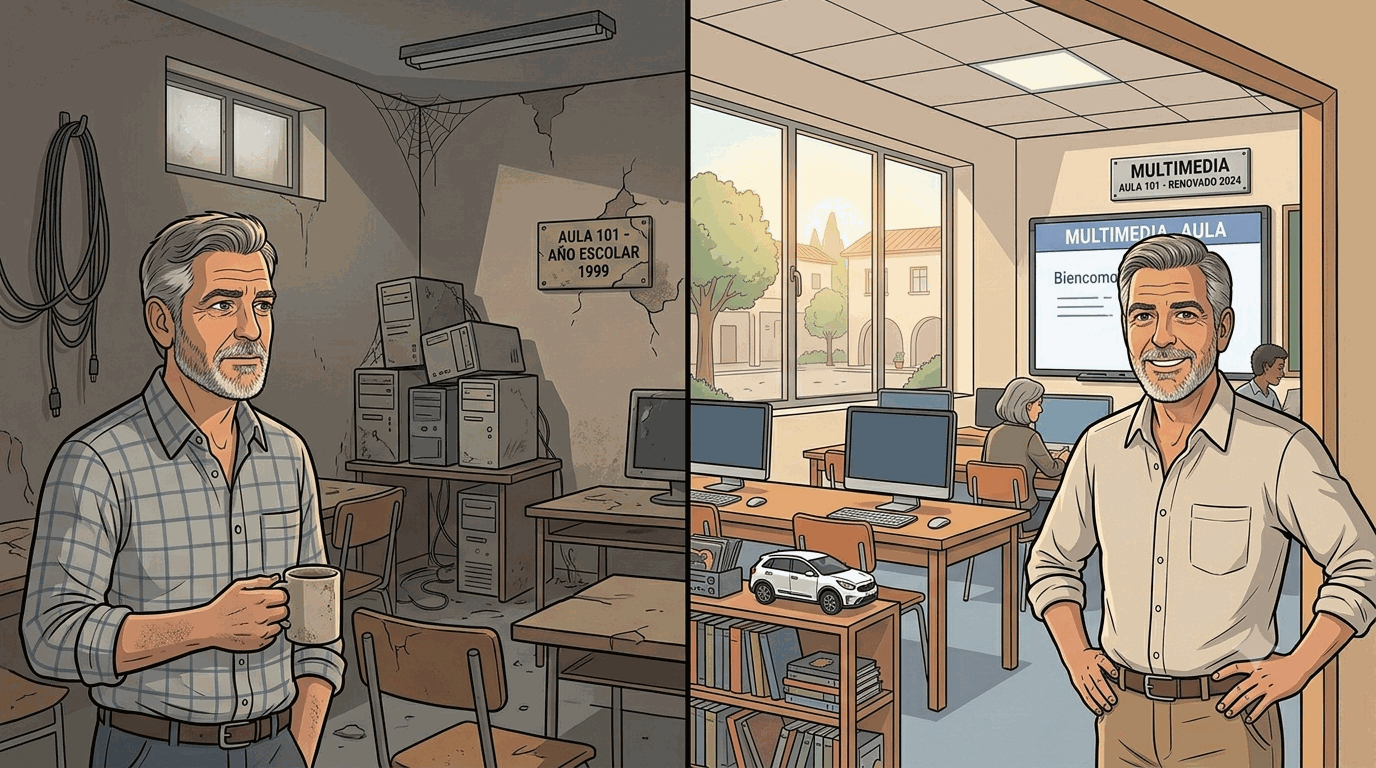
Imagen generada con Google Gemini Flash-Lite
🎧 Coloca el archivo audio/sda5_sesion4_story.mp3 junto a este HTML para que suene aquí.
The first time Julio opened the door of the Alquián classroom, he almost turned around
and left. Old, disconnected computer towers sat in a corner, thick with dust. Cables hung
loosely from the walls, connected to nothing in particular. A broken chair leaned against a
cracked whiteboard that hadn't been cleaned properly in what looked like years. It wasn't
really anyone's fault, not exactly — interim teachers passed through rooms like this one and
moved on quickly, without much reason to invest their time in making it better.
Julio decided, almost without thinking about it, that this would become his project for the
year. Over the following weeks, on Tuesday and Thursday afternoons, he cleared out everything
that no longer worked: outdated towers went to recycling, useless cables were finally thrown
away, and the room slowly began to breathe again. He requested two interactive whiteboards
through the school's usual channels, and — to his own surprise — actually got them installed
within a couple of months.
It wasn't glamorous work. Most of it involved carrying boxes, unscrewing brackets, and
sweeping up more dust than he expected from such a small space. But by November, the
transformation was clear: a functional, hands-on multimedia classroom, ready for proper
English and IT lessons, in a corner of the neighbourhood that had almost been forgotten.
Julio never mentioned the extra hours to anyone at school. It wasn't the kind of effort that
shows up on any official document, and he had stopped expecting recognition for that sort of
thing a long time ago. But every Tuesday and Thursday, walking into a clean, working
classroom instead of a dusty storeroom, felt like a small, private kind of reward.
Combinamos el pasado simple (la secuencia de lo que hizo Julio) con el Present Perfect de resultado (el estado actual del aula, gracias a ese trabajo). Como contraste puntual, aparecen también un par de frases en pasado perfecto (had cleaned, had never done), para expresar qué había — o no había — pasado antes de que Julio actuara.
Pulsa cada palabra para consultarla en WordReference.
1. interactive whiteboard /ˌɪntərˈæktɪv ˈwaɪtbɔːd/ — pizarra digital.
2. clutter (n./v.) /ˈklʌtə/ — desorden, trastos / abarrotar.
3. outdated (adj.) /aʊtˈdeɪtɪd/ — obsoleto/a.
4. cable /ˈkeɪbl/ — cable.
5. dusty (adj.) /ˈdʌsti/ — polvoriento/a.
6. clear out (phr. v.) /klɪər aʊt/ — vaciar, despejar.
7. functional (adj.) /ˈfʌŋkʃənl/ — funcional.
8. upgrade (v./n.) /ʌpˈɡreɪd/ — mejorar, actualizar / mejora.
9. spare (part) /speə/ — pieza de repuesto.
10. district /ˈdɪstrɪkt/ — barrio, distrito.
11. rewarding (adj.) /rɪˈwɔːdɪŋ/ — gratificante.
12. effort /ˈefət/ — esfuerzo.
13. transform (v.) /trænsˈfɔːm/ — transformar.
14. reorganise (v.) /riːˈɔːɡənaɪz/ — reorganizar.
15. hands-on (adj.) /hændz ɒn/ — práctico/a.
Escucha y reconoce contracciones frecuentes dentro de una narración de problemas y soluciones.
Repite las frases manteniendo cada contracción clara pero integrada en el ritmo.
Identifica las cinco contracciones y relaciónalas con su forma completa antes de repetir las frases.
Escucha el modelo. Repite y busca una producción clara e inteligible. Foco fijado por M4l A2-28.
Primero escucha sin leer. Después, si lo necesitas, muestra el script y vuelve a escuchar.
We couldn't use the old classroom, so we didn't stop working. It wasn't comfortable, but we'd brought the materials we needed. The students weren't happy at first, yet they didn't give up. Listen for `couldn't`, `didn't`, `wasn't`, `we'd` and `weren't`. Repeat each sentence with clear meaning.
English Pronunciation in Use Elementary · Unit 40.0 · p. 89 · exercise 40.0.2
Úsalo como modelo profesional complementario. El trabajo principal de este Sound Lab se mantiene sin cambios.
¿Has mejorado alguna vez un espacio (una habitación, un aula, un rincón de tu casa) con tus propias manos? Cuéntalo.
1. Escribe 3 frases en pasado simple sobre lo que hizo Julio en el aula.
2. Escribe 2 frases en Present Perfect sobre cómo está el aula ahora, gracias a ese trabajo.
3. Escribe una frase sobre por qué Julio no esperaba ningún reconocimiento.
EXTENDED · Canción de la sesión original
Nancy Sinatra – These Boots Are Made for Walkin' (1966)
Localizad verbos en pasado simple en la canción. Comentad el tono decidido e independiente de la letra — ¿os recuerda a la actitud de Julio con el aula de Alquián?
Imagen generada con Google Gemini Flash-Lite
En parejas: una persona es Julio enseñando el aula reformada a una compañera nueva; la otra pregunta cómo era antes y qué se ha hecho. Mezclad pasado simple y Present Perfect.
Abrir canción y actividades (BestSongs_A2_Interactivo.html · song-28)
Un compañero de otro centro te pregunta por qué Julio dedicó tantas horas extra a un aula que ni siquiera es su aula habitual.
"It wasn't the kind of effort that shows up on any official document, and he had stopped expecting recognition for that sort of thing a long time ago."
Tarea: Explícaselo en español de forma clara y natural, sin traducir palabra por palabra.
Si necesitas apoyo, elige Reinforce o Catch up. Si ya puedes hacerlo, prueba More practice cuando te apetezca.
Elige una ruta que te ayude. No necesitas hacerlas todas.
Selecciona solo la práctica relacionada con la sesión. Consulta el ejemplar del docente o el tuyo.
Recurso optativo: no forma parte de las tareas obligatorias.
SdA A2·5 · Clase 5
El Programa de Capacitación Digital

Tiempo lectivo orientativo: 90 minutos · planificación base: 85 min + margen flexible.
| Bloque | Min. | Qué haremos | Propósito |
|---|---|---|---|
| 1. Where were we? | 8 | Recordamos planes, predicciones y decisiones. | Reactivar |
| 2. Story / Listening | 12 | Escuchamos el balance de un curso de treinta horas y quince estudiantes. | Comprender |
| 3. Understanding | 8 | Comprobamos información concreta de la historia y la escucha. | Comprobar comprensión |
| 4. Language in Action | 15 | Usamos will para predicciones y decisiones sencillas. | Construir precisión |
| 5. Words We Need | 10 | Activamos vocabulario de formación, horarios y grupo. | Ampliar vocabulario útil |
| 6. Sound Lab | 10 | Localizamos el acento informativo en cifras, horarios y datos clave. | Escuchar y producir |
| 7. Let’s Use English | 12 | Hacemos predicciones y expresamos decisiones sobre el futuro próximo. | Comunicar |
| 8. Mediation / Real Life | 5 | Transmitimos los datos esenciales de un curso y una previsión sencilla. | Mediar |
| 9. Self-assessment | 5 | Comprobamos qué podemos hacer ya. | Reflexionar |
| 10. Aula sin Muros | Casa | Elegimos una práctica optativa de refuerzo o ampliación. | Continuar en casa |
Los tiempos son aproximados. Podemos dedicar más o menos tiempo a cada parte según las necesidades del grupo.
Recupera una idea y dos palabras de la sesión anterior.
Lee o escucha el episodio anterior y pide un resumen breve.
Thirty Hours, Fifteen Students
Escucha el audio de la narración (sin leer el texto) y marca True (T) o False (F).
🎧 Coloca el archivo audio/sda5_sesion5_listening.mp3 junto a este HTML para que suene aquí.
1. The head teacher personally ran the programme this year, as usual. →
2. Julio put himself forward to help organise the programme. →
3. Each course lasts fifteen hours in total. →
4. The courses take place during Julio's normal school timetable. →
5. Julio is paid separately for teaching these courses. →
Mirando hacia el resto del curso
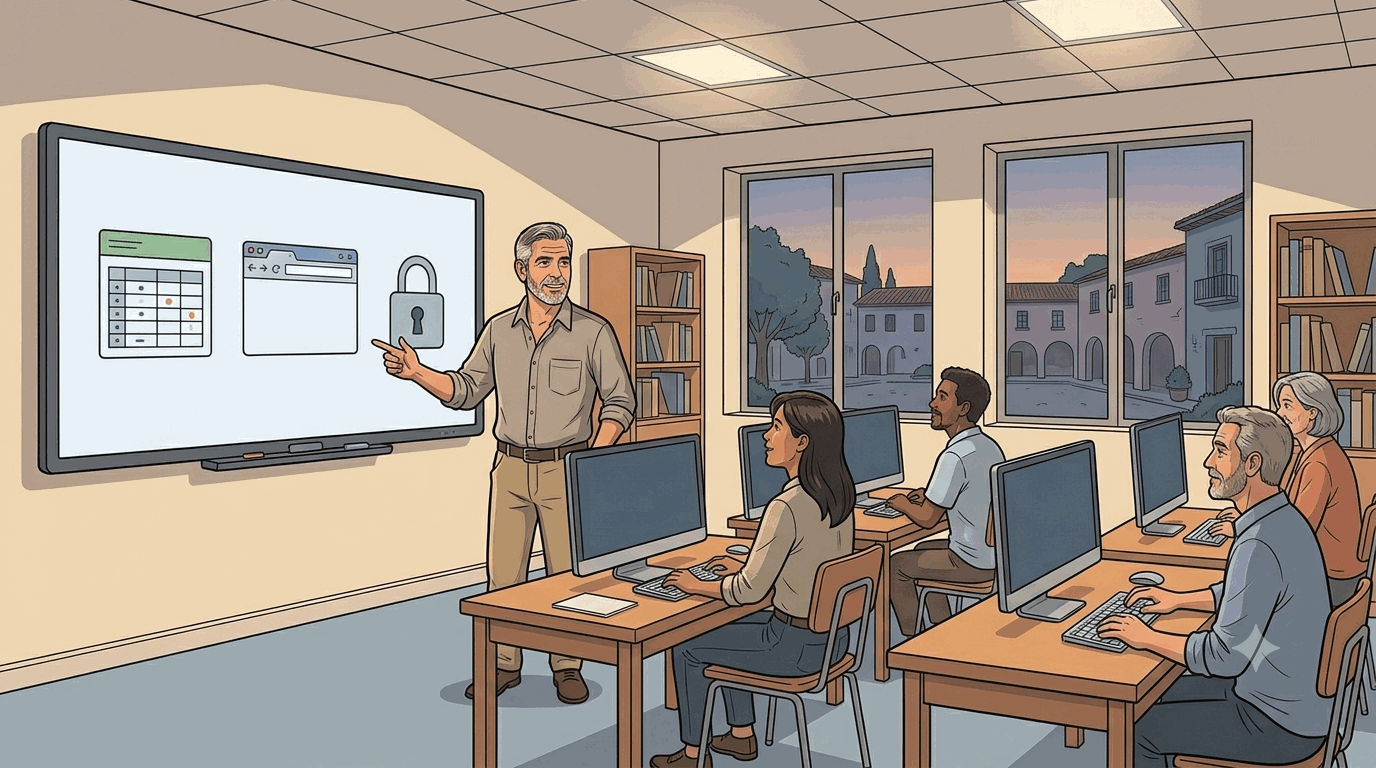
Imagen generada con Google Gemini Flash-Lite
🎧 Coloca el archivo audio/sda5_sesion5_story.mp3 junto a este HTML para que suene aquí.
Julio had been teaching digital skills to adults for years, almost always squeezed into
the margins of his regular timetable. This year, for once, he would have two full courses of
his own, properly funded and properly timed: thirty hours each, spread across several weeks,
for fifteen adult students who had signed up voluntarily, outside the usual school day.
He decided early on what the courses would cover. The first would focus on practical tools
most people used every day without really understanding: spreadsheets, browsers, passwords,
basic privacy settings — the kind of everyday digital skills that made real differences in
people's independence. The second course would go further, into digital citizenship proper:
how to use social media responsibly, how to spot unreliable information online, and a
session or two on Canva, which Julio suspected several of his students would enjoy far more
than they expected.
He planned to record his own materials for the courses, adapting much of what he had already
published on his own website over the years for adults who were often complete beginners
with a screen. By January, he calculated, the first group will have finished their thirty
hours, and — if the numbers hold — a second edition of both courses will probably run again
in spring, this time with a longer waiting list than the year before.
None of this depended on the head teacher's return, or on when the complaint would finally
be resolved, or on any of the uncertainty that still hung over Alkayasí. For a few hours a
week, in a small classroom full of adult students learning to use a spreadsheet for the very
first time, none of that mattered very much at all.
Usamos will para predicciones basadas en lo que sabemos ahora (the first group will have finished by January, simplificado a nivel A2 como will finish) y para decisiones tomadas en el momento. Repasamos brevemente going to para planes ya decididos de antemano (Julio is going to teach two courses this year — ya lo había decidido con tiempo).
Pulsa cada palabra para consultarla en WordReference.
1. intensive (course) /ɪnˈtensɪv/ — intensivo/a.
2. sign up (phr. v.) /saɪn ʌp/ — inscribirse.
3. citizenship /ˈsɪtɪzənʃɪp/ — ciudadanía.
4. skill /skɪl/ — destreza, habilidad.
5. spreadsheet /ˈspredʃiːt/ — hoja de cálculo.
6. slideshow /ˈslaɪdʃəʊ/ — presentación de diapositivas.
7. browser /ˈbraʊzə/ — navegador.
8. password /ˈpɑːswɜːd/ — contraseña.
9. privacy /ˈprɪvəsi/ — privacidad.
10. credential /krɪˈdenʃl/ — credencial, acreditación.
11. extracurricular (adj.) /ˌekstrəkəˈrɪkjʊlə/ — extraescolar.
12. additional payment /əˈdɪʃənl ˈpeɪmənt/ — pago adicional.
13. beginner /bɪˈɡɪnə/ — principiante.
14. advanced (adj.) /ədˈvɑːnst/ — avanzado/a.
15. capable (adj.) /ˈkeɪpəbl/ — capaz.
Escucha qué datos reciben prominencia porque contienen la información esencial.
Repite el mensaje destacando de forma natural cifras, horario y palabra clave.
Escucha el mensaje completo, anota los cinco datos destacados y después repítelo.
Escucha el modelo. Repite y busca una producción clara e inteligible. Foco fijado por M4l A2-29.
Primero escucha sin leer. Después, si lo necesitas, muestra el script y vuelve a escuchar.
The course lasted thirty hours and there were fifteen students. We met in the afternoon, three days a week. The most important thing was the group: everyone listened, shared ideas and helped. Listen for the key information: thirty hours, fifteen students, afternoon, three days, group. Now repeat the complete message.
¿Qué crees que hará Julio el año que viene? Haz 3 predicciones usando "will".
1. Escribe 3 frases con "will" sobre el futuro de los cursos de capacitación digital.
2. Escribe 2 frases con "going to" sobre planes ya decididos por Julio.
3. Escribe una frase negativa con "will" sobre algo que Julio no espera que le afecte.
EXTENDED · Canción de la sesión original
Nina Simone – Ain't Got No, I Got Life (1968)
Localizad ejemplos de presente o futuro en la canción. Comentad cómo el tono de "tener la vida por delante" conecta con esta sesión de cierre del hilo laboral.
Imagen generada con Google Gemini Flash-Lite
En parejas: una persona es Julio, presentando el programa a un grupo de posibles alumnos adultos; la otra hace preguntas sobre duración, horario y contenido. Usad al menos 3 frases con "will".
Abrir canción y actividades (BestSongs_A2_Interactivo.html · song-29)
Alguien te pregunta si estos cursos van a depender de lo que pase con el conflicto laboral de Julio en el centro.
"None of this depended on the head teacher's return, or on when the complaint would finally be resolved, or on any of the uncertainty that still hung over Alkayasí."
Tarea: Explícaselo en español de forma clara y natural, sin traducir palabra por palabra.
Si necesitas apoyo, elige Reinforce o Catch up. Si ya puedes hacerlo, prueba More practice cuando te apetezca.
Elige una ruta que te ayude. No necesitas hacerlas todas.
Selecciona solo la práctica relacionada con la sesión. Consulta el ejemplar del docente o el tuyo.
Recurso optativo: no forma parte de las tareas obligatorias.
SdA A2·5 · Clase 6
Repaso general de la SdA A2·5

Tiempo lectivo orientativo: 90 minutos · planificación base: 85 min + margen flexible.
| Bloque | Min. | Qué haremos | Propósito |
|---|---|---|---|
| 1. Where were we? | 8 | Recuperamos lo esencial de la SdA 5. | Reactivar |
| 2. Story / Listening | 9 | Reescuchamos momentos clave sobre curso, cambios, resultados y futuro. | Comprender |
| 3. Understanding | 6 | Comprobamos detalles y conexiones de la unidad. | Comprobar comprensión |
| 4. Language in Action | 12 | Consolidamos Present Perfect, pasado simple y futuro con will. | Construir precisión |
| 5. Words We Need | 8 | Recuperamos vocabulario de formación, problemas, cambios y futuro. | Ampliar vocabulario útil |
| 6. Sound Lab | 8 | Contrastamos la misma información a velocidad lenta y natural. | Escuchar y producir |
| 7. Let’s Use English | 12 | Reconstruimos lo aprendido y hablamos de lo que continuará. | Comunicar |
| 8. Mediation / Real Life | 7 | Mediamos un breve balance del curso para otra persona. | Mediar |
| 🌍 Culture Window | 10 | Conectamos la unidad con la referencia cultural anglófona prevista. | Conectar lengua y cultura |
| 9. Self-assessment | 5 | Comprobamos qué podemos hacer ya. | Reflexionar |
| 10. Aula sin Muros | Casa | Elegimos una práctica optativa de refuerzo o ampliación. | Continuar en casa |
Los tiempos son aproximados. Podemos dedicar más o menos tiempo a cada parte según las necesidades del grupo.
Recupera una idea y dos palabras de la sesión anterior.
Lee o escucha el episodio anterior y pide un resumen breve.
A Year That Doesn't Close (Review Fair)
Recupera una historia o escucha de esta unidad.
Comprueba dos detalles de la historia o escucha.
Repaso de Present Perfect y futuro simple, con repaso puntual de pasado simple, en los contextos de familia, salud, vida laboral y formación.
Recupera palabras conocidas y úsalas en contexto.
Escucha el mismo mensaje primero de forma lenta y clara y después a velocidad natural.
No imites artificialmente la velocidad lenta: tras las dos escuchas, reproduce el mensaje a un ritmo cómodo y comprensible.
Compara las dos pistas, identifica qué cambia en el ritmo y confirma que el contenido es idéntico.
Listen 1 — Slow and clear
Listen 2 — Natural speed
Escucha el modelo. Repite y busca una producción clara e inteligible. Foco fijado por M4l A2-30.
Primero escucha sin leer. Después, si lo necesitas, muestra el script y vuelve a escuchar.
The course is ending, but our learning is not over. We can remember the difficult days and the people who helped us.
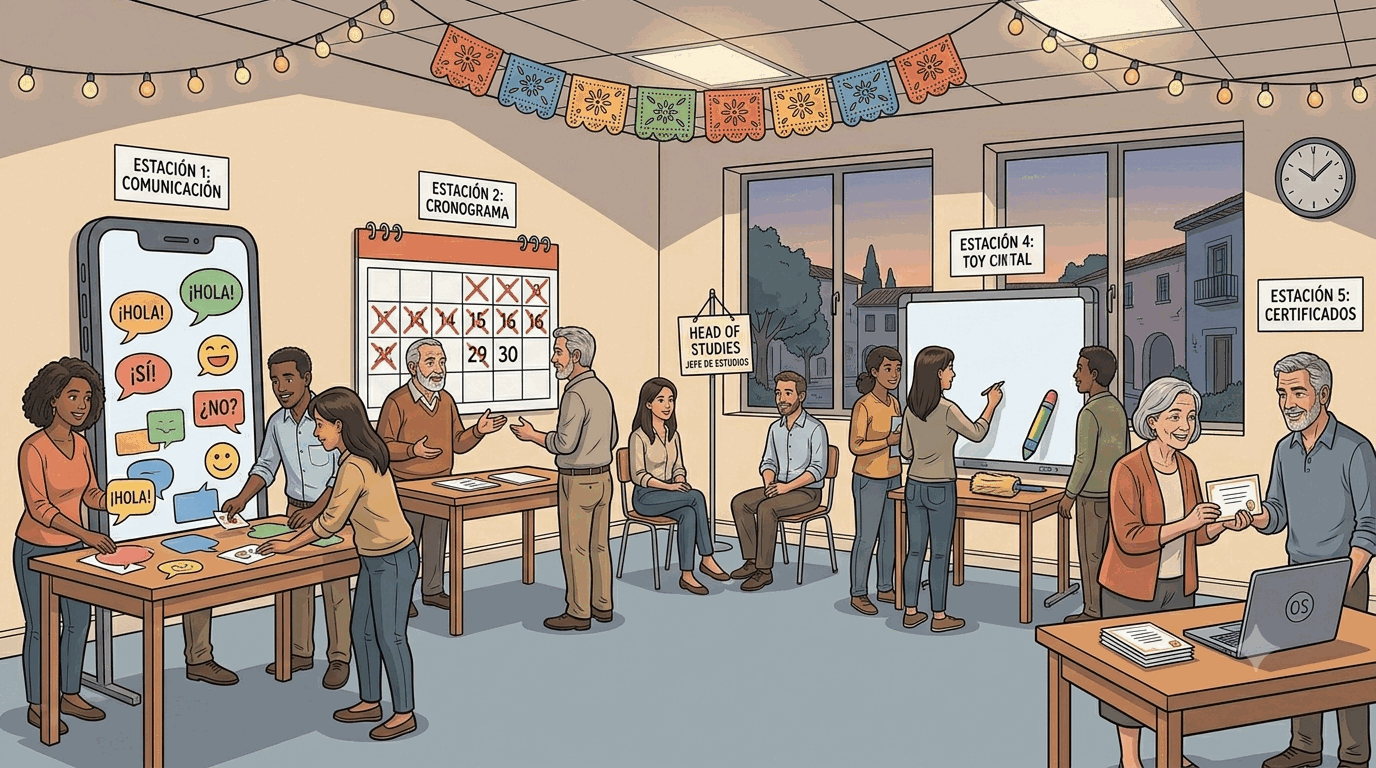
Imagen generada con Google Gemini Flash-Lite
La clase se organiza como una pequeña feria de repaso, con cinco estaciones montadas en
distintos puntos del aula:
Estación 1 — "The Night the Phone Wouldn't Stop": un teléfono de cartulina
cubierto de pegatinas con forma de burbuja de mensaje, para repasar la Sesión 1.
Estación 2 — "Fifteen Days, Then Fifteen More": un calendario de pared con los
días tachados en grupos de quince, para repasar la Sesión 2.
Estación 3 — "The Head Teacher We Never Had": dos sillas y una pequeña etiqueta
manuscrita con el rótulo "Jefatura de Estudios", para repasar la Sesión 3.
Estación 4 — "The Classroom Nobody Wanted": una pizarra digital de juguete
junto a un plumero, para repasar la Sesión 4.
Estación 5 — "Thirty Hours, Fifteen Students": una pequeña pila de
tarjetas-diploma junto a un portátil de atrezo, para repasar la Sesión 5.
Los alumnos rotan en grupos pequeños por las cinco estaciones, improvisando una breve escena
de 2-3 minutos en cada una.
EXTENDED · Canción de la sesión original
OneRepublic – Counting Stars (2013)
Como cierre de la unidad, comentad en gran grupo: de las cinco sesiones, ¿cuál os ha
parecido más significativa? "Counting Stars" habla de replantearse las prioridades en la
vida — ¿creéis que resume bien lo que le ha pasado a Julio este curso?
The complaint was still waiting for an answer somewhere in Delegación's files, the head teacher's return was still a date nobody quite knew, and María had already grown more than anyone expected in just a few months. Julio had learned, this year more than any other, that some things simply take the time they take — and that, in the meantime, there was still a classroom in Alquián to look after, two new courses to teach, and a much healthier version of himself to keep building, one day at a time.
Abrir canción y actividades (BestSongs_A2_Interactivo.html · song-30)
Ayuda a tu pareja a comprender una idea de la sesión.
Nueva Zelanda; el 6 de febrero recuerda la firma de Te Tiriti o Waitangi / the Treaty of Waitangi en 1840 y abre conversaciones actuales sobre historia, derechos, identidad y relaciones entre Māori y la Corona.
Listen to a clear New Zealand English text. Identify one historical fact, one present-day activity and one reason people may have different perspectives.
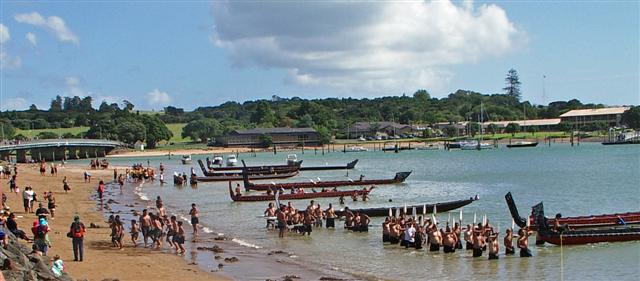
Waitangi Day is observed in New Zealand on the sixth of February. The date remembers the signing of Te Tiriti o Waitangi, the Treaty of Waitangi, in eighteen forty.
At Waitangi, representatives of the British Crown and more than forty Māori chiefs signed the agreement on the sixth of February. More signatures were collected later in different parts of the country.
The Treaty was written in English and translated into Māori. However, the two versions are not identical in meaning. Important ideas about government, authority and control were expressed differently. Most Māori chiefs signed the Māori-language text, and these differences have had major consequences for the way the Treaty has been understood.
For many years, the promises of the Treaty were not always respected. Māori communities experienced major losses of land and political power. Over time, the Treaty became increasingly important in public life and in discussions about historical injustice.
In nineteen seventy-five, the Waitangi Tribunal was established to investigate claims about breaches of the Treaty. Today, Treaty principles and relationships continue to influence public debate, policy, law and questions about Māori rights, language and identity.
Waitangi Day can include official ceremonies, speeches, cultural events, family activities and public discussions. For some people, it is a day of national identity and connection. For others, it is also a time to remember injustice, discuss promises that were not kept, and think about the relationship between Māori and the Crown.
Because of this, Waitangi Day does not have one single meaning. The same date can represent celebration, remembrance, disagreement and hope for a fairer future.
Listening carefully to different perspectives is important. A national day can help people celebrate what they share while also asking difficult questions about history.
Think about a public date you know. Does everybody understand or celebrate it in the same way?
Listen for clear key words and natural pauses. Repeat only for intelligibility.
Fuentes: fuente institucional · crédito de imagen.
Si necesitas apoyo, elige Reinforce o Catch up. Si ya puedes hacerlo, prueba More practice cuando te apetezca.
Elige una ruta que te ayude. No necesitas hacerlas todas.
Selecciona solo la práctica relacionada con la sesión. Consulta el ejemplar del docente o el tuyo.
Recurso optativo: no forma parte de las tareas obligatorias.